How bright does the sun shine?

Thread Starter

Ian0

Joined Aug 7, 2020
13,131
Photovoltaic panel datasheets usually have two sets of figures, NOCT based on 800W/m^2 and STC based on 1kW/m^2.
There are lots of data giving long term, daily, weekly or yearly averages for solar panel yield in various different locations, which is all very useful.
However, when designing equipment to connect to a solar panel, what is required is a peak figure. How much power will it have to deal with in the time it takes a MOSFET to get rather too warm. I haven’t been able to find that figure. Does anyone have any ideas?
The closest I’ve got to an answer is 1366W/m^2 reaching the top of the atmosphere.
 

fourtytwo

Joined May 16, 2022
20
Well I have had solar for many years and designed all my own conversion equipment.
At the end of the day it doesnt matter how bright the sun is as you simply design for the maximum power you have in mind as your equipment can limit to that power by controlling the maximum current it absorbs.
Imagine a car battery, it can cold crank at 1000A but an inverter powered by it does not need 1000A mosfets!
What is probably more critical is the maximum panel voltage and like everything else this is temperature dependent.
So really like anything else it's just a case of reading the panel spec carefully, adding some headroom and away you go :)
 

Jerry-Hat-Trick

Joined Aug 31, 2022
822
Maybe I'm misunderstanding this, but surely any electronic system connected to solar panels needs to be designed to accomodate the maximum power output of the panels and to function continuously, with a reasonable safety margin. MOSFETS used for example to convert the DC voltage to AC at a suitable design frequency need to cope with the power lost due to their RDS(on) when current is flowing through them and the power lost as the MOSFET turns on and off - the faster the better. Suitable heatsinks to accomodate the maximum expected ambient temperature and the maximum junction temperatures. All fairly simple maths using information from datasheets.

Solar panels are reaching about 25% efficiency these days and the improvement is ongoing. I believe Elon Musk has recently woken up to the fact that more power from the sun strikes the earth in one hour than mankind uses in a year.
 

nsaspook

Joined Aug 27, 2009
16,321
I think you can pretty much count in the panel never putting out more than its rated power.
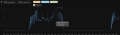
When there is bright sun (rare in the PNW winter) my panels are really cranking out the power in this cold snap. Now I get less total Wh because the sun is low and the days are shorter. When the cold and sun conditions are right, with the panels tilted just right, I can get more than rated power.
1705342954005.png
 
Last edited:

MisterBill2

Joined Jan 23, 2018
27,513
Normally, I think, a solar cell array will provide some voltage for a given intensity of light. It is the increase in voltage that makes possible the increase in current, as most systems present a fairly predictable internal resistance. That voltage from the array is rather predictable by the manufacturer, and the resulting current into the inverter system for a given voltage should be determined by the system designer. Adequate margin to avoid damage when that voltage is exceeded by some amount is normally included, both to allow for unanticipated increases and for component tolerances.
 

nsaspook

Joined Aug 27, 2009
16,321
https://www.allaboutcircuits.com/te...-to-photovoltaic-cells-solar-powered-devices/
You may be accustomed to thinking of a solar cell as similar to a battery, except that the “battery” voltage varies according to light intensity. However, the equivalent circuit makes a PV cell look like a current source rather than a voltage source. This could be rather awkward since we’re all accustomed to powering circuits using voltage sources, not current sources.

A solar cell is not really a voltage source or a current source as we usually think of them, but it can power a circuit in the typical voltage-source style. The additional components in the equivalent circuit indicate that the internal current source is not in direct interaction with the load components. Furthermore, the cell will always generate a voltage (even when nothing is connected to the terminals) because the internally generated current flows through the internal diode and RP.

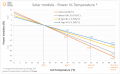
However, if you choose to think of a solar cell as a battery, keep in mind that it’s a rather mediocre battery. First of all, the voltage is highly unpredictable. As an example, consider this plot of open-circuit voltage vs. irradiance:
 

fourtytwo

Joined May 16, 2022
20
Going back to my earlier point it is not unusual to "overpanel" an inverter (that is peak panel power considerably in excess of inverter power) to obtain better output in winter. The inverter suffers no damage at all, as I pointed out earlier the inverter can control the maximum input current to whatever it chooses irrespective of the current that may be available from the panels. The critical factor however is to ensure VOC does not exceed the safe voltage rating of the inverter under any conditions, VOC is specified at 25C and has a negative temperature coefficient of -0.3%/degC so on hot days VOC will be higher.

Direct offline power supplies such as a phone charger do not have to absorb all the power available from the electricity grid, only that tiny proportion they wish to use, same applies to a solar inverter ......:)
 

fourtytwo

Joined May 16, 2022
20
Going back to my earlier point it is not unusual to "overpanel" an inverter (that is peak panel power considerably in excess of inverter power) to obtain better output in winter. The inverter suffers no damage at all, as I pointed out earlier the inverter can control the maximum input current to whatever it chooses irrespective of the current that may be available from the panels. The critical factor however is to ensure VOC does not exceed the safe voltage rating of the inverter under any conditions, VOC is specified at 25C and has a negative temperature coefficient of -0.3%/degC so on hot days VOC will be higher.

Direct offline power supplies such as a phone charger do not have to absorb all the power available from the electricity grid, only that tiny proportion they wish to use, same applies to a solar inverter ......:)
Ooops!! Sorry VOC will be higher on cold frosty mornings.........
Edit did not work
 

nsaspook

Joined Aug 27, 2009
16,321
Ooops!! Sorry VOC will be higher on cold frosty mornings.........
Edit did not work
I've been pushing the 150V VoC limit (THE FM80 just keeps the PV power relay open) just about every day this week. Once the MPPT kicks in it's fine, so I'm adding a switchable solar dummy load (100W incandescent light bulb) morning cycle to my DIY solar controller to reduce that.
1705427437630.png
 

Thread Starter

Ian0

Joined Aug 7, 2020
13,131
At the end of the day it doesnt matter how bright the sun is as you simply design for the maximum power you have in mind as your equipment can limit to that power by controlling the maximum current it absorbs.
No. Don't give me too much free energy!
But seriously, limiting the power takes extra circuitry. Utilising all the power takes more power devices and more heatsink.
What I'm trying to determine is what is the maximum power a panel is likely to give average over something like 5 minutes. Based on that information, I can decide which way to go.
Here at 53° North, the sun has to shine through a lot of atmosphere this time of year, but I have had higher instantaneous outputs on clear days than I did in the summer.
 

BobTPH

Joined Jun 5, 2013
11,515
Going back to my earlier point it is not unusual to "overpanel" an inverter (that is peak panel power considerably in excess of inverter power) to obtain better output in winter. The inverter suffers no damage at all, as I pointed out earlier the inverter can control the maximum input current to whatever it chooses irrespective of the current that may be available from the panels. The critical factor however is to ensure VOC does not exceed the safe voltage rating of the inverter under any conditions, VOC is specified at 25C and has a negative temperature coefficient of -0.3%/degC so on hot days VOC will be higher.

Direct offline power supplies such as a phone charger do not have to absorb all the power available from the electricity grid, only that tiny proportion they wish to use, same applies to a solar inverter ......:)
My system has panels rated at 9200W but a 7500W inverter. On good days, it does flatline at 7.5KW. I am a little pissed that they didn't sell me an inverter that could use all the power that falls on the panels.
 

Thread Starter

Ian0

Joined Aug 7, 2020
13,131
My system has panels rated at 9200W but a 7500W inverter. On good days, it does flatline at 7.5KW. I am a little pissed that they didn't sell me an inverter that could use all the power that falls on the panels.
Presuambly 9200W STC? So that would be 7360W NOCT, so that might explain the choice of inverter.
That fact goes a long way to answering my question!
 

fourtytwo

Joined May 16, 2022
20
Frequently the DNO (supply authority) limits the maximum inverter size that can be connected BUT not the maximum panel power.
But seriously, limiting the power takes extra circuitry. Utilising all the power takes more power devices and more heatsink.
But surely you have to employ the "extra circuitry" anyway in order to protect your power circuit.
Can I ask if this is a linear or switching approach, will it be using inductors (to store energy) ?
 

Thread Starter

Ian0

Joined Aug 7, 2020
13,131
Frequently the DNO limits the maximum inverter size that can be connected BUT not the maximum panel power.

But surely you have to employ the "extra circuitry" anyway in order to protect your power circuit. Can I ask if this is a linear or switching approach, will it be using inductors ?
Yes - it will be a buck regulator. Why should I protect the circuit from excess power when the input power is already limited?
 

fourtytwo

Joined May 16, 2022
20
Ahhh I see where you are coming from! That is a somewhat unusual approach as the "limit" would be very loosely defined.
How are you going to protect against inductor saturation ?
 

Thread Starter

Ian0

Joined Aug 7, 2020
13,131
Ahhh I see where you are coming from! That is a somewhat unusual approach as the "limit" would be very loosely defined.
How are you going to protect against inductor saturation ?
When I've established what the 5-minute peak input power from the solar panels is, I'm simply going assume that there will be no nearby supernovae within the 25 year lifetime of the panels, and that the available power will never exceed the figure I have calculated, hence the inductor current cannot exceed Power/Minimum Battery voltage
 
Top