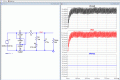
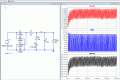
Bridge rectifier diode order.

Thread Starter

Bod

Joined Sep 18, 2016
317
Thanks for the advice, flipping the polarity of the diodes has solved the issue.

ow long have you been doing electronics for- I bet not that long, youll definitely get better with xp. But this rectifier I hadent seen it before this either, but I pretty much could read it pretty easy.
To be perfectly honest, I've been doing it quite a while but I've rarely (and do still rarely) create my own circuits, so I've definitely missed out on basics. I've regularly watch electronics videos so I can usually understand concepts but I don't use them and build upon them so I don't encounter the problems that come with them, which would strengthen what I know.

You said it gets hot with an open circuit. How much is open? Just the diode output on its own? Or with the cap? Or with cap and relay? It COULD be a bad cap if that's in your "Open" circuit. You've reverse polarized your cap and that could be causing issues.
I should have been more clear on that. By "open" I mean't with no load attached. The cap was included in the circuit. It was getting hot even without a load
An additional thought - - - perhaps the diodes are under-rated ? ? ?
That was a though but it's only a 12VAC supply and according to the datasheet 1N4001 are rated up to 50V, with 1A rectified current, all of which far beyond what is required for the other components.
 

Capernicus

Joined Jun 24, 2022
87
To be perfectly honest, I've been doing it quite a while but I've rarely (and do still rarely) create my own circuits, so I've definitely missed out on basics. I've regularly watch electronics videos so I can usually understand concepts but I don't use them and build upon them so I don't encounter the problems that come with them, which would strengthen what I know.
Some guys go all the way to making CPU's, thats what I want to do.
 

Thread Starter

Bod

Joined Sep 18, 2016
317
It doesn't look like D5 is going to be very happy. What is the current capability of the 12VAC source?
I haven't yet added D5 to the circuit and I'm not sure if its too necessary to be honest. Off the top of my head it's 12VAC 5 amps, though it might be way off.
You're lucky it didn't explode.
I did have my fingers on the caps and diodes so as I felt them getting too warm I disconnected them so I think I was safe. If I left it on though, it definitely would have gone bang.
 

MaxHeadRoom

Joined Jul 18, 2013
30,679
If there is any other electronics in the circuit, you should use the reverse diode D5.
1n4007 are handy to keep around for a bridge or reverse snubber.
 

ericgibbs

Joined Jan 29, 2010
21,448
Hi Bod,
You need some form of current limiting through that D5 Zener diode.
The resistor should be on the positive output of the bridge rectifier.

What is the current required for the relay coil at 12Vdc.?
E
 

MaxHeadRoom

Joined Jul 18, 2013
30,679
Off the top of my head it's 12VAC 5 amps, though it might be way off.
Incidentally, if the bridge load is just a DC relay or solenoid etc., you do not require the electrolytic cap, this allows the use of a transformer secondary rated the same as the inductive load.
In this case 12v RMS secondary.
 
Last edited:

dl324

Joined Mar 30, 2015
18,337
I haven't yet added D5 to the circuit and I'm not sure if its too necessary to be honest. Off the top of my head it's 12VAC 5 amps, though it might be way off.
Operating a 12V relay at 15V seems questionable to me.
 

crutschow

Joined Mar 14, 2008
38,529
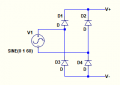
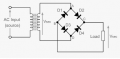
I've always found bridge rectifiers the hardest circuits to recreate even though they're so simple. Squishing the diodes from a square (like in rectifier schematics) to a stack of dioes like above, I just find really hard to match the connections up.
[/QUOTE]Just look at the diode polarities and current flow direction.
The bridge has two diode cathodes pointing to the positive output, while the negative output has two diode anodes (below).
1656867632460.png
 

Thread Starter

Bod

Joined Sep 18, 2016
317
Hi Bod,
You need some form of current limiting through that D5 Zener diode.
The resistor should be on the positive output of the bridge rectifier.
Operating a 12V relay at 15V seems questionable to me.
It outputs about 14V but I did add a current limiting resistor afterwards. I had it in my mind I just didn't add it to the schematic.
Still would be better than the time I ran a 5VDC relay with 12VDC for a few months ;)
 

MaxHeadRoom

Joined Jul 18, 2013
30,679
It outputs about 14V but I did add a current limiting resistor afterwards. I had it in my mind I just didn't add it to the schematic.
Still would be better than the time I ran a 5VDC relay with 12VDC for a few months ;)
See the tip of no cap needed, or do you have other electronics??
Although 14v should not damage it.
 

dl324

Joined Mar 30, 2015
18,337
I would've normally, but I put the schematic together to represent how I was gonna solder it more than it being an actual schematic, as I've put it together on perf board for the sake of time and cost.
If you want people to read your schematics, you should draw them conventionally to make them easier to read. You can use the board layout feature after you're satisfied with the schematic.
 

Thread Starter

Bod

Joined Sep 18, 2016
317
If you want people to read your schematics, you should draw them conventionally to make them easier to read. You can use the board layout feature after you're satisfied with the schematic.
I didn't plan for people to read my schematic in the first place, it was only once it didn't work and I couldn't figure out why. Possibly I could have rearranged everything to make it easier to read but in hindsight I could've run the risk of accidentally fixing the schematic while doing that and that wouldn't have been a fun time
 
Top