Book reading LED light

B-JoJo-S

Joined Jan 3, 2026
486
With any sort of reflector surface you can widen or narrow the angle of the beam of an LED.
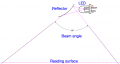
This drawing portrays a 30˚ viewing angle LED with a curved reflective surface, be it a white piece of paper or a piece of tin or aluminum foil. Any kind of reflective surface will disperse the beam. In this case the beam angle after reflection turned out to be 90˚. I don't have a mathematical explanation of why 30 became 90 degrees, it just did. A tighter bend would result in a wider beam and a lesser bend would turn out to be less than 90.
Screenshot 2026-06-30 at 8.47.17 AM.png

I think this is what others are saying about using a reflective defuser.
In that case, do I need to enclose the LED with white cards?
No. Just something for the LED to point at. Of course you'll have to make something to hold it all together, but I'm confident you can figure that out.

EDIT: After wondering why 30˚ became 90˚ is because I used a 3.5" radius. And to be more precise, the 90˚ angle is actually 90.1˚
 
Last edited:

ThePanMan

Joined Mar 13, 2020
950
Or you could just hold the LED close to the page on a 45 degree angle. You don't need to point the LED directly at the page. More of a skimming across the page sort of lighting.
 

MisterBill2

Joined Jan 23, 2018
28,097
I have had great success in diffusing the light beam from an LED, shaped like the one in post #42, by simply roughening the curved surface with a bit of fine abrasive. Of course, that effect is permanent, so it is not suitable for experimenting.
 

ci139

Joined Jul 11, 2016
2,022
want to make a book reading LED light
((((F**)))) the first honest reaction - it's because if you don't have a precise voltage/power source for your gizmo the regulation and thermal designs will be a head ache . . . but if not -- there is a slim chance for #6 will not "explode to your face"/"set anything on fire"

without the data on long term effects on your sight https://www.amazon.com/Leylix-Light-Reading-Night-White/dp/B0GR56XML9?th=1 (. . . at least it's affordable to buy !!!!)
 

MisterBill2

Joined Jan 23, 2018
28,097
A possibly interesting consideration is the use of a different color of light. Some specific colors allow much faster recovery to seeing in more brightly lighted areas.
AND, tolearn about different LEDs, I suggest looking in a DIGIKEY CATALOG!! It used to be that their catalog contained a great amount of information about the LEDs that were for sale. That might have changed, but looking at an on-line catalog is not expensive, usually it is free.
 

dl324

Joined Mar 30, 2015
18,451
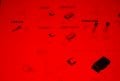
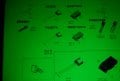
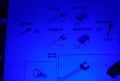
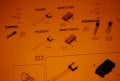
I built a fixture and tested 5mm red, green, blue, and yellow ultrabright LEDs with clear lens. Currents were 9.5mA, 6.2mA, 6.4mA, and 6.5mA. LED was held 8-10 inches from the paper.
bookLightRed.jpgbookLightGrn.jpgbookLightBlu.jpgbookLightYel.jpgbookLightFixture2.jpg
Text was readable with all colors. Any focus issues were due to taking pictures in the dark. I used a supply set to 4.09V to simulate a Li-ion battery.

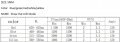
LED specifications:
1783901148916.png
AliExpress purchase.
 
Last edited:

MisterBill2

Joined Jan 23, 2018
28,097
There has been a VAST amount of research already done, and the results adequately verified, as to what colors,(wavelengths) of light allow the best viewing with the least fatigue. and with the least electrical power requirements.
That means that there is already a great amount of information available.
The question as to which cheap 5mm LED is best may already have been answered. Not by me, though.

The question I see relative to this thread is the relative color response of the light intensity measuring system. Certainly this is an interesting question!
Do we know what color of lighting is used in submarine control rooms?? Probably that has been optomised quite well.
 

dl324

Joined Mar 30, 2015
18,451
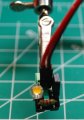
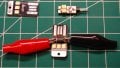
Did tests with the AliExpress USB book lights and a homemade one. All from 4.09V, held 6-8" from the paper.
bookLightsWhite.jpg

Commercial with 39 ohm resistor:
bookLightWhite39Res.jpg

Commercial with 281 ohm resistor:
bookLightWhite281Res.jpg

Homemade with 221 resistor:
bookLightWhiteHomemade221Res.jpg
 

dl324

Joined Mar 30, 2015
18,451
When you used your home-made light for reading, how did you power that up? With two coin cell batteries in series?
AA cell battery packs. Usually 3-4 NiMH cells, but also alkaline cells.

I also made up some that operated from 6V or 12V. I had some 12V lead acid gel cells. I used a jumper to switch between voltages. Two LEDs in parallel for 6V and 3 LEDs in series for 12V. Can't find any of them now.

EDIT: I didn't use them for reading. I used them as flashlights.
 
Last edited:

Thread Starter

loveforcircuits

Joined Jan 31, 2026
165
1788262859904.png

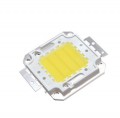
Does any of you have any experience in using the LED shown in the picture? This is an SMD LED Pure white Super Intensity 20W Light. The supply voltage is 12-14V as written in the website where I found it. I am curious to know, if I try to turn it on with a 9V battery, won't it turn on at all or lit dimly?
 

AnalogKid

Joined Aug 1, 2013
12,244
Without a part number, datasheet, link to a vendor page, or any other information, it is impossible to say. But note that operating on 12 V and dissipating 20 W, but part is drawing over 1.6 A. A 9 V radio battery cannot supply that.

ak
 

Thread Starter

loveforcircuits

Joined Jan 31, 2026
165
Without a part number, datasheet, link to a vendor page, or any other information, it is impossible to say. But note that operating on 12 V and dissipating 20 W, but part is drawing over 1.6 A. A 9 V radio battery cannot supply that.

ak
The vendor site has no datasheet. Only these specs-

ParameterSpecification
Power Consumption20W
LED TypeSMD (Surface Mounted Device)
Light ColorPure White
Color Temperature6000K – 6500K
Luminous FluxApprox. 1800 – 2000 lumens
Input Voltage12V – 14V
MaterialAluminum + Plastic
Dimension46mm X 52mm
Operating Temperature-20°C to 50°C
 

MisterBill2

Joined Jan 23, 2018
28,097
Quite probably, the 12 volt LED will produce a bit of light at 9 volts. BUT not close to the rated intensity. Diode conduction is not at all linear, nor simply predictable, outside of the intended operation range, which is why it is seldom shown on data sheets. BUT just because it is not shown does not mean that it does not exist, but rather that it is not consistent enough to be specified.
 
Top