Facebook
 Google
 GitHub
 Linkedin

With any sort of reflector surface you can widen or narrow the angle of the beam of an LED.
This drawing portrays a 30˚ viewing angle LED with a curved reflective surface, be it a white piece of paper or a piece of tin or aluminum foil. Any kind of reflective surface will disperse the beam. In this case the beam angle after reflection turned out to be 90˚. I don't have a mathematical explanation of why 30 became 90 degrees, it just did. A tighter bend would result in a wider beam and a lesser bend would turn out to be less than 90.
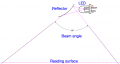
I think this is what others are saying about using a reflective defuser.
EDIT: After wondering why 30˚ became 90˚ is because I used a 3.5" radius. And to be more precise, the 90˚ angle is actually 90.1˚
This drawing portrays a 30˚ viewing angle LED with a curved reflective surface, be it a white piece of paper or a piece of tin or aluminum foil. Any kind of reflective surface will disperse the beam. In this case the beam angle after reflection turned out to be 90˚. I don't have a mathematical explanation of why 30 became 90 degrees, it just did. A tighter bend would result in a wider beam and a lesser bend would turn out to be less than 90.
I think this is what others are saying about using a reflective defuser.
No. Just something for the LED to point at. Of course you'll have to make something to hold it all together, but I'm confident you can figure that out.In that case, do I need to enclose the LED with white cards?
EDIT: After wondering why 30˚ became 90˚ is because I used a 3.5" radius. And to be more precise, the 90˚ angle is actually 90.1˚
Last edited: