Blown suppression capacitor

Thread Starter

kevolegend

Joined Sep 3, 2019
2
Hi folks,
I am attempting to replace a blown suppression capacitor, however I am having difficulty desoldering it out. The solder that is on the circuit board is invincible. I have tried ramping up my station all the way to 480 degrees Celsius with no luck. Do some professional circuit boards have a "mechanical" solder on one side to help keep it mechanically fixed? I cant access the the side the capacitor is on neither can I see whether it is soldered on both sides. I also can't simply "yank it out" as I can't access with pliers to cut the leads.

I will appreciate any help
Thanks,
Kev
 

LesJones

Joined Jan 8, 2017
4,511
You could try crushing the old capacitor and soldering the new one to remaining wires from the old capacitor. What you are describing sounds like plated through holes. There may be a large expanse of copper on one or both sides of the board acting as a heat sink. You may need a larger soldering iron.

Les.
 

dendad

Joined Feb 20, 2016
4,637
What iron are you using?
As Les mentioned, it sounds like the board is taking the heat away. Just ramping the iron temp up can help sometimes, but not the best way to go, but a bigger iron (ie, higher wattage), or even a bigger tip, not a small pointy one, may help.
On a couple of occasions, I have even used 2 irons together to get enough heat into a joint. But, do not fall into the trap of using a big iron on high over high temps as then you stand a good chance of damaging the board.
A surface mount hot air gun can help too.
 

MrSoftware

Joined Oct 29, 2013
2,273
Hot air can help. Also put a lot of flux on it, and add some leaded solder while you have your iron it it. The melted solder will conduct heat between your iron and the joint significantly better than trying to heat the dry joint directly. Make sure your iron is super clean, a dirty iron does not conduct heat well. Also you can try pre-heating the board slightly with a heat gun, skillet, hair dryer, etc.. don't go crazy, but if you can raise the temp of the surrounding board a bit then you need that much less energy from the iron to melt the solder.
 

narkeleptk

Joined Mar 11, 2019
586
For stubborn stuff I do just as Mr.Software suggests. Hot air to preheat and knife tip iron with a nice glob of solder on it to start out. I take it your trying to use wick as well so apply a good amount of flux to the wick. Heat the leg of cap first with the wet iron tip then slide your wick once you see its molten. Should suck most of it right up.
 

MisterBill2

Joined Jan 23, 2018
27,519
It may be soldered in with that lead-free solder, which has a higher melting point. And a soldering set intended for small connections will not be able to deliver enough heat no matter what. So you will need a soldering tool with more thermal mass, and you will need to add a bit of solder to conduct heat to the solder joint, since solder conducts heat about a thousand times better than air does. And some evil circuit board designers use plated through holes with almost no clearance between the hole plating and the wire through. For those instances you will need to gain access to both sides of the board , carefully cut the lead off of the failed part, leaving no burr, and heat the joint with a blob of melted solder while pulling the wire out from the bottom side. When the plated through portion of the board pulls out you will then need to solder the replacement to the circuit on both sides of the board, top and bottom.
 

shortbus

Joined Sep 30, 2009
10,050
I have tried ramping up my station all the way to 480 degrees Celsius with no luck.
It may be soldered in with that lead-free solder, which has a higher melting point.
Exactly what lead free solder uses a higher melting point than the TS mentions?

"Tin-silver-copper (Sn-Ag-Cu, or "SAC") solders are used by two-thirds of Japanese manufacturers for reflow and wave soldering, and by about 75% of companies for hand soldering. The widespread use of this popular lead-free solder alloy family is based on the reduced melting point of the Sn-Ag-Cu ternary eutectic behavior (217 °C), which is below the 22/78 Sn-Ag (wt.%) eutectic of 221 °C and the 59/41 Sn-Cu eutectic of 227 °C.[7] The ternary eutectic behavior of Sn-Ag-Cu and its application for electronics assembly was discovered (and patented) by a team of researchers from Ames Laboratory, Iowa State University, and from Sandia National Laboratories-Albuquerque.

Much recent research has focused on selection of 4th element additions to Sn-Ag-Cu to provide compatibility for the reduced cooling rate of solder sphere reflow for assembly of ball grid arrays, e.g., 18/64/14/4 tin-silver-copper-zinc (Sn-Ag-Cu-Zn) (melting range 217–220 °C) and 18/64/16/2 tin-silver-copper-manganese (Sn-Ag-Cu-Mn) (melting range of 211–215 °C)." From, https://en.wikipedia.org/wiki/Solder
 

Wolframore

Joined Jan 21, 2019
2,619
I just repaired a board for a buddy where he ripped out the plated thru hole. For large filter caps. Just be careful because the pads on the bottom where they were accessible was not connected to the top after he damaged them. This stopped his relay from triggering and powering up the unit.

In the end I had to remove and add lots of solder to the top remaining pads and heat up the legs enough for the repair to work.
 

MisterBill2

Joined Jan 23, 2018
27,519
Exactly what lead free solder uses a higher melting point than the TS mentions?

"Tin-silver-copper (Sn-Ag-Cu, or "SAC") solders are used by two-thirds of Japanese manufacturers for reflow and wave soldering, and by about 75% of companies for hand soldering. The widespread use of this popular lead-free solder alloy family is based on the reduced melting point of the Sn-Ag-Cu ternary eutectic behavior (217 °C), which is below the 22/78 Sn-Ag (wt.%) eutectic of 221 °C and the 59/41 Sn-Cu eutectic of 227 °C.[7] The ternary eutectic behavior of Sn-Ag-Cu and its application for electronics assembly was discovered (and patented) by a team of researchers from Ames Laboratory, Iowa State University, and from Sandia National Laboratories-Albuquerque.

Much recent research has focused on selection of 4th element additions to Sn-Ag-Cu to provide compatibility for the reduced cooling rate of solder sphere reflow for assembly of ball grid arrays, e.g., 18/64/14/4 tin-silver-copper-zinc (Sn-Ag-Cu-Zn) (melting range 217–220 °C) and 18/64/16/2 tin-silver-copper-manganese (Sn-Ag-Cu-Mn) (melting range of 211–215 °C)." From, https://en.wikipedia.org/wiki/Solder
I based my comment on the complaints that I have heard from manufacturers of circuit boards that for both reflow and wave soldering the lead-free solders require higher temperatures. I use the standard tin/lead solder because it produces more durable connections and also much better solder joints. Since the equipment that we sell is well worth repairing, the introduction of leaded solder into the waste steam does not happen.
 

shortbus

Joined Sep 30, 2009
10,050
I based my comment on the complaints that I have heard from manufacturers of circuit boards that for both reflow and wave soldering the lead-free solders require higher temperatures.
But then that means either you don't know the melting points of those solders you use, or you just couldn't be bothered to look before making a statement that isn't truthful. Some of us here do know these things.
 

dendad

Joined Feb 20, 2016
4,637
http://www.pcboardrework.com/difference-between-lead-and-lead-free-solder/
"Typically, leaded solder is a mixture of tin and lead. A benefit of using this type of solder is its flowing ability as it heats up at a much lower temperature than lead-free solder, thus posing less of a thermal threat to the component."

No doubt there are various alloys that melt lower than others, but I hate Lead free solder. It is so much harder to work with, and I have to run my iron at a higher temperature.
I have a couple of reels here that will probably never get used.
 

rsjsouza

Joined Apr 21, 2014
426
I have tried ramping up my station all the way to 480 degrees Celsius with no luck.
It may be soldered in with that lead-free solder, which has a higher melting point.
Exactly what lead free solder uses a higher melting point than the TS mentions?
Keep in mind that the temperature on the station is not the same of that on the tip. The moment the tip touches the pad/terminal, its temperature drops significantly (how much depends on the thermal mass) and the soldering station needs to react quickly to power the heater. Thus, saying the indicated temperature on the station is at 480°C means the set point is there, but the actual temperature on the junction will vary greatly. If the station is underpowered when compared to the thermal mass of the board, it will require a lot more time to recover and reach the specific setpoint again, risking ruining the pads, plating, component, etc.

Considering this aspect alone, the lead free compositions are at a disadvantage here, given they have higher melting point when compared to Tin/Lead: a common 60/40 composition typically melts at 188°C, while the eutectic 63/37 typically melts at 183°C.
 

Thread Starter

kevolegend

Joined Sep 3, 2019
2
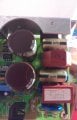
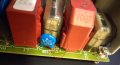
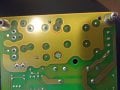
Hi guys, I used the larger soldering tips, no luck. I can't "crunch destroy" the capacitor either, its a tight squeeze. Any suggestions?
IMG_20190915_211624.jpg IMG_20190915_211911.jpg IMG_20190915_212006.jpg
 

kubeek

Joined Sep 20, 2005
5,796
Looks like there is no flux residue around the joints, so either your solder has no or very little flux inside, or you are doing it wrong and you are just heating the pad without adding solder. The joints are oxidised and oxides conduct heat very poorly, so you need plenty of flux to get rid of that oxide.

Get a small blob of fresh solder on your soldering iron tip, and dip the tip in rosin flux, then quickly touch it to the terminal and try to position the tip to get as large contact area as your tip and shape of that joint allows you. Add little dab of solder wire every few seconds to replace the flux that has burned off. Don´t be shy, a big ball of solder doesn´t hurt anything, but I would go with 350°C max so you don´t delaminate the copper pad from the substrate and destroy the board too fast. Once the drop that is on your iron seems to have connected with the solder on the pad, keep heating for say ten seconds or a bit more to get the heat all the way through, then the pin should let go.

Also, depending on your soldering iron it might be a good idea to clean the place where the tip contacts the heating element, beacues the heating element could be at 450°C but the tip could be much lower because of poor thermal contact there.
 

Wolframore

Joined Jan 21, 2019
2,619
Be careful this is exactly the problem I had to fix. If you don’t get it off correctly you will damage the traces which are on the same side as the components.
 

kubeek

Joined Sep 20, 2005
5,796
Be careful this is exactly the problem I had to fix. If you don’t get it off correctly you will damage the traces which are on the same side as the components.
True, patience and little to moderate force is required to remove it cleanly, and from the photos I don´t think there will be a trace on top. But you are right, the safe way is to obliterate that capacitor with a pair of cutters and just keep the nubs sticking from the board and see what is hiding there. Also makes for less thermal mass and no bending of the other pin when removing the remaining pins.
 

SamR

Joined Mar 19, 2019
5,488
Lots of liquid or paste flux, add 60/40 solder. The idea here is to mix the old solder with some lead. Add more if necessary and when you get it to puddle apply solder wick which has flux on it. Medium-sized chisel point on Iron. Or drill the sucker out.
 

kubeek

Joined Sep 20, 2005
5,796
Frankly not much would happen if you just deleted that capacitor. It is there so that the board passes conducted EMC emissions tests, and without it the power supply could produce a bit more interference into the power grid than required, but it is not at all essential for the operation of the power supply. So if your neighboars are not living right behind your bedroom wall (and you don´t happen to have high-end home cinema in your house) I would not bother if you for some reason still cannot get it replaced and just remove it.

Edit: haha neigh-boars could actually be the right term, based on the trampling sounds that sometimes come from the flat above :D
 
Top