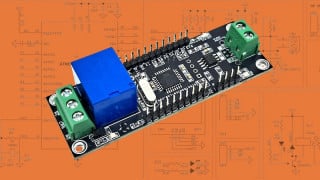
Blower motor modifications: speed control, timer, motion sensing

MaxHeadRoom

Joined Jul 18, 2013
30,662
The capacitor is there to provide phase shift in order for the motor to start and run, If not, a simple application of power without it, just results in an alternating 180° phase , hence oscillation, with no resultant rotation.
The three-phase version, has three phases with a 120° phase angle between each so rotor rotation is enabled..
 
Last edited:

Thread Starter

likes_shiny_things

Joined Sep 11, 2011
34
Torque can be tuned using a capacitor. And reduced torque in the context of a fan that was originally matched to the motor would mean lower speed and lower air flow.
But (with an induction motor) wouldn't the motor turn at the speed prescribed by the windings regardless of the initial starting torque? In other words, won't it turn at whatever speed it's going to turn no matter whether it's started with a capacitor or started by pushing it with your hand?
 

MisterBill2

Joined Jan 23, 2018
27,529
But (with an induction motor) wouldn't the motor turn at the speed prescribed by the windings regardless of the initial starting torque? In other words, won't it turn at whatever speed it's going to turn no matter whether it's started with a capacitor or started by pushing it with your hand?
The same phase shift that produces starting torque is required to keep an induction motor rotating. That torque is produced by the moving magnetic field, which is produced by the phase shift.
The magnetic field phase shift can be provided by several different means, which may not be so obvious.
Consider the common induction motor that uses a starting switch: After the switch opens, there is only one single winding energized, and yet the motor runs and delivers useful torque. The actual speed depends on both the AC supply frequency and the torque load. While the mechanism is well understood, without the explanation and the math, it looks a lot like magic!!
 

MaxHeadRoom

Joined Jul 18, 2013
30,662
The larger motor versions that use starting SW or relay generally use the large start cap for initial motion; after the SW opens this leaves the smaller run cap permanently in circuit for the start windings
The run winding is connected directly to the supply.
One interesting design that once was popular for large motors, 100hp and up was an induction motor that also had a pair of slip rings connected to an armature winding.
The motor was started as a typical 3ph AC induction motor, when the motor was sensed to be within a few cycles of synchronization , a DC voltage was injected via the slip rings and the motor came up to synchronization with the supply..
 

Tonyr1084

Joined Sep 24, 2015
9,744
Let me be clear - I'm not an expert on these things. But I can tell you that the cap YOU have is a STARTER cap. As you stated when you tested it without the cap in place, and as someone above said - the motor will not run. Not unless you spin it. And you can spin it in either direction. Once spinning it will continue to run in the spun direction, and at the same speed in either direction (unloaded). I've seen that in numerous tests of induction motors. You even tested it out yourself and said you CAN run it backwards.

There's a lot being said about larger motors with internal switches that open when the motor reaches a particular RPM. My AC (Swamp cooler) used such a motor. It did NOT have a cap, neither starter or run cap. You do not have a RUN cap. I have, if not the same motor, one very similar. Four wires; Low, Medium, High and a common wire, common to all three sets of coils.

An unloaded motor such as we're discussing will run "Without Load" will spin the same RPM regardless of which speed you choose. The difference is in how much work each speed can produce. High will take more amperage to move 3X air. Medium will take less amps to move "Less" air (however much the difference is between the energized circuits) and low will the still less amps. The result is the fan will move more air at high than at medium. More air will move at medium as opposed to Less. And low will move the least amount of air.
 

MaxHeadRoom

Joined Jul 18, 2013
30,662
It did NOT have a cap, neither starter or run cap. You do not have a RUN cap. I have, if not the same motor, one very similar. Four wires; Low, Medium, High and a common wire, common to all three sets of coils.
No Cap?
Are you sure it wasn't a shaded pole motor? i.e.No cap needed.
 

MisterBill2

Joined Jan 23, 2018
27,529
Let me be clear - I'm not an expert on these things. But I can tell you that the cap YOU have is a STARTER cap. As you stated when you tested it without the cap in place, and as someone above said - the motor will not run. Not unless you spin it. And you can spin it in either direction. Once spinning it will continue to run in the spun direction, and at the same speed in either direction (unloaded). I've seen that in numerous tests of induction motors. You even tested it out yourself and said you CAN run it backwards.

There's a lot being said about larger motors with internal switches that open when the motor reaches a particular RPM. My AC (Swamp cooler) used such a motor. It did NOT have a cap, neither starter or run cap. You do not have a RUN cap. I have, if not the same motor, one very similar. Four wires; Low, Medium, High and a common wire, common to all three sets of coils.

An unloaded motor such as we're discussing will run "Without Load" will spin the same RPM regardless of which speed you choose. The difference is in how much work each speed can produce. High will take more amperage to move 3X air. Medium will take less amps to move "Less" air (however much the difference is between the energized circuits) and low will the still less amps. The result is the fan will move more air at high than at medium. More air will move at medium as opposed to Less. And low will move the least amount of air.
I have a number of motors that will neither start not run without their one capacitor. They are often called "split phase" motors, and sometimes called "Permanent Split Capacitor" motors. They will neither start not run without the capacitor.
IN ADDITION, I also have a "SloSyn" , which is a synchronous motor that uses a capacitor for both start and run.

You will discover that any of those motors that use a starting switch that opens, can be hand spun started in either direction if the starting switch fails open.
 

MaxHeadRoom

Joined Jul 18, 2013
30,662
BTW, a SloSyn synchronous motor that has a capacitor or two, is typically a stepper motor ( SloSyn's Specialty) that requires the cap(s) to enable use on AC and sync's to the applied frequency.
The attached shows SloSyn use of steppers on AC & DC.
 

Attachments

Last edited:

MisterBill2

Joined Jan 23, 2018
27,529
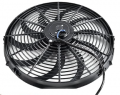
A radiator fan/motor package is totally different in every aspect, MAX !! like replacing a Mustang with a Corvette! Look back at post #1 to realize that it is not a "fan application" at all.
Actually, the best option might be a reasonably priced variable speed drive package. Check out the "AUTOMATION DIRECT" website catalog. The smaller single phase drives are not so terribly expensive, and they include ramping up the speed.
 

MisterBill2

Joined Jan 23, 2018
27,529
So if it's a radial fan, he could still use the motor.?
Probably not! The electric cooling fans in cars seem to mostly have the blades attached to the motor, or even integral with the motor assembly. True FANS, quite different from a BLOWER.
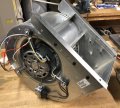
Possibly the TS can post a photo of their blower. That will explain everything.
 

MisterBill2

Joined Jan 23, 2018
27,529
That is quite similar to what I had guessed it was like. So it would be a "big deal" effort to replace the motor, even with an exact form factor replacement. I have first-hand experience doing that with my furnace blower a few years ago. And, certainly, it is a blower, not a fan, but a part of a system.
Returning to the TS wants from post #1, and the description of the application:
"I have a workshop air filter system that has a 115 VAC, 1/4 hp three-speed motor. The motor drives a centrifugal blower fan - it's similar to what is found in common HVAC systems. The motor has what I think is a run capacitor as opposed to a start capacitor."

"I want to modify it so that the blower motor ramps up slowly and/or can be made to run slower than it currently does.
Also I'm looking to make the blower power on via motion sensing and have a timer to shut off after XX minutes."

What is missing that matters is just how slow does the TS want the slowest speed, and how long a ramping up is wanted.
I am guessing that for a direct-drive blower application that the motor runs in a High Slip mode already, so possibly just reducing the supply voltage would slow the acceleration to the running speed. That could be done with a transformer, since a triac control works differently. A 24 volt transformer with the secondary phased to buck the mains would be one way to do it. In fact, the reduced voltage with the three speed connections might provide enough speed variation to be satisfactory, making the project much simpler.
 
Last edited:

Tonyr1084

Joined Sep 24, 2015
9,744
No Cap?
Are you sure it wasn't a shaded pole motor? i.e.No cap needed.
The TS has the same motor I have. I did state that my motor does not have a RUN cap. It DOES have a Starter cap. After telling the TS (likes_shiny_things) his motor (virtually the same motor as mine, only newer) I said:
I can tell you that the cap YOU have is a STARTER cap.
After that my comment about a motor that didn't have a starter cap I mentioned my swamp cooler motor
There's a lot being said about larger motors with internal switches that open when the motor reaches a particular RPM. My AC (Swamp cooler) used such a motor. It did NOT have a cap, neither starter or run cap.
THAT motor (swamp cooler motor) did not have a starter or run cap, it had a centrifugal switch. Sometimes when making a point I get ahead of my keyboard and start thinking of another comment and may lose some of the facts I was trying to expound upon.
I have a number of motors that will neither start not run without their one capacitor. They are often called "split phase" motors, and sometimes called "Permanent Split Capacitor" motors. They will neither start not run without the capacitor.
IN ADDITION, I also have a "SloSyn" , which is a synchronous motor that uses a capacitor for both start and run.

You will discover that any of those motors that use a starting switch that opens, can be hand spun started in either direction if the starting switch fails open.
The swamp cooler motor I briefly referred to, not the fan motor the TS has, has an internal switch.
So any confusion I may have caused, I apologize. Also, regarding the swamp cooler motor, while I don't recall it having a cap, I could be wrong about that as well. The thing I MOST remember about it was the adjustable pulley. It's intended that you adjust the size of the pulley until the motor draws no more than a max recommended amperage. Since I no longer have the swamp cooler I can't go up on the roof and double check if it had a cap or not. But I think it didn't. Again, I could be wrong.
 

Tonyr1084

Joined Sep 24, 2015
9,744
So as I said in #33, it is a radial fan.
So one option would be to replace the motor with a Universal (Brushed) motor rated for the mains voltage.
These can be speed controlled a little easier.
I actually had one of those. Got it from a very old treadmill. Never found a use for it. Scrapped it for its copper.
 
Top