Blower motor modifications: speed control, timer, motion sensing

Thread Starter

likes_shiny_things

Joined Sep 11, 2011
34
I have a workshop air filter system that has a 115 VAC, 1/4 hp three-speed motor. The motor drives a centrifugal blower fan - it's similar to what is found in common HVAC systems. The motor has what I think is a run capacitor as opposed to a start capacitor.

I want to modify it so that the blower motor ramps up slowly and/or can be made to run slower than it currently does.

Also I'm looking to make the blower power on via motion sensing and have a timer to shut off after XX minutes.

I'm assuming it will be more practical to use a different motor since the unit has a single phase induction motor (my understanding is that it's not easy to vary the speed of those). But since the motor mounts directly to the blower it may be somewhat of a challenge to fit a different motor.

My level of electronics knowledge is below being able to design something but I can follow directions (and intend to learn something in the process).

I would appreciate any suggestions on how I might achieve such a setup.
 

Ya’akov

Joined Jan 27, 2019
10,226
Welcome to AAC.

You are correct that replacing the motor is the correct way to solve the problem of variable speed.

The problem of mounting the motor to the blower assembly could be solved in a number of ways from designing a mount using laser cut parts (from a service bureau) to replacing the blower entirely. Surplus vendors are the place to look for that.

It is possible that scavenging parts from exist motor (e.g.: the shaft and front bearing) could simplify adapting a new motor).

As far as motor speed control goes, I would probably be inclined to use a DC motor and an ESC with a microcontroller for soft start, timeout, and motion sensing functions.

I would also avoid motion sensing in favor of presence detection (which is probable what you want) using the new generation of FMCW radar modules that can distinguish the presence of a person without relying on "motion" in way a PIR or previous radar sensor does.
 

schmitt trigger

Joined Jul 12, 2010
2,027
Whatever method you choose, ABSOLUTELY make sure that the motor doesn’t have a centrifugal switch.
If it does, at low speed it may switch back and re-engage the capacitor and/or winding that the motor uses for starting. These are rated for intermittent duty only and will burn if energized continuously.
 

MisterBill2

Joined Jan 23, 2018
27,164
Changing to a different blower motor will cost a fair amount, unless you have a stock of motors on hand. And since the present motor is a 3-speed device, it may work to simply switch speeds instead of ramping up over some time period.
But the very first question is how much are you willing to spend on the project? AND, how much work are you willing to put into it?
"Y" offers a good set of suggestions, although the "DC motor" should really have been a "BRUSHLESS DC motor", which might even come with a variable speed control input or a smart controller. (not a cheap system, though).
 

Tonyr1084

Joined Sep 24, 2015
9,744
I run a wood shop. It has dust collection for various machines, but they are never 100% efficient. So I have a dust extractor in the shop. It consisted of an AC induction motor (from an old HVAC unit) that also had three speeds. These were bodged together parts. The squirrel cage (centrifugal) fan is undersized for the motor. An induction motor wants to rotate at a particular speed. Since I don't know what that speed is I won't even guess. However, the undersized fan allowed the motor (3 speed) to achieve maximum RPM regardless of what speed I chose. Those motors depend on loading to achieve various speeds. On a single speed motor, a large fan will drag the motor RPM down and move X amount of air. A smaller fan will allow the motor to run faster but still move only X amount of air. The difference is in how hard the motor has to work to achieve the movement of air. A smaller fan will draw fewer amps but the motor will still run strong enough to move the same amount of air.

Mine was too noisy. So I changed the motor to a DC motor scavenged out of a treadmill. The motor shaft was the same size as the squirrel cage fan so it fit right on without need of modification. Now I had a 135VDC motor (DC as in direct current) that I could vary the speed. I could have done so by modulating the voltage down to what I wanted, but the folks here directed me to a great fan speed control for that motor. It's programmable so that when it comes on it spins at 20% power. I've adjusted it so that it never spins more than 35% power. At 35% it's moving a lot of air. Higher speeds are possible but then it's just way too noisy and stirs up more dust than it extracts. The extractor has two filter elements measuring 20" x 25" x 1", that's 1000 square inches of surface area. BUT WAIT! That's not the whole story. the filters are pleated. So the total surface area is far more than 1,000 square inches. I'd have to look and see how much total surface area each filter has. But that's without regard (or "regardless").

The key is two fold: Swap the motor and get a motor speed controller. I DID have to build a new motor support to fit the whole cage fan. I weld. So I was able to take some scrap and shape it and fit it to the motor and to the fan mounts. If you can do all that then changing the motor is the way to go. If not - there's not a lot of hope (if any) for varying the speed of an induction motor beyond the three power levels they give you.
 
Last edited:

Thread Starter

likes_shiny_things

Joined Sep 11, 2011
34
But the very first question is how much are you willing to spend on the project? AND, how much work are you willing to put into it?
Up to $200-$300 approximately. As far as how much work, I realize it's not going to be "plug-n-play" - so I'm expecting to spend a fair amount of time and fiddling to make it work adequately.
 

MaxHeadRoom

Joined Jul 18, 2013
30,557
Sounds like it is a permanent run cap motor, these sometimes are OK with speed control, e.g. roof fans controlled this way.
There is a semi-conductor, variable AC motor controller in the Fairchild App. note, AN-3006 that could be adapted, just needs a ramp up mod to get what you want.
 
Last edited:

MisterBill2

Joined Jan 23, 2018
27,164
How much is that fine level of control worth to the TS?? Hi, Medium and LOW come with only needing to wire in a 4 position switch (last position is OFF) NO extra hardware, the most reliable scheme, and it is repeatable.
 

Tonyr1084

Joined Sep 24, 2015
9,744
I have a workshop air filter system that has a 115 VAC, 1/4 hp three-speed motor. The motor drives a centrifugal blower fan - it's similar to what is found in common HVAC systems. The motor has what I think is a run capacitor as opposed to a start capacitor.
If this is anything like what I had (see post #7) then as @MisterBill2 suggests, yes, it has four wires. Low, Medium & High with a single neutral wire. You can run any ONE of these speeds at a time. If you try to run two of them you'll burn the motor out. Mine had a start capacitor.
I want to modify it so that the blower motor ramps up slowly and/or can be made to run slower than it currently does.
As for modifying it to ramp up slowly - - - Haven't a clue. As for running more slowly, @MaxHeadRoom suggests a speed controller designed for just such motors might also cause a slower ramp up speed. But that cap is not a run cap it's a startup cap. Without it the motor won't start without a manual spin by hand. You can spin that motor in either direction and it will continue to run in that direction. If you're still thinking you have a "Run" cap - disconnect it. Power it up. Use a stick to spin the blade one way or the other. Start with spinning it backwards. If it spins backwards then it's a start cap, not a run cap. After the test - put it all back together the way it came off.

AND BE SURE TO ISOLATE THE LEADS TO THE CAP SO THEY DON'T SHORT OUT OR SHORT TO ANYTHING. ESPECIALLY YOU.
 

Tonyr1084

Joined Sep 24, 2015
9,744
There is an semi-conductor, variable AC motor controller
Come to think about it - I have a fan that I built a cage for and applied water mister's to spray water into the air stream coming OUT of the fan. In the desert this acts to cool the air as the water evaporates. This fan has a dial control to set the speed of the fan. HOT days - I run the fan at full power. Not so "Hot" days the fan runs at a more comfortable speed. And for those who may be worried about water near an electrical appliance - the unit is grounded, the cord is grounded and the plug is grounded. My grandchildren have been playing in the mist in the air stream. They get soaking wet while the rest of us suffer the summer heat.

BTW: Happy Fall to all.
 

MaxHeadRoom

Joined Jul 18, 2013
30,557
I have a workshop air filter system that has a 115 VAC, 1/4 hp three-speed motor. The motor drives a centrifugal blower fan - it's similar to what is found in common HVAC systems. The motor has what I think is a run capacitor as opposed to a start capacitor.
Most small , AC, motors , typically 1/2 HP and under, have a capacitor that serves for both start and run, (PSC) .
 

MisterBill2

Joined Jan 23, 2018
27,164
For the slower start, add a series resistor, or some other way to drop the voltage a bit. Then bypass that when the speed comes up. My furnace blower did take quite a few seconds to come up to full speed. Then the capacitor failed completely, with the replacementit ramps up in seconds. So a lower capacitor value will result in a slower ramp up.
 

Thread Starter

likes_shiny_things

Joined Sep 11, 2011
34
I very much appreciate all the replies. I'm trying to sort out all the information so far.

If it spins backwards then it's a start cap, not a run cap
Yes, it spins backward with the cap disconnected.

Most small , AC, motors , typically 1/2 HP and under, have a capacitor that serves for both start and run, (PSC) .
Sounds like it is a permanent run cap motor, these sometimes are OK with speed control
Is there a way to determine if that's the case with the existing motor or should I just plan on getting a DC motor?
 

MaxHeadRoom

Joined Jul 18, 2013
30,557
I very much appreciate all the replies. I'm trying to sort out all the information so far.
Yes, it spins backward with the cap disconnected.
Is there a way to determine if that's the case with the existing motor or should I just plan on getting a DC motor?
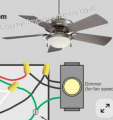
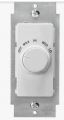
Yes, pick up a ceiling fan controller, the type that fit in an electrical wall switch box, and try it,
N.A. versions.

1758586540573.png1758587511816.png
 
Last edited:

jiggermole

Joined Jul 29, 2016
185
Another option if you can find it is a hvac blower with a brushless dc motor. Used that for my buddies shop and were able to cludge together the remainder of the controls from the removal of the blower to do what we needed.
I kind of agree the simpler option is best. That three speed fan control seems like the way to go. If you're looking for a soft start/ ramp up as well, maybe get the speed control and presence sensing working to your satisfaction first. Break up the problem. The simplest option I can think of for that would be a single phase variable frequency drive, but that might be cost prohibitive.
If you find an hvac control for it you might be able to use a pot for a differential pressure input to control speed. Thats what we use in my buddies garage.
 

MisterBill2

Joined Jan 23, 2018
27,164
I have installed, and replaced, motor speed controls that fit into the standard, deeper, single-gang, wall box. They do not ramp up the speed gradually, so the TS needs to decide how important that part is. Possibly, though, one of those controls coupled with the three-speed control, would be adequate.
Of course, that suggestion IS INDEED DIFFERENT from the original request, but often a compromise solution to some request is more readily available. A lot of design engineering involves examining trade-offs.
 

MisterBill2

Joined Jan 23, 2018
27,164
The capacitor that is usually part of an induction motor system used for blower applications provides the required phase shift. An induction motor requires a phase shift to produce the torque that makes it rotate. The detailed explanation is well understood but rather tedious to explain.
 
Top