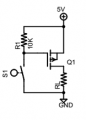
It's important if there's a reason that the load must be grounded.
For example, suppose you want to turn the power on and off to a different part of the circuit (which is all connected to the same ground).
That would require a high-side switch.
It's important if there's a reason that the load must be grounded.
For example, suppose you want to turn the power on and off to a different part of the circuit (which is all connected to the same ground).
That would require a high-side switch.
No. Field Effect Transistor is a generic term for transistors that operate by having an electric field control the conductivity of a channel. MOSFET is a more exact term for what you're referring to as a generic FET.
As to the drawing aspect, I'm not exactly sure what a conventional diagram would look like! Would you mind providing an example?
The source-follower configuration (load in source) will have a load voltage that is more than one Vgs threshold voltage drop below the gate voltage (and thus the supply voltage).
Thus it could act as a switch, but one with a large voltage drop, which is obviously not desired.
High side switches require the gate to be higher than the drain to source voltage. High side means that the load is between the source and ground/common.
Threads like this are why the internet is full of misinformation on electronics. New people to the idea of electronics wanting to post information they don't in fact understand.
As a beginner I've had little luck finding a site that clearly explains the various configurations used to employ MOSFETs (both n-channel and p-channel) as switches.
Frankly, the reason for this is that to anyone with even a little bit of experience, the circuit configurations are obvious. Except for the fact that MOSFETs are driven by gate-to-source voltage, while BJTs are driven by base current, MOSFET switching circuit configurations are pretty much the same as their corresponding BJT circuit configurations. This stuff is NOT rocket science, to anyone but the raw beginner.
As for your inability to find information, you need to look in the right places: MOSFET manufacturers' data sheets and application notes. There's plenty of information there, especially in app notes dealing with the topics of switching regulators and motor control.
Threads like this are why the internet is full of misinformation on electronics. New people to the idea of electronics wanting to post information they don't in fact understand.
What I find most vexing is that there's so much garbage floating around, even though there's a lot of really good information on the Internet at semiconductor manufacturers' web sites.
I never claimed to be an expert on the matter, in fact I think I made it crystal clear that I had only a vague understanding of the working principles. My intention was simply to bring together some ideas which may be helpful to beginners like myself.
Yes, I made some very rookie mistakes but please bear in mind that I've only been at this for three months! It takes a while to get well-grounded in this sort of thing. Anyway, I have a tendency to take in too much at once and as a result make an ass of myself in the process of learning things. Some attain mastery in elegant brush strokes, others...well not so much.
Look, being an expert does not preempt the need for humility. If it's confusion you're really concerned with then make an effort to clarify things. Otherwise you're just trying to ingratiate your own inflated ego, as far as I'm concerned.
It's important if there's a reason that the load must be grounded.
For example, suppose you want to turn the power on and off to a different part of the circuit (which is all connected to the same ground).
That would require a high-side switch.
Another example is in an automobile. the chassis is connected to the negative of the battery and the loads (such as lamps) connect to the chassis. There is no way to switch the ground side of the load.
We've all made mistakes in our posts on this website (those who haven't will). Particularly those of us who don't use simulators or breadboards to vet all of our designs before posting.
Making mistakes isn't the problem; it's not learning from them.
One of the good things about AAC is that material has the opportunity to be peer reviewed. The same can't be said for places like YouTube and a number of websites where peer review doesn't seem to be common.
We've all made mistakes in our posts on this website (those who haven't will). Particularly those of us who don't use simulators or breadboards to vet all of our designs before posting.
Which brings up a point.
A good way to learn how circuits work is to virtually test them in a simulator such as the free LTspice.
Simulators aren't perfect but they will usually show if there's an error in your circuit.
And you can examine parameters, such as the current through any component, that is difficult to do in a real circuit.
We've all made mistakes in our posts on this website (those who haven't will). Particularly those of us who don't use simulators or breadboards to vet all of our designs before posting.
Making mistakes isn't the problem; it's not learning from them.
One of the good things about AAC is that material has the opportunity to be peer reviewed. The same can't be said for places like YouTube and a number of websites where peer review doesn't seem to be common.
I completely agree, and yes the opportunity to learn from others here undeniably deserves appreciation.
And I do get that it's frustrating to have to repeatedly point out to beginners such as myself things which would be easily grasped if we were only to slow down and just follow instructions properly! Impatience is the hobgoblin of true understanding, after all.
But also keep in mind that even the best students can sometimes seem to be the most foolish. That doesn't necessarily mean we aren't listening to the good advice being given, just that more time is needed for everything to sink in. I for one tend to get so absorbed in such a vast plethora of thoughts on a subject that I literally overlook the most bloody obvious details (or even worse, absurdly volunteer to write a blog post on a topic I know scarcely about). It's stupid I know, but that's just how some of our brains work. Eventually it all settles in though and then all the sudden one day you're just awash with amazing clarity (well hopefully anyway!).
That said, a bit of harsh criticism now and then doesn't hurt either. Maybe it'll spur me on to be a little more rigorous in my studies.
The good students don't come here to ask questions. They probably don't even come here to answer questions because they should have better things to do with their time.
That said, a bit of harsh criticism now and then doesn't hurt either. Maybe it'll spur me on to be a little more rigorous in my studies.
I haven't seen anything I'd consider harsh criticism... Well, actually, I have.
When I first joined AAC, I had a couple members trolling me (I didn't even know what that meant until I joined) and making ad hominem attacks. Fortunately, the moderators shut that down quickly.
We all have our pet peeves. Mine are grammar (no paragraphs, lack of capitalization, use of text speak), and no or poorly drawn schematics. Some people take the criticism constructively and some don't; that's their choice.
xox posted 36 schematics of Mosfet "switches". But only a few are correct and the rest are wrong. Even some of the bipolar transistor switch schematics are wrong.
The corrections have errors and the corrections to the corrections also have errors.
A Mosfet on-off switch is about as simple as electronics gets but so many schematics of them in this thread are wrong.
That is why this thread should be closed.
xox,
use some Spice program. It will allow to investigate any scheme of switching on transistors and even erroneous. In this case, no real transistor will not suffer.

 Facebook
 Google
 GitHub
 Linkedin