Blocking oscillator with mosfet

Thread Starter

Hamlet

Joined Jun 10, 2015
553
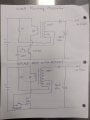
IMG_20260113_110253157.jpgI built the first schema, and using 1v to 4v, I had a slow charging rate, 60sec to 250v, but by swapping in a jellybean mosfet, charging time was made in 15seconds.

I'm surprised it worked at all. I don't know, but I don't imagine the mosfet surviving repeat attempts, what with all the flyback voltages swirling around...

Anybody have ideas on how I might optimize the circuit? I'm thinking two zeners
back to back to clamp voltages on the gate for starters...

Edit: to right side up image.
Edit: remove confusing duplicate image.
Edit notes: challenging to post or edit from a smart-phone.
 
Last edited:

Thread Starter

Hamlet

Joined Jun 10, 2015
553
I can try that, thanks. Let me note, the mosfet version test was 3A @ 3v, no heatsink, little heating.

The object of this line of bench top investigation is experimental. I'm trying to learn something new. Also, I can imagine applications for a small utility spot welder. I'm winding my own ferrite transformers, with different size cores (PC40), and different wire gauges, turns ratios.

I share the above as my past experience here has shown me that it is merciful to share context. Many threads on AAC are strongly goal oriented, but my questions about this circuit are how we might optimize for mosfet operation and boost small form efficiency.
 

Thread Starter

Hamlet

Joined Jun 10, 2015
553
I will do. I wonder if a capacitor somewhere as a snubber might catch faster transients?

I'm also going to place a parallel fast diode/resistor right at the gate, help with any ringing, and give the zeners more time to respond.
 
Last edited:

MisterBill2

Joined Jan 23, 2018
27,159
The most important thing the TS did was to use an adequately rated mosfet instead of an inadequately rated transistor.
An important thing to do is to make sure that the core you are using for the transformer can handle the power that the application requires. Otherwise it will never deliver the required power.
 

Thread Starter

Hamlet

Joined Jun 10, 2015
553
I'm using a core of adequate size, 25x32mm, and the bjt transistor is specifically rated for the application. Perhaps my windings are lacking somehow, yet, nothing a mosfet can't fix
 

Thread Starter

Hamlet

Joined Jun 10, 2015
553
In testing, the small capacitor that helps the BJT during transition, slows the mosfet way down. Better now that I eliminated it. The resistor is about right, none or too low, poor performance, and same if 1k or 10k, which surprised me. I'm going try different placements, and see. The mosfet, to-220, fqp?xxx-5030, is some china slop part, with a threshold of 1.75v. I have a bag of 'em. As configured, it's about 3sec to 150v.
 
Charging a big capacitor is a bit tricky with such converter because as this cap voltage rises the negative voltage at the gate (or base) rises also to extreme values.

Like:

When the output cap voltage is at 10V it makes gate negative voltage -1V.
But when the output cap voltage is at 160V the gate can observe a -16V.

You want more constant voltage at the gate.
 

Thread Starter

Hamlet

Joined Jun 10, 2015
553
Good point!

I was concerned about the configuration leading to something like that. I'm going to try isolating the secondary from the feedback coil.
 
Top