BJT, JFET and MOSFET Functionality?

LvW

Joined Jun 13, 2013
2,030
How about this perspective? Is a low impedance input device a current driven device or voltage driven device? Now vice versa. A voltage source without the ability to sustain current would be a poor driver for BJT or a speaker... etc.
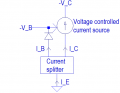
I think, in our discusion about transistor physics, we must not mix practical and application oriented aspects/terms with pure physical effects. Typical example: We always speak about "current sources" - but at the same time we know that in electronics each "current source" is in reality a voltage source with a sufficient large source resistance (it is just a kind of "labor jargon")
 
Last edited:

Bordodynov

Joined May 20, 2015
3,431
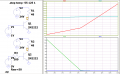
Here I have shown that bipolar transistor current control has an advantage over voltage control in the temperature range. Also it is more stable with the variation of the transistor parameters. Especially for a bipolar transistor the current gain is normalized, not the base-emitter voltage.2021-01-20_14-47-14.png
 

LvW

Joined Jun 13, 2013
2,030
Here I have shown that bipolar transistor current control has an advantage over voltage control in the temperature range. Also it is more stable with the variation of the transistor parameters. Especially for a bipolar transistor the current gain is normalized, not the base-emitter voltage.
As I have proposed - when discussing physical properties of the BJT, we should not mix it with practical and application-oriented aspects. Both views are allowed - but we always should know what we are discussing about.

By the way: What can we learn from the red curve (Ib as a funtion of temp) and the green curve (Vc as a function of temp). ?
Perhaps we do not like such a behaviour - however, we cannot change physics.
Both functions show us that it is the voltage Vbe which determines Ib and Ic :
The physical background is the temp. coefficient of Vbe (app. -2mV/K), which is defined as
d(Vbe)/dT for Ic=const.
That means: We must reduce Vbe for keeping Ic const for rising temperature. If we don`t do that (as in the above simulation) both currents increase with temperature (due to the temp. sensitivity of the saturation current Is) - no surprise at all.
 

Wolframore

Joined Jan 21, 2019
2,619
Vbe is required for the band gap but it’s the current flowing that generates this voltage and is dependent on thermal voltage (this is just a property) which is the effect and not the cause, if we could apply a current to the base without voltage it’s possible to get the collector current to flow. This causes the reverse biased collector to flow from the minority carriers (with respect to base) from the base current.
 

LvW

Joined Jun 13, 2013
2,030
Vbe is required for the band gap but it’s the current flowing that generates this voltage and is dependent on thermal voltage (this is just a property) which is the effect and not the cause, if we could apply a current to the base without voltage it’s possible to get the collector current to flow. This causes the reverse biased collector to flow from the minority carriers (with respect to base) from the base current.
I think that a current never can "generate" a voltage. A current needs an E-field within the conducting device - otherwise there is no force which can move the charged carriers (which we call "current").
Hence: Current is always ther result of an applied voltage - not vice versa.
No - you cannot "apply a current to the base without voltage".

I know that during design and analysis of electrical circuits we are allowed to use Ohm`s law in this form V=I*R - which means: The current I would "generate" a voltage V. Buth this has no physical meaning in the sense "cause-and effect". It is a mathematical "trick" - nothing else.
 
Last edited:

Wolframore

Joined Jan 21, 2019
2,619
Photons for a phototransistor can be viewed as a source of current (minority carriers) which controls the CE conduction and from your explanation no voltage involved.
 

Wolframore

Joined Jan 21, 2019
2,619
It’s this current that controls the larger collector current, due to relationship in Ohms law we can keep going around in circles and either case can be argued. Without the base current there is no collector current. I believe we are all saying the same just a matter of perspective.
 

Bordodynov

Joined May 20, 2015
3,431
Consider a transistor in supersaturated mode. I.e., the mode of the open collector. The base-collector junction is shifted in the forward direction. What shifts the junction, current or voltage. Let's complicate the situation a little bit. Take a Schottky transistor. In fact, it is an ordinary transistor + Schottky diode parallel to the Base-collector junction. In saturation mode, the Schottky diode is shifted in the forward direction. The voltage is determined by the current. How does the voltage appear in such a case? I was taught that a bipolar transistor is driven by current. It is diffusion and drift currents. And I think all the reasoning about voltage control is sophistry, which makes it difficult to calculate circuits and therefore detrimental. The current gain is determined by the injection and transfer coefficient in a common-base circuit. And these coefficients are theoretically calculated. In general, the transistor is voltage controlled if the voltage source is applied to the junction, and it is current controlled if the current source is applied to the junction. I have encountered voltage controlled LEDs. We had illiterate (novice) researchers. They asked me what voltage should be applied to the LED. I would get indignant and start explaining that it is necessary to control the current. One of them burned out a $35 LED this way. So your love of the truth is not harmless at all. Again fixing the current through the LED will save it even with the voltage variation of the direct voltage.
 

LvW

Joined Jun 13, 2013
2,030
Consider a transistor in supersaturated mode. I.e., the mode of the open collector. The base-collector junction is shifted in the forward direction. What shifts the junction, current or voltage.
There is no question about it.
The B-C pn junction is forward biased (npn case, collector potential lower than base potential) with a voltage Vbc>0.
That`s the simple truth.
I was taught that a bipolar transistor is driven by current. It is diffusion and drift currents. And I think all the reasoning about voltage control is sophistry, which makes it difficult to calculate circuits and therefore detrimental.
I also was taught that the BJT would be current-controlled. But later I have convinced myself that this is - physically - wrong.
There are many effects and circuit properties which can prove this statement.
In this respect, it is not a good argument to say that this view (voltage-control) would make it "difficult to calculate" (which is simply not true).
Physical laws do not ask us if we would like to have simpler relationships..

In general, the transistor is voltage controlled if the voltage source is applied to the junction, and it is current controlled if the current source is applied to the junction.
So, the transistor changes its properties - depending on the outer circuitry? I don`t think so.
I am sure you know that - in reality - there is no "current source". This is just a term we are using for a voltage source with a large source resistance Rs (or rs). Hence, when we "inject" a current - we do nothing else than to feed a voltage divider between Rs and the resistor (static Rbe) resp. differential (rbe) of the B-E path .
 

LvW

Joined Jun 13, 2013
2,030
It’s this current that controls the larger collector current, due to relationship in Ohms law we can keep going around in circles and either case can be argued. Without the base current there is no collector current. I believe we are all saying the same just a matter of perspective.
With all respect - the above (the first sentence) is just a claim without any proof.
But on the other hand, there are many proofs for voltage control. No - I don`t think that it would be "a matter of perspective".
A small quantity can NEVER directly control (determine) a larger quantity of the same kind.

I know that there are some books claiming that the BJT would be current-controlled - without any proove, just because of Ic=B*Ib.
But such a relation (in this casae, a result of correlation) must not automatically be interpreted as cause-and-effect.
Fortunately, there are some better and more exact knowledge sources (leading US-Universities as well as engineers with high reputation like Barrie Gilbert and R.A. Pease)
 

Thread Starter

pinkyponky

Joined Nov 28, 2019
373
Think of them all as being voltage controlled, and you won't be far wrong.

For a NPN transistor, N-channel JFET or N-channel MOSFET - gate/base voltage more positive with respect to source/emitter turns it on.
For a PNP transistor, P-channel JFET or P-channel MOSFET - gate/base voltage more negative with respect to source/emitter turns it on.

What's different is the voltage at which it swaps from OFF to ON:
NPN transistor = about 0.6V, N-channel JFET = about -2V, N-Channel MOSFET = about 3V
PNP transistor = about -0.6V, P-channel JFET = about +2V, P-Channel MOSFET = about -3V

In a bipolar transistor and a JFET there is a diode between base/gate and emitter/source which conducts just like any other diode does, starting at about 0.6V.
No current flows between gate and source in a MOSFET.
Hi Ian0,

Below I have described as I understand, please correct me if I'm wrong.

The NPN transistor will be turn ON when the voltage difference is about and/or above +0.6V (voltage between the base and emitter, like: +0.6V, +0.7V, +0.8V, +0.9V, +1V, and +2V and so on...), and when the voltage difference is below +0.6V (voltage between the base and emitter, like: +0.5V, +0.4V, +0.3V, +0.2V, +0.1V, 0V, -1V, and -2V and so on...) will be turn OFF.

The PNP transistor will be turn ON when the voltage difference is about and/or below -0.6V (voltage between the base and emitter, like: -0.6V, -0.7V, -0.8V, -0.9V, -1V, and -2V and so on...), and when the voltage difference is above -0.6 (voltage between the base and emitter, like: -0.5V, -0.4V, -0.3V, -0.2V, -0.1V, 0V, +1V, and +2V and so on...) will be turn OFF.
 

Ian0

Joined Aug 7, 2020
13,155
Hi Ian0,

Below I have described as I understand, please correct me if I'm wrong.

The NPN transistor will be turn ON when the voltage difference is about and/or above +0.6V (voltage between the base and emitter, like: +0.6V, +0.7V, +0.8V, +0.9V, +1V, and +2V and so on...), and when the voltage difference is below +0.6V (voltage between the base and emitter, like: +0.5V, +0.4V, +0.3V, +0.2V, +0.1V, 0V, -1V, and -2V and so on...) will be turn OFF.

The PNP transistor will be turn ON when the voltage difference is about and/or below -0.6V (voltage between the base and emitter, like: -0.6V, -0.7V, -0.8V, -0.9V, -1V, and -2V and so on...), and when the voltage difference is above -0.6 (voltage between the base and emitter, like: -0.5V, -0.4V, -0.3V, -0.2V, -0.1V, 0V, +1V, and +2V and so on...) will be turn OFF.
Yes, in theory, but if you take the base voltage above much more than 0.7V a lot of current will flow between base and emitter, the same as if you put voltage across any other diode.
 

dl324

Joined Mar 30, 2015
18,344
The NPN transistor will be turn ON when the voltage difference is about and/or above +0.6V (voltage between the base and emitter, like: +0.6V, +0.7V, +0.8V, +0.9V, +1V, and +2V and so on...), and when the voltage difference is below +0.6V (voltage between the base and emitter, like: +0.5V, +0.4V, +0.3V, +0.2V, +0.1V, 0V, -1V, and -2V and so on...) will be turn OFF.
There is no well defined turn on voltage for a BJT. For silicon BJTs, some use an "on" voltage of 0.6V, while some teach 0.5-0.7V. You could assume a transistor will off when the junction voltage is 0.59V, but I'd assume it was on.
 
Top