BJT, JFET and MOSFET Functionality?

LvW

Joined Jun 13, 2013
2,030
So, is transistor voltage or current controlled?
This is a question which involves reality (physics) - and cannot be answered by simulation of an artificial model.
More than that, there is no ideal current source, in reality. I can present to you - if requested - real, clear and reliable proofs for voltage control.
(At the risk of someone finding me "pedantic").
 
Last edited:

crutschow

Joined Mar 14, 2008
38,534
So, is transistor voltage or current controlled?
Okay, let me give it one more shot as I didn't mean to muddy the waters.

The solid-state physics of the BJT is that it is a voltage-controlled current-output device with a low base-emitter input impedance (looking like a forward-biased diode).
So since the base-emitter input current is logarithmically related to the input voltage, there is also an input current (some call it parasitic) which happens to be fairly proportional to the collector-emitter (characterized by the transistor Beta or hfe).
So for some design purposes (such as switching and large-signal calculations) it is often easier to use this input current to determine the collector-emitter current rather than Vbe, but that doesn't change the physics that it is a voltage-controlled device.

All clear now? :)
 

ElectricSpidey

Joined Dec 2, 2017
3,335
This debate is almost as amusing as when the conventional current cult takes on the electron flow heretics.

Got to love it when the experts agree...

>humor<
 

jonzadi

Joined Dec 23, 2019
2
Hello All,

I have been spending more time for watching and reading the tutorials to understand the functionality of BJT (NPN and PNP) transistors, JFET (N-channel and P-channel) and MOSFET (N-channel and P-channel for both Depletion and Enhancement modes), but I got confused and not understand. I would like to know only that when these BJT's and FET's will be turn ON and OFF?. Please could you clearly explain with examples (If possible)?.

Your answers would be more valuable and I'm more thankful to you Sir/Madam.
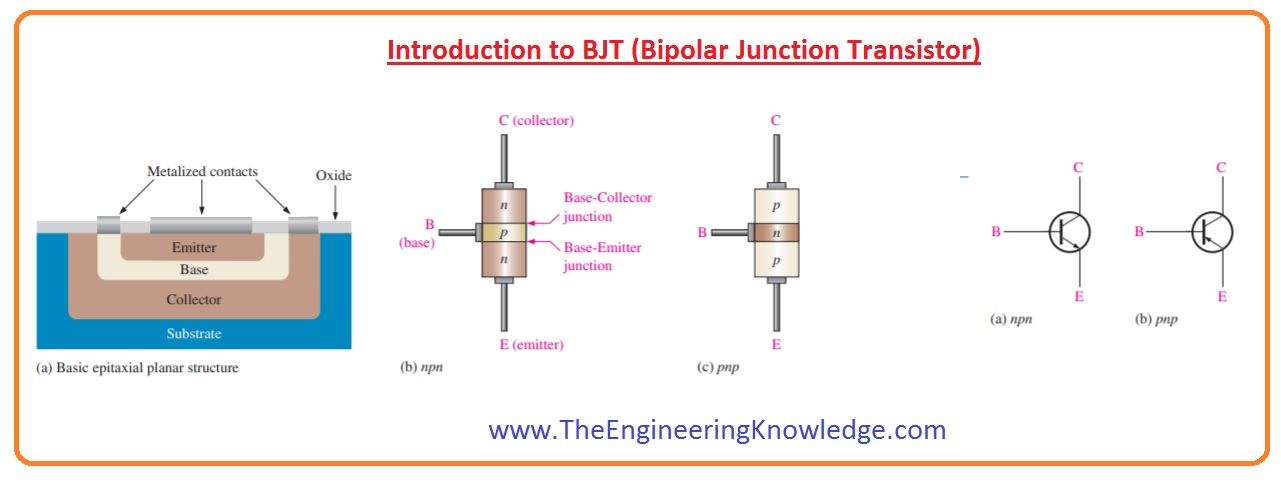
  • The BJT stands for bipolar junction transistor is an electronic device that has 3 terminals and used in different amplification circuits. It also known as current controlling instruments.

  • Its 3 terminals are emitter, base, and collector, also have two pn junctions.
  • The junction formed through the base and emitter called base-emitter junction and combination of base and collector makes the base-collector junction.
  • There are 2 further types of BJT first is NPN and the second one is PNP. These types are designed according to doping level.
  • As it used in for amplification process for this it needed an external dc source,
  • In below figure the symbol and internal structure of BJT are shown below.
BJT Collector Characteristic Curves BJT Circuit Analysis, BJT DC Model, BJT Characteristics And Parameters, BJT Currents, BJT Working, Introduction to BJT (Bipolar Junction Transistor)

https://www.theengineeringknowledge.com/introduction-to-bjt-bipolar-junction-transistor/
 

jonzadi

Joined Dec 23, 2019
2
  • The BJT stands for bipolar junction transistor is an electronic device that has 3 terminals and used in different amplification circuits. It also known as current controlling instruments.

  • Its 3 terminals are emitter, base, and collector, also have two pn junctions.
  • The junction formed through the base and emitter called base-emitter junction and combination of base and collector makes the base-collector junction.
  • There are 2 further types of BJT first is NPN and the second one is PNP. These types are designed according to doping level.
 

LvW

Joined Jun 13, 2013
2,030
This debate is almost as amusing as when the conventional current cult takes on the electron flow heretics.
>humor<
I do not agree because:
To me it is quite logical to have such a debate because in some knowledge sources (some ominous internet-sides, even some books) it is claimed - just claimed without any explanation/verification - that the BJT would be current-controlled.
And there are some people who are able to see the contradiction between such a claim and the behaviour/properties of the "naked" transistor as well as some electronic circuits.
 

vanderghast

Joined Jun 14, 2018
70
So, is transistor voltage or current controlled?
View attachment 227079
Use a DIODE (and a resistor). Since the temperature highly changes the "threshold" of the diode ( defined by some manifacturers by a current of 1 mA through it, by the way ), a current source will adjust to the temperature and "force" the voltage at the diode accordingly. The graph will be like the first curve. But with a voltage source, you will get a graph with great variations, like the second case. Would you conclude that a DIODE is current controled or voltage controled?

To say that a BJT (NPN precisely) is VOLTAGE controlled is simply because you can defined its states using ONLY the voltages:
- VBE_ON < VBE < VBE_ON : blocked
VBE > VBE_ON and VBE < VCE : active forward ( beta almost constant, when no Early effect worth of mention)
VBE > VBE_ON and VBE > VCE : saturation ( beta decreases )
Look mom, *** NO CURRENT *** involved. You CANNOT do it using ONLY current... or you can?
 

crutschow

Joined Mar 14, 2008
38,534
Would you conclude that a DIODE is current controled or voltage controled?
That is unrelated as to whether a BJT is current or voltage controlled.
The solid-state physics of the device (and all the derived equations from that) show that it is a voltage controlled device.
 

neonstrobe

Joined May 15, 2009
200
A "hole" does not move, it is strongly tied to the atom
Are you confusing fixed charges and mobile charges, here?
A boron atom in silicon accepts an electron and in so doing acquires a negative charge. To all intents and purposes, that negative charge stays fixed, whether the electron actually moves or not, because if it should move, another filling its place restores the overall charge.
In the crystal, electrons form bonds between the silicon atoms. When doped p type with boron, say, many sites are generated (one per boron atom, mostly) where electrons can jump into. They come from silicon atoms. Where they came from is a new hole. The hole moved from the boron atom to a silicon - and as silicon atoms are almost identical holes can flow, fairly randomly, between the silicon atoms. Silicon atoms which have lost an electron assume a positive charge, so the hole appears to be a positive charge which can move. You can still say that the electrons are actually doing the moving, but the holes where they came from are also moving. It is very convenient for the device physics to think of holes as mobile positive charges - as Shockley first suggested.
You can make a crystal model using ball and stick plastic material, and actually remove an "electron". There is a hole, right there. You can then take another "electron" and shift it into position. There is then a hole where it came from. Take the next neighbouring "electron" and replace that, etc. Put a few images of that together and show it as a movie demonstrates that a hole can move.
 
Last edited:

neonstrobe

Joined May 15, 2009
200
Much of this debate is perhaps clouded by the issue of switching and static characteristics.
If you are concerned with switching a transistor, both Vbe and Ib are important (in fact neither can be ignored in any circuit). The internal physics of the transistor is based on voltages within the device. That does not preclude the fact that you can drive a current into the base and get a gain's worth out of the collector. Danko's circuits, for example, only shows that gain variation with current is more linear than the collector current to base voltage, which is exponential.
And in switching a transistor off, charge in the base (for an NPN, that is electrons in transit - and for a PNP it is holes!) need to be removed to get the device to turn off. So for switching, charge is the main consideration.
 

neonstrobe

Joined May 15, 2009
200
Holes don't move
The TS was looking for help understanding the differences between transistors. Your comments do not shed much light as they have criticised without giving any explanation.
The idea of holes is a bit nebulous. The concept arose because that became a way of explaining the effects of a nearly full (valence) band of electrons, where the "missing" electrons appear to have a positive charge, and mass, as opposed to electrons with a negative mass.
While it is widely accepted that holes are a missing electron from a bond in a crystal, electrons can jump into them. If so, on average, statistically, another hole appears somewhere else which maintains the electrical neutrality. Whether you think that the electron moved it can also, as you mentioned yourself, give the illusion of the hole moving. My crystal model cartoon can also be interpreted as an electron moving in the opposite direction to the hole.
Given that a hole is a sort of "made up" particle, I suggest it is equally valid to imagine them as moving. Certainly physics can describe hole currents as moving positive charges, even if electrons are actually "doing the work".
Whether you think the hole is filled and another appears, or by being filled in one site but another opening can be considered moving, I leave to the individual.
I think it is more helpful to understand PNP transistors and PMOSFETs where holes are mobile positive charges.
And with even small currents, the effect is macroscopic as billions of holes or electrons are flowing. What they do locally is less important than the overall effect , even though microscopic effects participate in the behaviour.
 

tindel

Joined Sep 16, 2012
939
Hello All,

I have been spending more time for watching and reading the tutorials to understand the functionality of BJT (NPN and PNP) transistors, JFET (N-channel and P-channel) and MOSFET (N-channel and P-channel for both Depletion and Enhancement modes), but I got confused and not understand. I would like to know only that when these BJT's and FET's will be turn ON and OFF?. Please could you clearly explain with examples (If possible)?.

Your answers would be more valuable and I'm more thankful to you Sir/Madam.
If you're still around -

I'd set JFET's aside unless you have a specific use in mind. These are somewhat esoteric devices that find limited use.

Painting with broad strokes here (i.e. there are exceptions to these rules.):
BJT's need to be current limited with a resistor and will turn ON when the base/emitter voltage is greater than 0.7V. There are varying levels of ON here, but driving the base with 10mA will suffice in most applications. This transistor will be OFF below base/emitter of 0.4V.
FET's don't need to be current limited with the resistor. Setting the gate/drain voltage of almost any FET greater than 10V will turn ON this transistor; voltages less than 1.0V will turn the transistor OFF. There are logic-level FET's that will turn ON at voltages above 3V.

I hope you find your answers in the noise. PM me if you have further questions.
 

Wolframore

Joined Jan 21, 2019
2,619
How about this perspective? Is a low impedance input device a current driven device or voltage driven device? Now vice versa. A voltage source without the ability to sustain current would be a poor driver for BJT or a speaker... etc.
 

Ian0

Joined Aug 7, 2020
13,155
It's not different from a triode valve. Anode current varies with grid voltage, and if you make the grid positive of the cathode, grid current starts to flow. The gird current is not causing the anode current to flow, it is the grid voltage.
 
Top