BJT, JFET and MOSFET Functionality?

neonstrobe

Joined May 15, 2009
200
Ian- You are right, actually. Sorry. I had forgotten the Ebers Moll model, as it has largely been superceded by the Gummel-Poon model, which I was thinking of, but quoted a very basic form.
The E-M model does not describe the base current variation whereas the main difference is that Ic is much more "linear" (on a log scale) with Vbe, at the low to medium current range, and the emitter current is then described by Ic+Ib, where Ib is a more extended calculation to represent various contributions it is made up from.
The SPICE model currently widely used in simulators is based on the G-P model as a result of being more representative.
 

vanderghast

Joined Jun 14, 2018
70
- The "holes" do not move. We are in a solid crystal and only the electrons move, in fact they surf and doing so insure most of the mechanical cohesion itself of the metal. A "hole" appears when an electron (or two, as in silver and copper) leaves "their" atom. The material, as a whole, stands electrically neutral while locally, there can be an excess of electrons or of "lack" of electrons. But when a "hole" get filled by another surfing electron and then, another "hole", almost in a randomly somewhere else, appears because, there, an electron has left, there is NO CAUSALITY allowing to establish a law that a (single) "hole" has "moved". (Unless you are, in fact, speaking of "the statistical average of a group of many, really many, holes".)

- The gate current of a BJT does not control anything. It is the diode of the junction Emitter-Base which does control the forward current in an NPN, and it is the thickness of the base region, coupled with the difference of voltage between the base and the collector which determines how much (on average) of the electrons emitted by the diode would be captured by the base and how much pass through the base region to exit by the collector.

Saying that the base current controls the NPN is a PRACTICAL point of view, when the NPN is in the active mode, but has nothing to do with the physic, at least, nothing more than "moving" individual "hole", in solid crystal, does any. It may help, sure, but the "plateaux" of Ic (vertival) versus Vce (horizontal) for a CONSTANT Vbe curve explains exactly the same concept, with, in addition, a clear show (imvho) of the limitations of the "practical" point of view.
 

BobaMosfet

Joined Jul 1, 2009
2,211
Hello All,

I have been spending more time for watching and reading the tutorials to understand the functionality of BJT (NPN and PNP) transistors, JFET (N-channel and P-channel) and MOSFET (N-channel and P-channel for both Depletion and Enhancement modes), but I got confused and not understand. I would like to know only that when these BJT's and FET's will be turn ON and OFF?. Please could you clearly explain with examples (If possible)?.

Your answers would be more valuable and I'm more thankful to you Sir/Madam.
Title: Understanding Basic Electronics, 1st Ed.
Publisher: The American Radio Relay League
ISBN: 0-87259-398-3
 

LvW

Joined Jun 13, 2013
2,030
Saying that the base current controls the NPN is a PRACTICAL point of view, when the NPN is in the active mode, but has nothing to do with the physic,
More than that. It is a common misunderstanding that in practice it would be easier to work with the "current-control"- view.
Each simple transistor stage is designed - and, surprisingly, some people seem not to know what they are doing - using the voltage-control view. They start - of course - with an estimated value Vbe=0.65 volts.
And they know - hopefully - that a value of Vbe=0.7 volts would rise the DC collector current Ic.
And from this moment on they suddenly think that a further increase of Ic would be caused by the base current Ib.
A surprising step in thinking.
After selecting Vcc and Ic and the resistors Rc and Re (emitter feedback) they are calculating the necessary base voltage Vb=IeRe+0.7V.
Now - during designing the base voltage divider (as a last step) they consider - perhaps, but it is not necessary - an estimated value for the base current Ib. That`s all - and now they speak of current-control!! Surprising - and the problem is: Some books do the same.
We should ask them if they can explain how a current mirror works....or how Re can provide negative feedback.
 

crutschow

Joined Mar 14, 2008
38,535
It's all well and good to discuss the physics of a BJT as a voltage-controlled device when operating in the active region, but when it is used as a switch, it is easiest to view it as a black-box current-controlled device.
Thus a minimum base current is normally supplied to insure it is saturated when on, not a minimum base-emitter voltage.
 

Ian0

Joined Aug 7, 2020
13,155
Agreed - electronics is full of rules of thumb to calculate various things. To be perfectly pedantic, there IS a minimum base emitter voltage to turn a transistor on, and it does have to be taken into account when calculating the base resistor especially on lower MCU supply voltages. i.e. BaseResistor = (control_voltage - Vbe)/current.
When calculating the minimum base current, though, it must be borne in mind that Hfe varies all-over-the-place, so one should look up the value of Hfe at the particular collector current required when calculating the base resistance.

Of course, if one looks at this from the voltage-controlled-device point of view, all one is doing is ensuring that Vbe is raised above 0.6V, and providing the current required for the base-emitter diode, which is Ic/beta
 

vanderghast

Joined Jun 14, 2018
70
It's all well and good to discuss the physics of a BJT as a voltage-controlled device when operating in the active region, but when it is used as a switch, it is easiest to view it as a black-box current-controlled device.
Thus a minimum base current is normally supplied to insure it is saturated when on, not a minimum base-emitter voltage.
In deep saturation, for your NPN, its VCE behaves as a diode with a threshold of 0.2 to 0.4 volt, independently of Ib. Sure IB has to be high enough to match the threshold point of its diode Base-Emiter.
 

crutschow

Joined Mar 14, 2008
38,535
When calculating the minimum base current, though, it must be borne in mind that Hfe varies all-over-the-place, so one should look up the value of Hfe at the particular collector current required when calculating the base resistance.
When used as a switch the Hfe of the transistor is ignored and a forced Beta of 10-20 is typically used to insure the transistor is fully saturated.
In deep saturation, for your NPN, its VCE behaves as a diode with a threshold of 0.2 to 0.4 volt
The saturated Vce at low currents (relative to the maximum transistor rating) is often well below 0.1V.
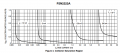
2N2222 example curves below:

1609896508810.png
 
Last edited:

kaindub

Joined Oct 28, 2019
179
My last word on this topic.
I stand by my view that a transistor is a current to current amplifier.
Have a look at ANY transistor data sheet. The only amplification factor mentioned is the hfe or the DC current gain. The unit value is given as "-". Thats because ma/ma works out to be a dimensionless number.
If the gain were to be ma to V, the unit would be ma/V and the dimension would be mho (the inverse of ohms)
So even the manufacturers classify a BJT by this parameter of current gain.
There is NO mention in any data sheet of a voltage to current transformation.
 

crutschow

Joined Mar 14, 2008
38,535
There is NO mention in any data sheet of a voltage to current transformation.
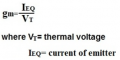
That's because the transconductance of a BJT is a fundamental value which varies very little between transistors and is given by
1609916340960.png
1609916396696.png
Since the gm varies with emitter current this current can be varied to control the AC gain such as in an AGC circuit.
 

LvW

Joined Jun 13, 2013
2,030
My last word on this topic.
I stand by my view that a transistor is a current to current amplifier.
I cannot and do not want to change your "view" - however, there are everal proofs for voltage control.
Did you not stumble yet over some discreapencies or contradictions?
Just one example: Didn't you ask yourself how and why the current mirror works ? How would you explain the feedback effect of the emitter resistor?
 

LvW

Joined Jun 13, 2013
2,030
It's all well and good to discuss the physics of a BJT as a voltage-controlled device when operating in the active region, but when it is used as a switch, it is easiest to view it as a black-box current-controlled device.
Thus a minimum base current is normally supplied to insure it is saturated when on, not a minimum base-emitter voltage.
Yes - that is true, of course. But one could ask - WHY? Does the BJT change its working principle when used as a switch? No - of course not.
But what should we do when we want to use it as a switch ...how can we be sure that the BJT is in saturation mode?
Is it sufficient to make Vbe=0.8 or 0.9 volts? What means "saturation"?
Answer: With Vce=0.2....0.3 volts (npn case) the base-collector pn junction will certainly be open and there will be a pretty large current from the base to the collector (larger than the "classical" base current to the emitter). Hence, a "large" current into the base is a good indication for saturation - and the rule of thumb is: Let the base current be 10 times larger than under "normal" conditions. This means we assume B=10 (instead of B=100)
 

neonstrobe

Joined May 15, 2009
200
"The "holes" do not move."
Er... actually, you mentioned they did. It is true that electrons jump into a hole, when they can. That leaves a "hole" where that electron was. To all intents and purposes, holes can be considered to move.
Try telling a PNP its holes can't move!
 

crutschow

Joined Mar 14, 2008
38,535
how and why the current mirror works ?
Yes, for linear operation of a BJT, the voltage model is usually needed.
How would you explain the feedback effect of the emitter resistor?
It reduces the signal Vbe of course, but it also reduces Ib.
how can we be sure that the BJT is in saturation mode?
Is it sufficient to make Vbe=0.8 or 0.9 volts? What means "saturation"?
Saturation of a BJT is typically defined as when Vce is equal to or less than Vbe.
Applying a minimum Vbe to achieve this is obviously impractical, since Ib will vary significantly with a slight change in voltage or temperature.

That's why the black-box current model is used for switching or other large signal analysis, since the voltage model is not practical for engineering purposes.
Of course the physics don't change for the transistor, but a circuit designer is less interested in what the transistor actually is doing internally, as opposed to how it acts in a practical circuit.

There was another member of this forum who was pedantic about the operation of BJT being voltage controlled.
Have you taken his place?
 

vanderghast

Joined Jun 14, 2018
70
"The "holes" do not move."
Er... actually, you mentioned they did. It is true that electrons jump into a hole, when they can. That leaves a "hole" where that electron was. To all intents and purposes, holes can be considered to move.
Try telling a PNP its holes can't move!
A "hole" does not move, it is strongly tied to the atom (which has momentarely lost one of its electron) and in a solid, atom just do not move relatively one to the other (well, they can vibrate, but that is not the kind of move that we are speaking of, right now). And when a vagabon eletron get captured by that "hole", there is NOTHING that obliged another atom to lose immediatly an electron WHICH IS AN OBLIGATION to create a new "hole" and to speak of a "moving hole". Indeed, if no such thing happen, a "hole" has just dissapeared ... vanished, evaporated. And if a new hole appears later on, the "move" is more like a quantic move than a Newtonian move since the "hole" tranjectory is ... jumpy, not passing through a set of points. Useless complexity would have claim Einstein (well, that part is an assumption from my part, I agree). In a liquid or in air, positive ions can move, but inside a solid, positive ions, atoms, cannot move (relatively to the crystal they belong to).
 
Last edited:

vanderghast

Joined Jun 14, 2018
70
That's because the transconductance of a BJT is a fundamental value which varies very little between transistors and is given by
View attachment 226900
View attachment 226901
Since the gm varies with emitter current this current can be varied to control the AC gain such as in an AGC circuit.
gm is linked to the small model analysis and is about the VARIATIONS between IC and VBE (without Early effect), that is, if we increase Vbe from its actual value (in fact, from the actual state defined as the "point Q", so referred to by the index Q in IEQ) by an amount Delta_Vbe, graphically, we move the plateau upward (downward) by how much to match the Delta_Ic that we would get. The curent Ib is not even mentionned doing something, directly in the variation.
 

LvW

Joined Jun 13, 2013
2,030
It reduces the signal Vbe of course, but it also reduces Ib.
However, the input resistance at the base is increased due to THIS kind of feedback - and THIS is a clear indication of VOLTAGE feedback.
There was another member of this forum who was pedantic about the operation of BJT being voltage controlled.
Have you taken his place?
Why are you using a term like "pedantic"? Why such a personal attititude?
From your last contributions I was of the opinion that you are also convinced on "voltage-control". Is this not the case?
In physics, there are only very few observations/effects which are NOT a cause-effect problem (natural laws).

But all other effects can be explained clearly because there is a certain cause which is responsible for the corresponding effect.
Hence, there is only ONE SINGLE working principle for the device we call "transistor"- in spite of the fact that we have two or three different small-signal equivalent models.
It can be proven that the BJT is voltage-driven (and leading US-universities as well as many well-known researchers like Barrie Gilbert, Robert Pease, etc support this claim) - do you recommend not to mention this physical truth?
So - do you still think that I am "pedantic" in this respect?

In the past, many students have asked me: Why is there a discreapency between some books (claiming for current-control) and some measurements/observations which clearly speak for voltage-control ? Is it "pedantic" to give them a correct answer?
 
Last edited:

crutschow

Joined Mar 14, 2008
38,535
Is it "pedantic" to give them a correct answer?
No.
I'm not saying the voltage control model is not the correct model to describe the solid-state physics operation of a BJT.
But it does seem a bit pedantic to me to try to fit the voltage control model into switching or large signal applications where the current-control model is normally used (and is much easier to use) in the design of such circuits.

I apologize if that is not what you intended to convey.
 

LvW

Joined Jun 13, 2013
2,030
But it does seem a bit pedantic to me to try to fit the voltage control model into switching or large signal applications where the current-control model is normally used (and is much easier to use) in the design of such circuits.
Please, read again my position regarding switching operation in post #32 - and you will see that - in this respect - I am with you.
 
Top