BJT excercises with Vb=0

Thread Starter

kalemaxon89

Joined Oct 12, 2022
389
I found this exercise online in which Vb=0 is assumed because it is much smaller than Re*(b+1):
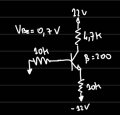
SmartSelect_20230217_232352_Samsung Notes.jpg

In the next exercise (this one below) I wonder why this approximation is not possible .. since here too Rb<<Re*(b+1).
Obviously this is not possible because with a simple voltage divider, we can see that Vb is present on the base!
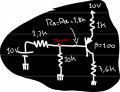
SmartSelect_20230217_232617_Samsung Notes.png

It is not clear to me when this rule/approximation of Vb=0 applies :/
Maybe Rb is not small enough? .. since Rb = 1.8k<Re*(b+1)=101k
 

WBahn

Joined Mar 31, 2012
32,824
Two totally different situations.

In the first case the base is connected to a 0 V source with a 10 kΩ resistance.

In the second case the base is connected to an 8.2 V source with a 1.8 kΩ impedance.
 

Thread Starter

kalemaxon89

Joined Oct 12, 2022
389
Two totally different situations.

In the first case the base is connected to a 0 V source with a 10 kΩ resistance.

In the second case the base is connected to an 8.2 V source with a 1.8 kΩ impedance.
Exactly, in fact now my question is when this rule/approximation of Vb=0 applies.
 

ericgibbs

Joined Jan 29, 2010
21,439
hi k89,

Updated reply.
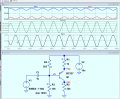
This is your 2nd circuit, with an input signal of 100mV 100Hz, it works.
E
EG57_ 624.png
 
Last edited:

WBahn

Joined Mar 31, 2012
32,824
Exactly, in fact now my question is when this rule/approximation of Vb=0 applies.
There IS no rule that Vb = 0 V, any more than there is a rule that Vb = 10 V.

The voltage at any point in a circuit is dependent one where you choose to establish your 0 V reference (often erroneously called "ground"). In that first circuit, you have three power supply nodes, one at 0 V, one at -22 V and one at (what looks like it might be) +22 V. Well, you could just as easily (and this is commonly done), have those at 22 V, 0 V, and +44 V, respectively, and absolutely nothing would change as far as the circuit is concerned. But now Vb would be very close to 22 V.

The approximation you are trying to get at is that we can (sometimes) assume that the transistor has negligible effect on the base voltage because the base current is small relative to the other currents that establish the base bias voltage. In other words, if you disconnect the base, the base bias network will establish some voltage at that node. In the first example it's 0 V and in the second example it's 8.2 V. Now, when you connect the base of the transistor, the bias network is going to be loaded a bit and the voltage will change. The same thing happens when you add a load resistor to a voltage divider. If the load is small compared to the Thevenin equivalent impedance of the bias network (as seen by that node), then the loading will be minor and the voltage won't change much. The load of the transistor on the base network is approximately the emitter resistance multiplied by the transistor gain. If that is less than 10% (ideally 1%) of the Thevenin resistance, then the base voltage will be close to the Thevenin voltage. In the first case, it's 0.5% and in the second it's even better at 0.25% (using your assumed beta values). So I would expect the base voltages to be very close to the Thevenin voltages.
 

WBahn

Joined Mar 31, 2012
32,824
hi WB,
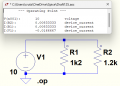
LTSpice does recognize the'k' in that position, so as it says 2k2 and 3k6.
E
QED.
Huh. Not too long ago there was a thread where several people, myself included, determined that it didn't (nor did several other simulators).

But I tried a similar test just now and it did.

I'm pretty sure I haven't updated LTSpice in the meantime.

Interesting.
 

Thread Starter

kalemaxon89

Joined Oct 12, 2022
389
There IS no rule that Vb = 0 V, any more than there is a rule that Vb = 10 V.

The voltage at any point in a circuit is dependent one where you choose to establish your 0 V reference (often erroneously called "ground"). In that first circuit, you have three power supply nodes, one at 0 V, one at -22 V and one at (what looks like it might be) +22 V. Well, you could just as easily (and this is commonly done), have those at 22 V, 0 V, and +44 V, respectively, and absolutely nothing would change as far as the circuit is concerned. But now Vb would be very close to 22 V.

The approximation you are trying to get at is that we can (sometimes) assume that the transistor has negligible effect on the base voltage because the base current is small relative to the other currents that establish the base bias voltage. In other words, if you disconnect the base, the base bias network will establish some voltage at that node. In the first example it's 0 V and in the second example it's 8.2 V. Now, when you connect the base of the transistor, the bias network is going to be loaded a bit and the voltage will change. The same thing happens when you add a load resistor to a voltage divider. If the load is small compared to the Thevenin equivalent impedance of the bias network (as seen by that node), then the loading will be minor and the voltage won't change much. The load of the transistor on the base network is approximately the emitter resistance multiplied by the transistor gain. If that is less than 10% (ideally 1%) of the Thevenin resistance, then the base voltage will be close to the Thevenin voltage. In the first case, it's 0.5% and in the second it's even better at 0.25% (using your assumed beta values). So I would expect the base voltages to be very close to the Thevenin voltages.
Thanks for the explanation and the photo! Everything is clearer now
 
Top