Facebook
 Google
 GitHub
 Linkedin
Hi, this is my first post and before I start, this is not really homework or anything. I am doing this on my own to just improve my skill in deriving these small signal models so it's, kind of, study related I guess.
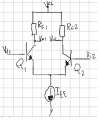
I have a little experience using the hybrid-pi model for circuit with a single transistor, but this one has two and it seems to give me a headache. I am trying to find the transferfunctions for this basic BJT differential amplifier. I want to first find one that relates a differential input to a differential output and then with a single ended output. I want to, eventually, add Cmu, Cpi, rx etc, but not before I'm more comfortable with this. I am going wrong somewhere in the process, probably when I'm setting up my KVL loops, but I can't quite figure it out and I'm hoping someone can nudge me a bit.
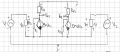
I start by writing up the equivalent small signal hybrid pi model and I have accounted for the early effect by adding ro for the two transistors.
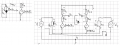
Now in preparing for setting up some KVL mesh equations I use source transformations on the dependant sources and ro.
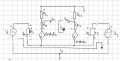
I choose some KVL mesh currents i1 and i2 as shown and I choose element polarities so the mesh currents enter at the + terminal of each element.
I now get the following KVL loop equations and this is where I get a bit thrown off in the i2 loop.
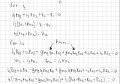
I think I have done something wrong at this point. If the two transistors were matched then the gm terms would just cancel and in the end the TF would be a big "0". Can someone point out what I am doing wrong here?
Thanks all
I have a little experience using the hybrid-pi model for circuit with a single transistor, but this one has two and it seems to give me a headache. I am trying to find the transferfunctions for this basic BJT differential amplifier. I want to first find one that relates a differential input to a differential output and then with a single ended output. I want to, eventually, add Cmu, Cpi, rx etc, but not before I'm more comfortable with this. I am going wrong somewhere in the process, probably when I'm setting up my KVL loops, but I can't quite figure it out and I'm hoping someone can nudge me a bit.
I start by writing up the equivalent small signal hybrid pi model and I have accounted for the early effect by adding ro for the two transistors.
Now in preparing for setting up some KVL mesh equations I use source transformations on the dependant sources and ro.
I choose some KVL mesh currents i1 and i2 as shown and I choose element polarities so the mesh currents enter at the + terminal of each element.
I now get the following KVL loop equations and this is where I get a bit thrown off in the i2 loop.
I think I have done something wrong at this point. If the two transistors were matched then the gm terms would just cancel and in the end the TF would be a big "0". Can someone point out what I am doing wrong here?
Thanks all