BJT amplifier

Thread Starter

full

Joined May 3, 2014
225
hello everyone,

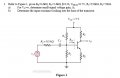
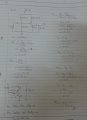
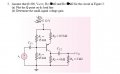
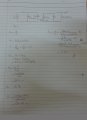
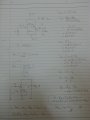
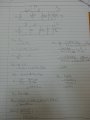
I do this problem in basic common emitter Bipolar junction transistor (BJT) amplifier ........

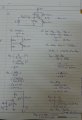
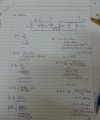
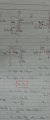
me solution true? or there are some wrong?

thanks :)
 

Attachments

Last edited:

Jony130

Joined Feb 17, 2009
5,598
Well you made a mistake R1 is 250k not 225K. Because Vth = 1.1538V not 1.25V.
Ib = 3.48329μA; Ic = 417.995μA; Ie = 421.478μA.

As for the gain

Av = Rc/(re + RE) * (Rib||Rth)/(Rs + Rib||Rth) = 8.46 * 0.985 =8.3V/V
re = 26mV/Ic
Rib = ( β+1 )*(re + RE) = 80kΩ
Rth = R1||R2 = 57.7kΩ

And for BJT we have Ie = Ib + Ic but as you know Ic = Ib*β. So we have Ie = Ib + β*Ib = (β +1)*Ib.
 

Thread Starter

full

Joined May 3, 2014
225
Well you made a mistake R1 is 250k not 225K. Because Vth = 1.1538V not 1.25V.
Ib = 3.48329μA; Ic = 417.995μA; Ie = 421.478μA.

As for the gain

Av = Rc/(re + RE) * (Rib||Rth)/(Rs + Rib||Rth) = 8.46 * 0.985 =8.3V/V
re = 26mV/Ic
Rib = ( β+1 )*(re + RE) = 80kΩ
Rth = R1||R2 = 57.7kΩ

And for BJT we have Ie = Ib + Ic but as you know Ic = Ib*β. So we have Ie = Ib + β*Ib = (β +1)*Ib.
thanks sir,
when current collector equal current emitter (Ic=Ie)?
 

Jony130

Joined Feb 17, 2009
5,598
The emitter current is always equal to Ib + Ic. But because the beta value is large we can ignore the base current and say that Ie = Ic.
For example if β = 100 and Ib = 10μA we have Ic = 100 * 10μA = 1mA and Ie = Ib + Ic = 1.01mA
So we don't do the big mistake/error if we ignore the Ib current and say that Ie = Ic = 1mA
 

Jony130

Joined Feb 17, 2009
5,598
Your DC current calculation are totally wrong.
Vth is ok and Rth also. But your KVL loop (Vth - VRB - Vbe - VRe = 0) is wrong.
You forget about Vee in your loop.
 

Thread Starter

full

Joined May 3, 2014
225
Your DC current calculation are totally wrong.
Vth is ok and Rth also. But your KVL loop (Vth - VRB - Vbe - VRe = 0) is wrong.
You forget about Vee in your loop.
if I do KVL loop (Vth - VRB - Vbe - VRe +VEE= 0) true?
thanks sir
 

Thread Starter

full

Joined May 3, 2014
225
No, wrong again.
ok , If I do KVL loop (-Vth - VRB - Vbe - VRe +VEE= 0)
but the loop flowing from -Vth+ is mean positive in voltage true?

about Av= (B Rc)/(r-bi +(1+B)Re) *Ri true?

thanks sir
 
Last edited:

Jony130

Joined Feb 17, 2009
5,598
ok , If I do KVL loop (-Vth - VRB - Vbe - VRe +VEE= 0)
but the loop flowing from -V+ is mean positive in voltage true?
In PNP transistor current flow from +Vee--->Re--->emitter-base junction--->Rth--->Vth--->-Vee
Because for PNP Ie current is also equal to Ie = Ib + Ic

3.PNG

So we start at the bottom of a Vee and we go from - to + so we give + sign.
Vee - VRe - Veb - VRth - Vth = 0V

Vee - Ie * Re - Veb - Ib*Rth - Vth = 0

Ib = Ie/(Hfe +1) therefore

Vee - Ie * Re - Veb - Ie/(Hfe +1) *Rth - Vth = 0

Ie = (Vee - Vht - Veb)/( Rth/(Hfe +1) + Re ) = (12 - 10.2 - 0.7)/(12.75/100 + 0.5) = 1.75mA

about Av= (B Rc)/(r-bi +(1+B)Re) *Ri true?
Ri ?? And where is RL ?
 

Thread Starter

full

Joined May 3, 2014
225
In PNP transistor current flow from +Vee--->Re--->emitter-base junction--->Rth--->Vth--->-Vee
Because for PNP Ie current is also equal to Ie = Ib + Ic

View attachment 74355

So we start at the bottom of a Vee and we go from - to + so we give + sign.
Vee - VRe - Veb - VRth - Vth = 0V

Vee - Ie * Re - Veb - Ib*Rth - Vth = 0

Ib = Ie/(Hfe +1) therefore

Vee - Ie * Re - Veb - Ie/(Hfe +1) *Rth - Vth = 0

Ie = (Vee - Vht - Veb)/( Rth/(Hfe +1) + Re ) = (12 - 10.2 - 0.7)/(12.75/100 + 0.5) = 1.75mA


Ri ?? And where is RL ?
thanks sir:):)

Ri =(Rth//r-bi)

I forget RL sorry ,

Av= (B Rc//Rl)/(r-bi +(1+B)Re) *Ri
 

Jony130

Joined Feb 17, 2009
5,598
But in this circuit we don't have source resistance? So how can Rht has any effect on voltage gain ?
For me the voltage gain is equal to
Av = Rc||RL/(re + RE) = (β * Rc||RL)/(Rpi + (β+1)*Re) ≈ 2.6V/V
 

Thread Starter

full

Joined May 3, 2014
225
But in this circuit we don't have source resistance? So how can Rht has any effect on voltage gain ?
For me the voltage gain is equal to
Av = Rc||RL/(re + RE) = (β * Rc||RL)/(Rpi + (β+1)*Re) ≈ 2.6V/V
thanks sir ,you are great man...... :)
 
Top