bjt amplifier basic.......

Bordodynov

Joined May 20, 2015
3,431
COllector of Q3 is (246/36)*0.7 V..
Real (210/36+1)*0.629V+ibQ1*210kOhm.
...but somehow C1 increases gain, don't understand how
General feedback is replaced by two feedbacks.
 

Bordodynov

Joined May 20, 2015
3,431
It is not entirely correct to replace the second transistor with an opamp. Everything is more complicated.
The emitter of the second transistor is an output of the emitter follower.
 

Thread Starter

Zeeus

Joined Apr 17, 2019
616
Garbage In, Garbage Out


How can you have a high open loop gain if the Q2 will kill all off it? Due to its low input impedance.
Add emitter resistor on Q2?

Today is bad day for you? You confuse me today with 0 help
Post link to circuit
 

Bordodynov

Joined May 20, 2015
3,431
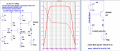
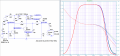
I took your circuit and showed what the gain of each cascade and what the resulting gain and the results of this calculation coincided with the results of Spice. Some have suggested that the current generator is of little use and there will be a small gain. I can immediately say that if the current generator is replaced by a resistor, then the gain of the first stage will decrease by about 15 times.
My circuit on three transistors with multi-loop feedback has a gain of more than a thousand and almost limit output amplitude without distortion.
...
Why would there be no oscillation?
In my scheme, I did not use strong feedback. I broke the gain in two. Reduced gain using feedback using emitter resistors. The maximum number of stages covered by the feedback is 2. Everything increases the stability of the amplifier. I also applied a power filter.
 

Thread Starter

Zeeus

Joined Apr 17, 2019
616
I took your circuit and showed what the gain of each cascade and what the resulting gain and the results of this calculation coincided with the results of Spice. Some have suggested that the current generator is of little use and there will be a small gain. I can immediately say that if the current generator is replaced by a resistor, then the gain of the first stage will decrease by about 15 times.
My circuit on three transistors with multi-loop feedback has a gain of more than a thousand and almost limit output amplitude without distortion.
...
Why would there be no oscillation?
In my scheme, I did not use strong feedback. I broke the gain in two. Reduced gain using feedback using emitter resistors. The maximum number of stages covered by the feedback is 2. Everything increases the stability of the amplifier. I also applied a power filter.
Thank you...Will build 3 stage circuit today and use double feedback and see...Jony is having a bad day unfortunately
 

Bordodynov

Joined May 20, 2015
3,431
There is also feedback in the output stage (emitter resistor). This emitter resistor increases the base voltage of the third transistor, and also reduces the gain of the third transistor, which reduces the gain of the last two stages and this increases their stability. It also reduces distortion without the common feedback of the last stage.
Ps. Do not add a 100 pF capacitor to the output. This is not a schema element.
 

BobaMosfet

Joined Jul 1, 2009
2,211
Seriously, if you want to understand BJTs, start here:

Title: Understanding Basic Electronics, 1st Ed.
Publisher: The American Radio Relay League
ISBN: 0-87259-398-3
 

Thread Starter

Zeeus

Joined Apr 17, 2019
616
Seriously, if you want to understand BJTs, start here:

Title: Understanding Basic Electronics, 1st Ed.
Publisher: The American Radio Relay League
ISBN: 0-87259-398-3
Thank you...MrChips suggested before

Read online that book is very basic (I am basic and for sure there's something in to learn)...Please if you have the book can you post a bjt circuit in it?

It's "cheap" $26..can get it today but have some basic books already

Please post circuit if you have
 

Thread Starter

Zeeus

Joined Apr 17, 2019
616
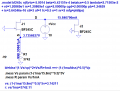
View attachment 178784 View attachment 178783 It is quite possible to use three stages of a circuit with a common emitter, if we introduce into them several negative feedbacks. As a bonus, this is a more stable gain and reduced distortion. Here is an example of such an amplifier:
Please how to calculate gain? dont understand how C1 increases gain..Negative feedback should reduce gain, no?
 

Thread Starter

Zeeus

Joined Apr 17, 2019
616
COllector of Q3 is (246/36)*0.7 V..
Real (210/36+1)*0.629V+ibQ1*210kOhm.
...but somehow C1 increases gain, don't understand how
General feedback is replaced by two feedbacks.
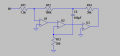
Please how to calculate gain...was trying to do similar circuit but with 2 npn and 1 pnp then realized I don't know how to get the 1000 gain
 

Bordodynov

Joined May 20, 2015
3,431
See
2019-06-03_08-35-04.pngDo not locate the outlet close to the entrance. Otherwise there will be oscillation. The gain is large at frequencies of the order of megahertz and there is practically no phase shift. Therefore, for oscillation, a small enough capacitance between the input and output...
 

Attachments

Thread Starter

Zeeus

Joined Apr 17, 2019
616
See
View attachment 178874Do not locate the outlet close to the entrance. Otherwise there will be oscillation. The gain is large at frequencies of the order of megahertz and there is practically no phase shift. Therefore, for oscillation, a small enough capacitance between the input and output...
lol..want to do it myself..How to calculate the gain of the nice circuit?

and want to do npn then pnp then npn..Please how to calculate gain so I know how to choose resistor values
 
Top