Facebook
 Google
 GitHub
 Linkedin
Usual amplifier has two bias resistors, collector resistor and emittor resistor among other elements.
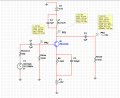
I have question about collector resistor (that will be replaced later with LC tank), that is connected between DC voltage source and collector pin of transistor.
Collector's resistor voltage is usually set as DC_VOLTAGE_SOURCE / 2 . And I choose Ic (collector current) from transistor datasheet - here I look for maximum Ic. By equation R = U / (Ic_max / 2), I get it's resistor value. And quiescent collector current is calculated by Ic_max / 2
But for tuned amplifier, how to calculate quiescent Ic - for purpose of DC biasing? Because the inductor, which is part of LC tank, has almost 0 ohms and that means also almost zero value of voltage on it.
I would need to get proper quiescent Ic,so I can later get quiescent Ib by equation Ib = Ic / beta and then calculate bias resistors as final step
I have question about collector resistor (that will be replaced later with LC tank), that is connected between DC voltage source and collector pin of transistor.
Collector's resistor voltage is usually set as DC_VOLTAGE_SOURCE / 2 . And I choose Ic (collector current) from transistor datasheet - here I look for maximum Ic. By equation R = U / (Ic_max / 2), I get it's resistor value. And quiescent collector current is calculated by Ic_max / 2
But for tuned amplifier, how to calculate quiescent Ic - for purpose of DC biasing? Because the inductor, which is part of LC tank, has almost 0 ohms and that means also almost zero value of voltage on it.
I would need to get proper quiescent Ic,so I can later get quiescent Ib by equation Ib = Ic / beta and then calculate bias resistors as final step