Bias circuit for common emitter

Thread Starter

boggydew

Joined Apr 29, 2017
13
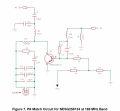
Can someone please explain how this bias circuit works. I read somewhere in Silicon Labs literature that the voltage at the base should be around 0.75V to 0.85V, but I can't see how this circuit achieves this.

Vdd = 3.3V.

I am aware inductors LM0 and L0 are for impedance matching to RF IN, but in being there they provide a DC path to ground from the base across resistor R9. Assuming that the DC resistance of these inductors is negligible, then the resistance from base to ground has to be equal or less than 51 Ohm. Even if the full 3.3V were available at junction R6, R3, R8, which it is not, the voltage divider of R8 and R9 results in a voltage at base of (51/(2000+51))*3.3V = 0.082V. Ridiculous.

With the inductors providing a path to ground how is a bias voltage present at the base? Clearly I'm missing some grand underlying principle other than V=RI.

Also, without any resistance between the emitter and ground, the impedance at the base must be very low. So even if we were able to provide a current source to the base, the voltage at the base will be clamped by the forward voltage drop of the base/emitter junction. I don't get it at all.
169Mhz.png
 

MrChips

Joined Oct 2, 2009
34,807
This is an RF amplifier which often uses a class C amplifier for greater efficiency.
The base is biased lower than what is needed for linear amplification. Hence the base DC bias is much lower than 0.7V.
 

Thread Starter

boggydew

Joined Apr 29, 2017
13
This is an RF amplifier which often uses a class C amplifier for greater efficiency.
The base is biased lower than what is needed for linear amplification. Hence the base DC bias is much lower than 0.7V.
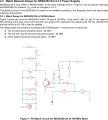
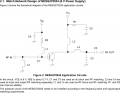
I'm not sure that's it. I'm pretty sure is class A. Page 2 of application note says Vb=0.7V, figure 7 says figure 2 applies to this case as well.

AN656-pg2.png

AN656-pg7.png
 

tim987

Joined Aug 25, 2017
11
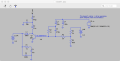
I could have messed up something with the input or output RF terminals (like a series 50 ohm resistor) ... or I could have been way off on the transistor's beta ... but I get 18 mV for the base voltage. I can post the ASC file if you want to tinker with it yourself.

The output didn't look class C (however it did look like there was something horribly wrong with my simulation). I put in 0.01 Vp-p, got out nano volts. :(
 

Attachments

Thread Starter

boggydew

Joined Apr 29, 2017
13
I'm not sure that's it. I'm pretty sure is class A. Page 2 of application note says Vb=0.7V, figure 7 says figure 2 applies to this case as well.

View attachment 135377

View attachment 135378
Thanks for your efforts. I've never used simulation software so I don't know what to make of it. RF IN is 17 to 20dBm which is around 3Vp I think. Not that I have any clue what I'm talking about. Read a million books and still don't understand how to bias a transistor. I hate RF!
 

Thread Starter

boggydew

Joined Apr 29, 2017
13
The text states that Fig. 7 is for a PA at 169 MHz. This suggests that this is Class C amp.
Your prolly right, although I was sure that I read somewhere that the quiescent collector current for this circuit/pico board was 30mA. The reason I asked is because the BJT NESG250134 is no longer available, and I wanted to swap it for MAX2601/MAX2602. MAX2602 has a biasing diode which scales the quiescent collector current to 15 times the diode current. the MAX2602 is designed to have a quiescent current of between 30 to 100mA and says it operates as AB amplifier. The MAX2601 doesn't have the diode, and the data sheet says to provide the base with 0.85V for quiescent current of 100mA.

I'm going to have to work a bit harder to understand all this.
 

Thread Starter

boggydew

Joined Apr 29, 2017
13
Your prolly right, although I was sure that I read somewhere that the quiescent collector current for this circuit/pico board was 30mA. Efficiency is 42% if this gives a clue?

The reason I asked is because the BJT NESG250134 is no longer available, and I wanted to swap it for MAX2601/MAX2602. MAX2602 has a biasing diode which scales the quiescent collector current to 15 times the diode current. the MAX2602 is designed to have a quiescent current of between 30 to 100mA and says it operates as AB amplifier. The MAX2601 doesn't have the diode, and the data sheet says to provide the base with 0.85V for quiescent current of 100mA.

I'm going to have to work a bit harder to understand all this.
 

tim987

Joined Aug 25, 2017
11
Ok - ramped the input voltage up to about 1V peak to peak, and it starts to give about the same peak to peak output. It is also rather nonlinear. Mr. Chips' suggestion that it is class-C makes sense too. I don't have a model for that transistor (and probably couldn't even make one with a data sheet).

Good luck :)
 

Thread Starter

boggydew

Joined Apr 29, 2017
13
Cheers Tim

I am interested to know why MrChips assummed it was class C because of the frequency. The two BJT I'm looking at were designed for broadband match at 900Mhz, and their data sheets also give information for operation at 470Mhz. Both operating as class AB (I think) ie with DC bias giving collector currents of 30ma and 100mA. What is it about the lower frequency of 169Mhz that predicates Class C?
 

tim987

Joined Aug 25, 2017
11
The more I think about it - the less I realize that I really know about the design of RF amplifiers ... I suppose that the reason I was thinking that class-C sounded reasonable was that the transistor in my model was biased so that the base was barely above ground (0.018V). If you go back to the base voltage divider (2k and 820 ohm) the voltage there is about 0.7 ish though ... so it isn't out of the question that the transistor could have been biased to conduct for a larger fraction of the input waveform.

However, the thing to bear in mind is that I'm just using a generic transistor from the simulator, and that the manufacturer's circuit may have behaved quite differently. I have become quite suspicious of simulations over the years.
 

MrChips

Joined Oct 2, 2009
34,807
There is nothing special about 169MHz. What is significant is the fact that the PA (power amplifier) in the example shown is tuned to 169MHz. The objective here is to produce a narrow band of frequency as efficiently as possible, i.e. not to waste power as heat in the transistor. The tuned output will suppress the harmonics of the non-linear amplifier.

If you want to create a wide band amplifier then you will need a Class A amplifier.
 

Thread Starter

boggydew

Joined Apr 29, 2017
13
The more I think about it - the less I realize that I really know about the design of RF amplifiers ... I suppose that the reason I was thinking that class-C sounded reasonable was that the transistor in my model was biased so that the base was barely above ground (0.018V). If you go back to the base voltage divider (2k and 820 ohm) the voltage there is about 0.7 ish though ... so it isn't out of the question that the transistor could have been biased to conduct for a larger fraction of the input waveform.

However, the thing to bear in mind is that I'm just using a generic transistor from the simulator, and that the manufacturer's circuit may have behaved quite differently. I have become quite suspicious of simulations over the years.
There is nothing special about 169MHz. What is significant is the fact that the PA (power amplifier) in the example shown is tuned to 169MHz. The objective here is to produce a narrow band of frequency as efficiently as possible, i.e. not to waste power as heat in the transistor. The tuned output will suppress the harmonics of the non-linear amplifier.

If you want to create a wide band amplifier then you will need a Class A amplifier.
What do you make of the bias circuit then? I seems a bit elaborate if all that is required is a simple voltage divider, ie 2 resistors, to provide a voltage less than the emitter diode drop. What bias voltage to you see at the base?
 

tim987

Joined Aug 25, 2017
11
I understand the frustration with RF biasing ... I was pretty happy with H-biasing, or universal biasing, until I started to look at some of the things in commercial equipment. Here is a link to a PDF file that I thought was pretty illuminating for me, a link from VA3IUL 's page on QSL.
 
Top