Beta testing transistors

Thread Starter

SamR

Joined Mar 19, 2019
5,488
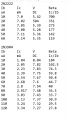
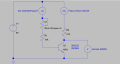
While working on an amplifier project question I was to use the measured Beta for the transistor. So I used this as my test circuit. I did not get what I think are the correct results since the Beta is all over the place. The emitter mAs are not following the base uAs in a linear fashion?
 

Attachments

rsjsouza

Joined Apr 21, 2014
425
Looking at figure 4 of this datasheet, it is a bit hard to extrapolate but it seems you may be in the saturation range of your transistor. In this region, the behaviour is highly non-linear.

In fact, bipolar transistors vary their beta depending on the DC bias (figure 3 of the same datasheet shows this).

Also, double check the method and equipment used to measure these ultra-low Ib currents - the error margin sometimes is quite large, especially if the multimeter is very close to its lowest limit of its lowest range.
 

Thread Starter

SamR

Joined Mar 19, 2019
5,488
double check the method and equipment used to measure these ultra-low Ib currents
Which is why I put the Vici and Fluke in relative mode to zero them first. And swapped it and my tried and true Fiuke around and got the same basic results. Saturation is a question and why I continued past 50 uA on the 3904?
 

Thread Starter

SamR

Joined Mar 19, 2019
5,488
I also swapped out the multi-turn trimmer for a standard pot to see the wide range effect although I didn't log it.
 

Thread Starter

SamR

Joined Mar 19, 2019
5,488
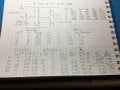
To update a bit. This is what I am trying to work out. I have an amplifier circuit using the 2N2222 and 2N3904 transistors. 10VDC bias and 0.2VACpp signal @ 10kHZ. Measuring the output ACpp with my scope. The calculated gain is more than a bit off from the measured values . I expected the 3904 to produce more gain than the 2222. It didn't? I also breadboarded and tested the Beta for both chips and did not get the expected gain. Am I overlooking something? Is this even close to correct? Including my notes if you can read my chickenscratch.


IMG_0405.JPG
Capture.PNG
 

mvas

Joined Jun 19, 2017
539
CKT #1 - 2n2222
You claim 7 ma of Ic with a 1K ohm Rc yields Vc = 5.42 Volts ?
How can this be?
7 ma flowing through a 1 K ohm Rc must drop 7 Volts.
I calculate Vc as ( 10 volt supply - 7 volt Rc drop ) = 3 Volts ?

Are you sure the 2n2222 is wired correctly, as a common emitter, and is functional ?

Are you trying to measure the Large Signal DC Gain or the Small Signal AC Gain?
How are you changing the Base Current from 10 ua => 20 ua => 30 ua => 40 ua ?
 
Last edited:

Thread Starter

SamR

Joined Mar 19, 2019
5,488
Are you trying to measure the Large Signal DC Gain or the Small Signal AC Gain?
How are you changing the Base Current from 10 ua => 20 ua => 30 ua => 40 ua ?
In order to measure the Ib and Ic to calculate the measured Beta I am using this circuit and tweaking the multi-turn pot to set the measured Ib uAs, measuring the resulting Ic mAs and Vce. Let's start with this circuit first. I have double checked the resistor values, used my transistor checker on the transistors, and swapped out the transistors. The transistors are mounted correctly. The Beta is way off? I would expect some error between calculated and experimental data, but not this. At Ib=10uA the 2n2222 Ic = 7.0mA and Vce =5.42V? Beta = 700? I don't think so...

Annotation 2019-04-11 134631.png
 

DickCappels

Joined Aug 21, 2008
10,661
It is not good practice to design a circuit with behavior that depends on Beta. Beta is going to change with temperature, current, voltage and aging. Design to cover a range of betas. Use negative feedback when possible to minimize variation.
 

Thread Starter

SamR

Joined Mar 19, 2019
5,488
NVM I found the problem. Third times the charm I guess, it was mix up in the snake pit of meter wiring connections.
 

Thread Starter

SamR

Joined Mar 19, 2019
5,488
It is not good practice to design a circuit
Purely an experimental test circuit project based on a book I'm learning from... Just an exercise to compare datasheet and calculated values versus experimental. I was expecting experimental to be ~90% of calculated due to instrument error, manufacturer variations, and tolerence %s and not even getting close to that. So something was wrong and it was me... I had checked and double checked, then found it on the third go round. Sorry for wasting your time guys and thanks for looking.
 

Thread Starter

SamR

Joined Mar 19, 2019
5,488
IMG_0408 (2).JPG I knew about the current gain and the exercise was ultimately about the voltage gain when used as an amplifier with an AC signal on top of the DC bias. I ended up w/ Beta/hFE of 120-137 for the 2N2222 ~130 and 363-327 for the 2N3904 ~345 which is a bit high, but within spec (400 max). The 2N3904 was approaching saturation at 50uA Ib. Those were the numbers I expected to find and not what I was getting so I knew there was a problem somewhere unless I was overlooking something. I had already checked the circuit thoroughly and the meter wiring at least twice before I found the wiring error with the 3 meters I had attached to the circuit for measurements and their resulting snakepit of wires piled up on my small desk. I did find it curious that the Av was higher for the lower hFE 2N2222 in the exercise. Amplifiers are new territory for me as I've usually used xstrs as a switch so it was a good lesson.
 
Last edited:

Audioguru

Joined Dec 20, 2007
11,248
The voltage gain of your circuit is the ratio of the collector resistor value divided by (the internal emitter resistance of the transistor plus the emitter resistor value).
The hFE (beta) affects the DC biasing.
Then the transistor has severe distortion because the top part of the waveform has less voltage gain than the bottom part and when the transistor is operating near cutoff its voltage gain is low and when the transistor is operating near saturation then its voltage gain is higher.
 
Top