Emitter capacitor and beta stabilization in AC mode

Status
Not open for further replies.

Thread Starter

georgefrenk

Joined Dec 24, 2023
54
One function of emitter resistor is to stabilize beta - prevent changing, when transistor temparature increases.
AC amplifiers have also emitter capacitor, which at large frequences has very small resistance, so most of current passes through this capacitor.
In this case, what happens with beta stabilization, since almost no current runs through emitter resistor and circuit behaves as being without that resistor?
 

Irving

Joined Jan 30, 2016
5,109
The emitter resistor stabilises the DC operating point, it plays no direct purpose in the actual AC gain based on the stabilised beta but obviously reduces it. Bypassing at AC allows that gain to be realised...
 

Papabravo

Joined Feb 24, 2006
22,082
The emitter resistor stabilises the DC operating point, it plays no direct purpose in the actual AC gain based on the stabilised beta but obviously reduces it. Bypassing at AC allows that gain to be realised...
Except in the case where the emitter resistor is only partially bypassed. The un-bypassed part of the emitter resistor reduces the AC gain in conjunction with the intrinsic emitter resistance.
 

Irving

Joined Jan 30, 2016
5,109
Except in the case where the emitter resistor is only partially bypassed. The un-bypassed part of the emitter resistor reduces the AC gain in conjunction with the intrinsic emitter resistance.
True, but that's relatively rare, in the vast majority of CE amplifiers the whole emitter resistor is bypassed. Though the use of a CE transistor amp these days is a dying breed I'd guess - outside of a teaching context...
 

Papabravo

Joined Feb 24, 2006
22,082
True, but that's relatively rare, in the vast majority of CE amplifiers the whole emitter resistor is bypassed. Though the use of a CE transistor amp these days is a dying breed I'd guess - outside of a teaching context...
It must have been a thing at some point if is mentioned in the textbooks we used, which to be honest are perhaps getting a bit long in the tooth.
Yeah, Malvino, A. P., Semiconductor Circuit Approximations, 1980.
 

Thread Starter

georgefrenk

Joined Dec 24, 2023
54
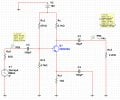
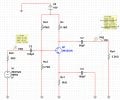
Why is inside Multisim, measured AC gain of circuit dropping a lot, when I increase emitter resistor value, which has parallel 1 uF capacitor connected? This capacitor is supposed to prevent dropping of AC gain. Just keeping resistor without capacitor normally drops AC gain. But adding capacitor in parallel should have solved this problem.
 
Last edited:

Thread Starter

georgefrenk

Joined Dec 24, 2023
54
For test frequency I tried 50 MHz, 5 MHz and 1 Mhz.
For emitter resistor, I changed from 1 kOHM to 22 kOHM while observing fall of AC gain.
 

ericgibbs

Joined Jan 29, 2010
21,439
Hi geo,
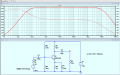
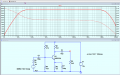
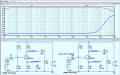
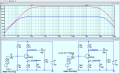
This is a compare without the bypass capacitor, the 5k version is acting as attenuator, you will find it difficult to recover the higher gain by using a 100uF.
E
EG57_ 1375.png
EG57_ 1376.png
 

Thread Starter

georgefrenk

Joined Dec 24, 2023
54
I finally got the point.

This are results of my test:

Re: 1 KOHM, paralell Ce = without => result AC gain: 1.47
Re: 1 KOHM, paralell Ce = 100 uF => result AC gain: 40.2

Re: 5 KOHM, paralell Ce = witout => result AC gain: 296 m
Re: 5 KOHM, paralell Ce = 100 uF => result AC gain: 9.01

To conclude, parallel conductor Ce helps to some amount to improve the result AC gain.
 

LvW

Joined Jun 13, 2013
2,026
One function of emitter resistor is to stabilize beta - prevent changing, when transistor temparature increases.
Just for your basic understanding:
It is not correct to state that an emitter resistor would "stabilize beta". Thats simply wrong!
Such an external component can never change an internal transistor parameter.
The effect of an emitter resistor rather is to reduce the influence of temperature changes to the current Io in the following expression:

Ic=Io[exp(Vbe/Vt(-1].

This works because any unwanted temperature induced increase in Io (and with it Ic) will somewhat rise the voltage at the emitter node Ve and, hence. will cause a corresponding reduction of Vbe=Vb-Ve. Thus, the increased voltage drop across Re will counteract the unwanted current increase.
 

MrAl

Joined Jun 17, 2014
13,702
True, but that's relatively rare, in the vast majority of CE amplifiers the whole emitter resistor is bypassed. Though the use of a CE transistor amp these days is a dying breed I'd guess - outside of a teaching context...
Hi there,

In my experience the best amplifiers use two resistors and one capacitor. That's so you can set the maximum gain due to the capacitor. With the capacitor voltage approximated as zero at the high-end frequency, that effectively grounds the emitter and that means higher distortion. With a resistor in series with the cap, the high-end frequency circuit equivalent still has some actual resistance from emitter to ground.
We could look at this in more detail if you would like to do that.
 

MrAl

Joined Jun 17, 2014
13,702
One function of emitter resistor is to stabilize beta - prevent changing, when transistor temparature increases.
AC amplifiers have also emitter capacitor, which at large frequences has very small resistance, so most of current passes through this capacitor.
In this case, what happens with beta stabilization, since almost no current runs through emitter resistor and circuit behaves as being without that resistor?
Hi,

Beta is as Beta does.

It may be called "Beta stabilization" sometimes but it does not actually stabilize the transistor Beta it stabilizes the circuit by limiting the forced Beta. The forced Beta is set by the external components while the internal Beta changes for other reasons. The apparent Beta changes as a result of the transistor collector emitter voltage. The forced Beta is kept lower than the apparent Beta so that the transistor never runs out of gain in the normal operating mode as that would increase the distortion dramatically.
The emitter resistor also plays a part in the DC biasing obviously because it provides some negative feedback for both AC and DC.
Because it has an effect on the forced Beta, it may be called Beta stabilization anyway.
 
Status
Not open for further replies.
Top