Emitter capacitor and beta stabilization in AC mode

Status
Not open for further replies.

LvW

Joined Jun 13, 2013
2,031
Hi,

Beta is as Beta does.

It may be called "Beta stabilization" sometimes but it does not actually stabilize the transistor Beta it stabilizes the circuit by limiting the forced Beta. The forced Beta is set by the external components while the internal Beta changes for other reasons. The apparent Beta changes as a result of the transistor collector emitter voltage. The forced Beta is kept lower than the apparent Beta so that the transistor never runs out of gain in the normal operating mode as that would increase the distortion dramatically.
The emitter resistor also plays a part in the DC biasing obviously because it provides some negative feedback for both AC and DC.
Because it has an effect on the forced Beta, it may be called Beta stabilization anyway.
Here a new term "forced beta" was introduced without further explanation. As to my knowledge, this term applies to switch applications (BJT in saturation) only. I think, it has nothing to do with the question under discussion (effect of Re on operational point stabilization in AC mode)
 

Irving

Joined Jan 30, 2016
5,145
Hi there,

In my experience the best amplifiers use two resistors and one capacitor. That's so you can set the maximum gain due to the capacitor. With the capacitor voltage approximated as zero at the high-end frequency, that effectively grounds the emitter and that means higher distortion. With a resistor in series with the cap, the high-end frequency circuit equivalent still has some actual resistance from emitter to ground.
We could look at this in more detail if you would like to do that.
Your experience & mine may well differ, I think the last time I actually used a CE BJT config in a real product was around 1990... since then I've taught it under BJT theory but in practice have always used ooamp for analog gain, other than in VHF+ stuff where other configurations are more common. I'm not disputing that 2R+C is a useful configuration for all the reasons stated, just that it was, in my previous experience, relatively rare, and now, given that opamps are a better solution (IMHO), maybe not often seen outside a teaching context.
 

WBahn

Joined Mar 31, 2012
32,932
Your experience & mine may well differ, I think the last time I actually used a CE BJT config in a real product was around 1990... since then I've taught it under BJT theory but in practice have always used ooamp for analog gain, other than in VHF+ stuff where other configurations are more common. I'm not disputing that 2R+C is a useful configuration for all the reasons stated, just that it was, in my previous experience, relatively rare, and now, given that opamps are a better solution (IMHO), maybe not often seen outside a teaching context.
But is that configuration used in on-chip circuitry within ICs?

I don't know the answer to that question, but it wouldn't surprise me. If so, then that is more than sufficient reason to keep teaching it, aside from the concepts that it conveys.
 

Irving

Joined Jan 30, 2016
5,145
But is that configuration used in on-chip circuitry within ICs?
Not generally as far as I'm aware, because most opamp designs are differential and use current mirrors to set the operational point - which also gives temperature stability - and opamps use multi-stage feedback (internal & external) to set gain.

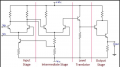
Here's a basic opamp internal... and of course many opamps are MOSFET based and so don't have this issue anyway.

1703701004643.png
 

MrAl

Joined Jun 17, 2014
13,720
Your experience & mine may well differ, I think the last time I actually used a CE BJT config in a real product was around 1990... since then I've taught it under BJT theory but in practice have always used ooamp for analog gain, other than in VHF+ stuff where other configurations are more common. I'm not disputing that 2R+C is a useful configuration for all the reasons stated, just that it was, in my previous experience, relatively rare, and now, given that opamps are a better solution (IMHO), maybe not often seen outside a teaching context.
Hi,

I had a Sony portable tape player that had the 2R+C configuration I'll see if I can find the schematic. Going back some 30 years.
I suppose if the transistor internal emitter resistance is high enough that may make a second resistor redundant. This leads me to believe that it would depend on the transistor part number.

One thing else I might note is that the impedance for a parallel RC circuit is:
Z=R/(j*w*R*C+1)

and if we take the limit as w goes toward infinity we get a plain old zero (0), so Z=0.
That means that effectively the emitter is almost tied to ground for the high end frequencies, meaning there is no high frequency limiting for the gain.
The extra R also causes a filter function to form:
Z=(j*w*C*R*R1+R1+R)/(j*w*C*R+1)

and this allows us to precisely set the -3db frequency.
For example, with R=1 and the series resistor equal to sqrt(2) we get a -3db cutoff point of 2841.56103763358Hz (provided I calculated that correctly).
That's the frequency where the impedance reaches 3db lower than max.
This is theoretical of course, and the series resistor value has to include the transistor internal emitter resistance if it is comparable.
 

MrAl

Joined Jun 17, 2014
13,720
Not generally as far as I'm aware, because most opamp designs are differential and use current mirrors to set the operational point - which also gives temperature stability - and opamps use multi-stage feedback (internal & external) to set gain.

Here's a basic opamp internal... and of course many opamps are MOSFET based and so don't have this issue anyway.

View attachment 311047
Hi again,

That schematic does not look quite complete yet. There is usually a compensation capacitor in there somewhere like the LM358 has.
It may not be for the same purpose we were talking about however.
 

LvW

Joined Jun 13, 2013
2,031
I suppose if the transistor internal emitter resistance is high enough that may make a second resistor redundant.
I do not understand this sentence. What is the "internal emitter resistance" that could "make a second resistor redundant"?
For example, with R=1 and the series resistor equal to sqrt(2) we get a -3db cutoff point of 2841.56103763358Hz (provided I calculated that correctly).
That's the frequency where the impedance reaches 3db lower than max.
This is theoretical of course, and the series resistor value has to include the transistor internal emitter resistance if it is comparable.
For my opinion, a 3db highpass corner frequency depends also on the used capacitor. Or am I wrong?
 

MrAl

Joined Jun 17, 2014
13,720
I do not understand this sentence. What is the "internal emitter resistance" that could "make a second resistor redundant"?

For my opinion, a 3db highpass corner frequency depends also on the used capacitor. Or am I wrong?
Hi,

Transistors in theory have an equivalent internal resistance in series with the emitter. Looking at it this way it makes a little more sense when dealing with an external emitter resistor also.

Yes the capacitor value was not mentioned, I think I used C=100uf. However, all you have to do is calculate the impedance of a capacitor in parallel with a resistor and that will get you started.
 

Irving

Joined Jan 30, 2016
5,145
Hi again,

That schematic does not look quite complete yet. There is usually a compensation capacitor in there somewhere like the LM358 has.
It may not be for the same purpose we were talking about however.
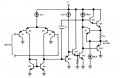
It is for a basic opamp, where compensation, if needed, is done externally. The LM358, by comparison, is much more sophisticated design:

1703781527861.png

It features an inverted (PNP) input stage, to allow inputs to operate at or just below ground on a single supply rail, and compensation to maintain stability when used as a unity-gain voltage follower.
 

LvW

Joined Jun 13, 2013
2,031
Hi,

Transistors in theory have an equivalent internal resistance in series with the emitter. Looking at it this way it makes a little more sense when dealing with an external emitter resistor also.
I think, this is a severe misunderstanding of the transistors working principle resulting from a false interpretation of the transconductance gm.
It is not true that there is something like "an equivalent internal resistance with the emitter" that "may make a second resistor redundant." (as you wrote in your former post.)

Such a misinterpretation results from an equivalent circuit diagram which uses the quantity 1/gm=re as a transistor parameter.
It is to be noted that (a) this quantity does not belong to the emitter region and (b) it is not a resistance at all.

The formula for the gain of a RE-stabilized common-emitter stage is
A=-gmRc/(1+gmRE).
The reason for the misinterpretation is the following notation, which unfortunately can be found in some publications (with re=1/gm):
A=-Rc/(re+RE).

The corresponding small-signal equivalent diagram showing an external RE in series with this "mystic" quantity re is (a) totally superfluous (there are two others) and (b) totally misleading (as we can see here).
The biggest mistake - resulting from such a view - is to believe that this "resistor" re would act in series with the external resistor RE and support the negative feedback (stabilization). Of course, this cannot be the case.
 

MrAl

Joined Jun 17, 2014
13,720
I think, this is a severe misunderstanding of the transistors working principle resulting from a false interpretation of the transconductance gm.
It is not true that there is something like "an equivalent internal resistance with the emitter" that "may make a second resistor redundant." (as you wrote in your former post.)

Such a misinterpretation results from an equivalent circuit diagram which uses the quantity 1/gm=re as a transistor parameter.
It is to be noted that (a) this quantity does not belong to the emitter region and (b) it is not a resistance at all.

The formula for the gain of a RE-stabilized common-emitter stage is
A=-gmRc/(1+gmRE).
The reason for the misinterpretation is the following notation, which unfortunately can be found in some publications (with re=1/gm):
A=-Rc/(re+RE).

The corresponding small-signal equivalent diagram showing an external RE in series with this "mystic" quantity re is (a) totally superfluous (there are two others) and (b) totally misleading (as we can see here).
The biggest mistake - resulting from such a view - is to believe that this "resistor" re would act in series with the external resistor RE and support the negative feedback (stabilization). Of course, this cannot be the case.
You need to realize that there are two basic types of models for components.
1. Physical, resulting from the physics of the transistor.
2. Behavioral, resulting from empirical data.

The 're' model includes this emitter resistor. It DOES NOT MATTER if it is really in there or not, the model still functions as it should.
I am very surprised to read a reply that insists that there is no such thing as 're'. It's in a lot of books and web sites and so why is it that you don't understand this. It does not matter if your notes are the only notes you ever use, as other people have their notes too. When you quote equations that miss the entire premise of the models it does not do any good because you've already rejected the model, a model that has been around for as long as I can remember.

This may describe the basics of it and probably goes into more detail:
Transistor Re Model for common emitter, common base and emitter follower (cxi1.co.uk)

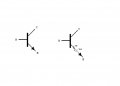
I like to draw it like the one on the right:

Transistor_re-1.png
 
Last edited:

michael8

Joined Jan 11, 2015
472
The gain and bandwidth of the transistor depends on the emitter current (in addition to any unpassed external emitter resistor).

So what you are seeing is that when you raise the emitter resistance it lowers the transistor current which lowers the transistor
gain. You should adjust the bias for the transistors so that they are running with the same emitter current with the different emitter
resistors to make a real comparison.
 

MrAl

Joined Jun 17, 2014
13,720
The gain and bandwidth of the transistor depends on the emitter current (in addition to any unpassed external emitter resistor).

So what you are seeing is that when you raise the emitter resistance it lowers the transistor current which lowers the transistor
gain. You should adjust the bias for the transistors so that they are running with the same emitter current with the different emitter
resistors to make a real comparison.
Hi,

I believe it changes the slope of the collector voltage vs input voltage which would be the voltage gain (common emitter circuit). I'd have to check that though.
Through re and Beta the characteristic would closely match a spice model over the limited range usually seen in AC amplifiers.
I had shown examples elsewhere on this site.
 
Status
Not open for further replies.
Top