Bernina 1080 sewing machine repair help

Thread Starter

usnavystgc

Joined Jan 6, 2012
2
I'm working on a Bernina 1080 sewing machine and I'm afraid I messed it up. Here's what happened
The machine was overheating so I figured I'd install a fan. While looking to locate a voltage source for the fan, I inadvertently shorted a mosfet IRF720 from gate to source. The machine immediately shut off. Fuse is good.
I replaced the mosfet (which tested bad) but the machine is still not powering up.
Does anyone have any suggestions on how to try to fix this? Schematics seem unobtainable. Will the capacitors downstream from the mosfet be a good place to start?
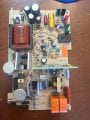
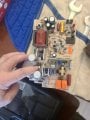
Pics of the board in question below88add522-efed-4e12-bd33-9af2587b8f71.jpg71299a2a-ee61-4ae9-8077-5fce3d1290e4.jpg
 

Classified

Joined Nov 16, 2024
1
The overheating issue would be more a matter of actual drag in the mechanism requiring more power (unless it is being run under significant load on a long extension cord.), and that drag could be related to gelled lubricant, a stray pin, or other debris in the mechanism. Adding aditional hear sinking to the existing heat sinks would have potentially been the better approach. If you are still stuck, assuming you have not done so already, check the other transistors and rectifiers in the vicinity of the transistor that failed. And though rare, check the "new" Mosfet too as it "may" have been bad initially.

Did you do any voltage checks after the "event"? See if the UC3844 is getting power at pin 8. Datasheet can be downloaded here https://docs.rs-online.com/513b/0900766b80034724.pdf (It is one of those IC's that are made by multiple manufacturers.). If there is no voltage on pin 8, you need to work your way back to the power input until you find a voltage, and you may find that the device soldered to that point is what has failed. For safety, you may want to use an isolation transformer while checking.

If nothing is apparently bad in testing the semiconductors (including an electrical check of the fuse and not just a visual), check the inrush current limiter (the black disk near the fuse. Look up the number on the part itself to find the datasheet for specs at room temperature.) to make sure it did not burn out (they usually fail more visibly, but there are some exceptions.) It is a negative temperature coefficient (NTC) Thermistor from what I can see from the portion of the number visible in your photo. And check the larger power resistors as some can act like fuses as well. Though this is an absolute worst case scenario to get this far without some resolution.

Caps are usually somewhat robust, and would usually be the last things to look at unless they were Tantalum types.
 
Top