Facebook
 Google
 GitHub
 Linkedin

A long time ago at school I was taught that a capacitor was like a barrel with a hole at the bottom (+) and a hole at the top (-). Electricity would act like water and come in at the bottom (+) and begin filling the barrel until it eventually was full/charged enough to allow the flow of water/electricity to flow out the top (-).
After reading about capacitors again it appears that this is actually the reverse of what I was taught? Only when the barrel was full does the flow stop.
Experiment
Battery (measuring 2.5v according to my multimetre)
LED
Electrolyte Capacitor 100uF (10v?)
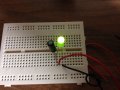
Attached Battery + to + leg of Cap
- Leg of Cap to + of LED
- Leg of LED to - Battery
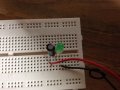
LED was lit and waited 20 or so seconds. LED has not flashed or changed at all.
Should the capacitor not fill and stop the flow of electricity thus turning off the LED?
After reading about capacitors again it appears that this is actually the reverse of what I was taught? Only when the barrel was full does the flow stop.
Experiment
Battery (measuring 2.5v according to my multimetre)
LED
Electrolyte Capacitor 100uF (10v?)
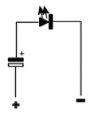
Attached Battery + to + leg of Cap
- Leg of Cap to + of LED
- Leg of LED to - Battery
LED was lit and waited 20 or so seconds. LED has not flashed or changed at all.
Should the capacitor not fill and stop the flow of electricity thus turning off the LED?
Last edited: