Basic mesh method

Thread Starter

halp

Joined Oct 11, 2009
8
Hello;

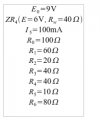
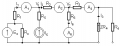
I'm supposed to calculate I1, I2, I3, I6, but nothing's working for me. According to the superposition method, they are 0, 100, 12.5, and 87.5 mA respectively, but I can't get these results using the mesh method. The equations I'm using are as follows;

R0*I1 + R1*I1 - R5*I5 = E0
R5*I5 + R2*I2 + R6*I6 = 0
-R6*I6 - R34*I3 = -E4
I1 + I5 = I2
I2 + I3 = I6

Could anyone correct them? Or perhaps it's the superposition results that are wrong?
 

Attachments

Last edited:

Ratch

Joined Mar 20, 2007
1,070
halp,

I'm supposed to calculate I1, I2, I3, I6, but nothing's working for me. According to the superposition method, they are 0, 100, 12.5, and 87.5 respectively, but I can't get these results using the mesh method. The equations I'm using are as follows;

R0*I1 + R1*I1 - R5*I5 = E0
R5*I5 + R2*I2 + R6*I6 = 0
-R6*I6 - R34*I3 = -E4
I1 + I5 = I2
I2 + I3 = I6

Could anyone correct them? Or perhaps it's the superposition results that are wrong?
First, remove and throw away R0, because E0 will still be E0 no matter what the value of R0 is. I don't know what R34 is in the third equation. Theveninize R5 and I5 to a I5*R5 voltage in parallel with R5. Then throw away the parallel R5, because the voltage will be the same no matter what the parallel resistance is. So the Thevenized voltage will be (I2-I1)R5. Now write 3 equations for I1,I2, and I3.

E0 -R1*I1 - (I2-I1)R5 = 0
(I2-I1)R5 - I2*R2 - (I2 + I3)R6 = 0
(I2 + I3)R6 + I3*R3 -6 + I3*Rw = 0

After substituting the given values and solving for I1,I2, and I3, we get
I1 = 0.2 amps
I2 = -0.1 amps
I3 = 0.0875 amps

Then I5 and I6 can be found from the above 3 values.

Ratch
 
Last edited:

Ratch

Joined Mar 20, 2007
1,070
halp,

Well, these results don't check out with lab results of -3.4, 96.7, 12.3 and 84.4 mA.
Calculate the voltages around the three meshes using the calculated currents. If correct, what does that say about the lab work?

Ratch
 

Thread Starter

halp

Joined Oct 11, 2009
8
For the second mesh and your results, there's 10 * 0.1 - 0.1 * 20 -0.9125 * 80, which is far from zero. And I checked the lab results with other people, and I'm pretty confident that they are right.
 

Ratch

Joined Mar 20, 2007
1,070
halp,

For the second mesh and your results, there's 10 * 0.1 - 0.1 * 20 -0.9125 * 80, which is far from zero. And I checked the lab results with other people, and I'm pretty confident that they are right.
Fair enough, let's check it out.

V1 = I5*R5 = (I2-I1)R5 = (-0.1 - 0.2)10 = -3 volts
V1 = E0-I1*R1 = 9 -0.2*60 = -3 volts

V1 has been checked two ways.

V2 = V1 -I2*R2 = -3 -0.1*20 = -1
V2 = 6 - I3*Rw -I3*R3 = 6 - 0.0875*40 - 0.0875*40 = -1
V2 = I6*R6 = (I2 + I3)R6 = (-0.1 + 0.0875)*80 = -1

V2 has been checked 3 ways.

So the calculated values of I2,I2, and I3 have been used to calculate the values of V1 and V2. Did I make a mistake in my calculatons?

Ratch
 

Thread Starter

halp

Joined Oct 11, 2009
8
halp,


Fair enough, let's check it out.

V1 = I5*R5 = (I2-I1)R5 = (-0.1 - 0.2)10 = -3 volts
V1 = E0-I1*R1 = 9 -0.2*60 = -3 volts

V1 has been checked two ways.

V2 = V1 -I2*R2 = -3 -0.1*20 = -1
V2 = 6 - I3*Rw -I3*R3 = 6 - 0.0875*40 - 0.0875*40 = -1
V2 = I6*R6 = (I2 + I3)R6 = (-0.1 + 0.0875)*80 = -1

V2 has been checked 3 ways.

So the calculated values of I2,I2, and I3 have been used to calculate the values of V1 and V2. Did I make a mistake in my calculatons?

Ratch
Actually, I5 is given, so V1 = 0,1 * 10 = 1V.

And it turns out that I am supposed to calculate that using the node voltage method, and I've never done that. Could anyone guide me through this example?
 

Ratch

Joined Mar 20, 2007
1,070
halp,

And it turns out that I am supposed to calculate that using the node voltage method, and I've never done that. Could anyone guide me through this example?
Sorry for the delay in answering.

I see now that my previous solution is in error, so let's do the problem both ways and see how they check out.

Mesh method:

Left and middle loops combine for a supermesh because they have a common current source of 0.1 amps.

Going around the supermesh we get Eo-R1*I1-(0.1+I1)*R2-(0.1+I1+I3)*R6 = 0
Going around the right loop we get (0.1+I1+I3)*R6+I3*R3-6+I3*Rw = 0
Substituting values and solving we get I1=0 and I3=-0.0125 amps

Node method:

Combining the currents for node V1 we get (Eo-V1)/R1+0.1 = (V1-V2)/R2
Combining the currents for node V2 we get (V1-V2)/R2+(6-V2)/(R3+Rw) = V2/R6
Substituting values and solving we get V1 = 9 volts and V2 = 7 volts.

The results appear to check with each other.

Ratch
 
Top