Basic audio amp - bad book examples?

WBahn

Joined Mar 31, 2012
32,844
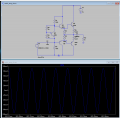
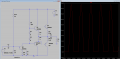
I have a wrong connection on the Darlington bottom pnp transistor, but after I fixed it nothing has changed.

Also, I have increased the voltage from 5V to 10V and there is no current gain:
View attachment 350450
View attachment 350451

why is that?
I've asked this before. When YOU talk about current gain, exactly WHICH currents are you referring to?

Current gain is a ratio of the current at one point in the circuit to the current at another point. Which two currents are you taking the ratios of?
 

WBahn

Joined Mar 31, 2012
32,844
Instead of a plot that is a smear of many thousands of cycles, please adjust your simulation so that it consists of just a few cycles.
 

Thread Starter

mondo90

Joined May 16, 2025
122
How much current would you get through 8 Ω if it were connected directly to 5 V?
5/8 = 625mA
I've asked this before. When YOU talk about current gain, exactly WHICH currents are you referring to?

Current gain is a ratio of the current at one point in the circuit to the current at another point. Which two currents are you taking the ratios of?
It's not that I am comparing input current to output - all I am saying is the addition of Darlington pair transistor does NOT improve the output current (current gain). As you can see on the attached waveforms. So, it doesn't matter to me what is the current gain, whether it is 20, 50 or 200, whether it is the ratio of input current to output current, all I question here is the role of the darlington configuration due to zero effect on output current (the current on R5, 8ohm speaker)

Instead of a plot that is a smear of many thousands of cycles, please adjust your simulation so that it consists of just a few cycles.
That also doesn't make any difference as you can see the current is trapped between -100 and 100mA:
1749007784133.png
 

Ian0

Joined Aug 7, 2020
13,132
90mA is the current you get with 720mV across 8Ω,
If you want more output current, you need more output voltage.
If you want more output voltage, you need more gain or more input signal.
At the moment, you don't have any voltage gain.
You probably have x10000 current gain, but you are not using it because you are limited by the output load.
 
Last edited:

WBahn

Joined Mar 31, 2012
32,844
5/8 = 625mA
So that sets a max in an ideal world. Now let's chip away at it for the circuit in use.

What's the maximum possible base voltage on Q1? Assuming your signal source is being powered by the same 5 V supply, that would be 5 V. That's also ignoring pesky things like the voltage drop across R1 (we can come back to that if we need to). That makes the max voltage at the emitter Q1 something like 4.4 V and, from there, the max emitter voltage on Q3 around 3.8 V. Assuming that C1 looks like a short at 10 kHz, that makes the max current in the R5,R6 combination about 450 mA?

One big thing that we are ignoring right now is the impact of R3. So we should come back to that a bit later.

This gives an upper limit on the current assuming that the base of Q1 can be taken all the way up to 5 V. But can it?

What is the quiescent voltage at the base of Q1 with the two 470 Ω resistors and the two diodes? It's going to be something around 3.9 V, so (assuming C2 is essentially a short), the max base voltage on Q1 should get up fairly close to 5 V, assuming that things are ideal, which they probably aren't.

So let's think a bit about R3. If Q3 is in the active region, how much current has to be flowing in R3? If there's 0.6 V across the base-emitter junction of Q3 and R3 is a 1 Ω resistor, then that's going to be 600 mA.

How reasonable is that?

Look at the node voltages such as the base and emitter voltages for Q1 and Q3. What is Vbe for both transistors? Is Q3 even turning on?

Also, what transistors are you using? Don't just use the generic NPN/PNP transistors. Pick models for real transistors (reasonable ones) so that you can consider the information in the data sheet.
 

0ri0n

Joined Jan 7, 2025
173
So, it doesn't matter to me what is the current gain, whether it is 20, 50 or 200, whether it is the ratio of input current to output current, all I question here is the role of the darlington configuration due to zero effect on output current (the current on R5, 8ohm speaker)
Well, it has zero effect because you botched the circuit again. Try to understand first how the darlington configuration should work and why yours doesn't.
Q3, Q4 can not do their job because R3, R4 are still way to small. The book is very clear on the values of those two resistors. The Vbe multiplier probably needs some adjustment too.
 

AnalogKid

Joined Aug 1, 2013
12,130
As in a previous post, your values for R3 and R4 are incorrect.

BUT before you change them, show us the current waveform through R3.

ak
 
Last edited:

AnalogKid

Joined Aug 1, 2013
12,130
How much current would you get through 8 Ω if it were connected directly to 5 V?
Ah, but it isn't. Thanks to C1, the peak output voltage is 2.5 V. Also, there is no global DC feedback, so IRL the actual output stage DC operating point (and thus the peak current) is unknown.

ak
 

Thread Starter

mondo90

Joined May 16, 2025
122
What's the maximum possible base voltage on Q1? Assuming your signal source is being powered by the same 5 V supply, that would be 5 V. That's also ignoring pesky things like the voltage drop across R1 (we can come back to that if we need to). That makes the max voltage at the emitter Q1 something like 4.4 V and, from there, the max emitter voltage on Q3 around 3.8 V. Assuming that C1 looks like a short at 10 kHz, that makes the max current in the R5,R6 combination about 450 mA?
3.8V on 8ohm resistor? This is impossible - there is 5V - 2x0.7 (Vbe drop) that is already 3.6, next this 3.6 is peak to peak, so the max RMS voltage is ~1.3V
Also, what transistors are you using? Don't just use the generic NPN/PNP transistors. Pick models for real transistors (reasonable ones) so that you can consider the information in the data sheet.
Good suggestion, I have just added NPN 2n3904 and PNP 2n5401


As in a previous post, your values for R3 and R4 are incorrect.

BUT before you change them, show us the current waveform through R3.

ak
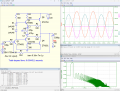
Here is R3 current waveform
1749072965993.png

As you can see I have modified the circuit a little bit - the voltage supply is now 10V as I can't effectively power 3W 8ohm speaker from 5V and class AB amplifier like this one. Next I have added actual transistors I use, and added one stage of voltage gain.

When I connect the extra 2 transistors on the far right, even with the exact values as in the book R3,4 = 150 and R2,8 0.47 ohm they output some current yes, but at the expense of lower Q1,Q2 current and therefore the end result is the same.

This is what I have so far with my new design:
1749073284395.png

4V peak to peak, it is certainly an improvement by I was expecting much more from 10V supply. But this is probably the best I can do because, Q6 needs to maintain 0.8V Vbe and since my input signal is 1V I am already looking at 10V - 2.8 = 7.2 - this is my swing "bandwith". Next I need to remove two diodes drop and that gives me ~5.8 peak to peak, finally minus two Vbe drop = ~4V peak to peak.
 
Last edited:

Thread Starter

mondo90

Joined May 16, 2025
122
Also, I tried to breadboard it, I have replaced the two D1,D2 diodes with a single LED diode, R3,4 with a wire and the output was very low, in mV range. No sure what could be wrong but first suspcion is I assumed 1V peak input signal while from what I see the audio jack output signal from a laptop is more like 0.1V peak
 

AnalogKid

Joined Aug 1, 2013
12,130
Also, I tried to breadboard it, I have replaced the two D1,D2 diodes with a single LED diode,
The forward voltage of a single LED can be anything from 1.5 V to almost 4 V. That could be a problem. Why did you make this change? Did you think it would improve something?

Also, what is the DC voltage at the Q6 collector with no signal? After that, what is the AC signal at that point?

ak
 

Thread Starter

mondo90

Joined May 16, 2025
122
The forward voltage of a single LED can be anything from 1.5 V to almost 4 V. That could be a problem. Why did you make this change? Did you think it would improve something?
Yes, that's a good point, I was predicting that too. I replaced it with a pair of diodes IN4007, and verified on the breadboard that it drops ~0.7V, the volume has improved a bit.
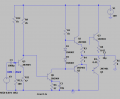
So I have improved previous circuit with this one, assuming 10mV peak input signal I have added one more stag of amplification:
1749106057136.png

This also gives 4V peak to peak in the simulation and on the breadboard I see my multimeter shows 1,4V in AC mode. This makes sense since 1,4 is RMS value. It plays but there is a lot of noise.. can it be only due to the breadboard alone? Or there is something else I miss here?
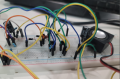
Here is how it looks in real word:
1749106627635.png
 

Thread Starter

mondo90

Joined May 16, 2025
122
Bordodynov, thank you for the example, it is helpful. However, can you elaborate a bit on how did you derive the R7 value in the feedback path? Plus why did you use this feedback in the first place? For instance, I have tried to do the same using my schematic above and all I see is it drastically lower the output voltage - from 3V to milivolts range.
 

Bordodynov

Joined May 20, 2015
3,431
R7 is β times larger than R1. I just wanted to get half the power (a little less than 0.7V) on these resistors. R7 and R8 define negative feedback and voltage gain. Using negative feedback reduces distortion.
 
Top