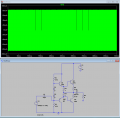
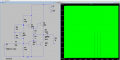
Basic audio amp - bad book examples?

WBahn

Joined Mar 31, 2012
32,840
Or they also show this:
View attachment 350234

Again, it only lowers the gain
When you say "lowers the gain", the current gain from where to where?

You have two Darlington pairs, so the current gain from Vin (i.e., the base current into TR3/TR4) should be approximately the product of the betas of the two transistors in each pair.

But you also pick up a lot of dead band with the circuit as shown -- something in the range of 2.4 V to 2.8 V.
 

Thread Starter

mondo90

Joined May 16, 2025
122
When you say "lowers the gain", the current gain from where to where?

You have two Darlington pairs, so the current gain from Vin (i.e., the base current into TR3/TR4) should be approximately the product of the betas of the two transistors in each pair.

But you also pick up a lot of dead band with the circuit as shown -- something in the range of 2.4 V to 2.8 V.
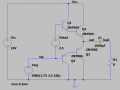
When I say lowers the gain I mean the Darlington pair lowers the gain of a single push pull pair. According to the book it is supposed to increase the voltage gain but it doesn't in my LTspicie simulations. I believe it happens because I have extra Vbe drop, voltage across the load is lower and so is the current.

Also, I think the absolute maximum voltage gain I can get from emitter follower is the Vbe peak, regardless of what stages are preceding it.
 

0ri0n

Joined Jan 7, 2025
173
They are with resistors but also with a comment "the RE1/2/3/4 resistors should be much smaller than RL, otherwise they will dissipate a lot of power" so that's why I removed them because a resistor < 8 Ohms won't make much difference.
The resistors are essential and make a lot of difference between being and not being there. This is what the book says:

"RE1 and RE2 must be much less than RL (4 Ohm) but should be as high-valued as possible
to achieve maximum bias stability.
RE1=RE2=0.47 Ohm is a satisfactory compromise. RE3 and RE4 may be 150 Ohm,
establishing in TR3 and TR4 a quiescent current of 5 mA over and above the
quiescent base currents of TR1 and TR2."


By removing Re1/2/3/4 you cut off TR1/TR2 and now the pre-drivers TR3/TR4 have to do the work.
 
Last edited:

crutschow

Joined Mar 14, 2008
38,507
Instead of a Darlington pair, you could use a Sziklai pair (sometimes called a complimentary Darlington).
It basically has the current gain of a Darlington, but only one base-emitter drop.
And the base-emitter drop is from the low-power half of the pair, so is easier to bias and stabilize since any power heating of the high-current transistor doesn't affect the base-emitter drop.
 

WBahn

Joined Mar 31, 2012
32,840
When I say lowers the gain I mean the Darlington pair lowers the gain of a single push pull pair. According to the book it is supposed to increase the voltage gain but it doesn't in my LTspicie simulations. I believe it happens because I have extra Vbe drop, voltage across the load is lower and so is the current.

Also, I think the absolute maximum voltage gain I can get from emitter follower is the Vbe peak, regardless of what stages are preceding it.
The Darlingtons are not going to increase the voltage gain -- they will increase the current gain.

How are you calculating your voltage gain? Be sure to account for the Vbe offset -- it is an offset, it is not part of the gain. The gain is the small signal gain -- the ratio of the change in output to the change in input. Your output drivers are emitter-followers, so the voltage gain will be a bit less than unity.

Consider the following:

1748669235977.png

For simplicity, I'm using 2N3904/2N3906 transistors for both stages of the driver. The purpose of Vdead is to just remove the deadband. It is a simplification that replaces the Vbe multiplier, but serves the same purpose. The Vsig is set with a DC offset of 3.75 V to move the midpoint of the bases to about 5 V.

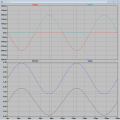
Here is the result. The top shows that the deadband is just barely removed. The bottom shows the input and output voltage signals.

1748669646059.png
Using the cursors (not shown), the peak-to-peak amplitude of V(load) is 4.41 V while that of the V(sig) is signal is 5.00 V, for a gain of 0.88.

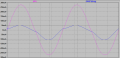
The top plot is now changed to show the signal current and the load current. Note that the current gain is so high that the signal current is multiplied by 10k. The negative is because the current direction is defined as positive flowing into Pin 1 of a device. The current gain of the top part is about 50k, while the current gain of the bottom is about half that -- this reflects that NPN transistors typically have more gain than their PNP counterparts.

1748670018896.png

See what you get if you repeat this simulation with the Q2/Q3 stage removed and the deadband voltage lowered correspondingly,
 

AnalogKid

Joined Aug 1, 2013
12,130
From post #16:

This is my current design:
View attachment 350229

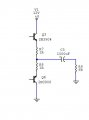
It gives a nice voltage and current gain - 250mV peak voltage and 30mA current. I have added transistors Q5 and Q6 following book suggestion to get more current however they don't seem to have any effect. A quick look the diagram gives me an answer - if base is at the same potential as emitter they are bot off! So how is it supposed to work?
It doesn't, you have the base-emitter junctions of Q5 and Q6 shorted out, so the output is being driven by Q1 and Q2 only.

The resistors you removed are important. And that notation is incorrect. Re3 and Re4 do not have to be much smaller than the load impedance. Their job is not to provide additional output current, although they do a little bit. Their real job is to provide a current path to turn off TR1 and TR2. TR3 and TR4 are emitter followers, and those are the emitter resistors.

Re1 and Re2 are emitter ballast resistors. No two transistors are alike, so no two base-emitter junction voltages (Vbe or Vf) are exactly equal. Also, the base-emitter voltage is very temperature-dependent; it decreases with increasing temperature. That means that if you adjust RV1 for a small bias current through the output transistors when the circuit is cold, that static output current will increase as the components warm up during use. The warmer they get, the lower the Vbe, and the lower the Vbe, the higher the static current and the warmer they get. This is called thermal runaway, and was a big surprise when early audio amplifier manufacturers began to transition from tubes to transistors. (Fun fact: field effect transistors do not do this.)

Re1 and Re2 do dissipate power, but that power is not wasted; it is the cost of doing business. With those resistors in the circuit, the voltage from the top of TR5 to the output now is not just the two Vbe drops across TR3 and TR1; it is the combination of those two temperature-dependent voltages plus the drop across Re1 which is temperature-stable. This lessens the overall temperature-related variations, so the bias current setting is much more stable. The value of Re1 is a trade-off between power dissipation and circuit stability. As a starting point, Re3 can be somewhere in the region of 10x to 50x Re1.

ak
 

Ian0

Joined Aug 7, 2020
13,132
Instead of a Darlington pair, you could use a Sziklai pair (sometimes called a complimentary Darlington).
It basically has the current gain of a Darlington, but only one base-emitter drop.
And the base-emitter drop is from the low-power half of the pair, so is easier to bias and stabilize since any power heating of the high-current transistor doesn't affect the base-emitter drop.
But it's much more prone to instability, and to shoot-through when recovering from clippiing.
 

MrChips

Joined Oct 2, 2009
34,812
Class AB audio amplifier development

You start with the output push-pull common collector stage and work backwards.

Common collector (or emitter follower) provides current gain and unity voltage gain. The purpose is to supply current at low impedance output.

Emitter resistors R7 and R8 limit the short circuit DC current and provide negative feedback.
DC blocking capacitor C3 is required when using a single voltage supply.

If you connect the base together you are creating a Class B amplifier which comes with significant cross-over distortion.

audio amplifier development1.jpg

We need to bias the transistors towards conduction by forward biasing the base-emitter junction. This moves the transistors towards the linear region, or Class A amplifier. Since this is a compromise between Class A and Class B, we call this a Class AB amplifier.


Biasing the push-pull transistor pair for Class AB operation

audio amplifier development2.jpg

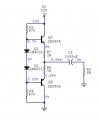
One simple method of applying proper base bias is with two diode drops. As you can observe with the DC voltages from simulation, the base-emitter voltage is about 0.7 V, in other words, the forward bias voltage of a single PN silicon diode.

Let's do some current calculations.
At peak voltage output, the current through Q3 is 6V/9Ω = 667 mA.
If we assume a current gain, beta, of 100, we need a base-emitter current of about 7 mA.
Current supplied by R5 is 5.3V/470Ω = 11 mA.
So that should be enough.

What is the power output of this Class AB push-pull stage?
If we simplify the calculation using a peak-to-peak voltage of 12 V, this gives about 4 V rms.
Power into an 8-ohm load is 2W. To be on the conservative side, without clipping, we will derate this to 1 W.

(Note: I am using 2N3904/2N3906 pair simply for demonstration purposes even though they are only rated for 200 mA. With these transistors, you will still get ample listening power, not rock band stage performance! Even 500 mW output would make it a successful attempt.)

The next step is to add the driver stage.
 

Ian0

Joined Aug 7, 2020
13,132
Why?
Also why?
Certainly I wouldn't think that would be an issue unless it's a rock band amplifier.
1. Because it forms a common-emitter amplifier with 100% negative feedback around the pair, and phase shift due to the Miller effect.
(The Sziklai is not quite as bad as the CFP (Complementary Feedback Pair) which is the same thing but with gain. Because of the gain-setting resistors, the phase shift due to the Miller effect reaches 180° at a lower frequency)
2. The complementary emitter follower reverse biases the power transistor that is OFF which speeds up the removal of charge. The Sziklai relies solely on the base-emitter resistor to turn it off.
3. Yes, I do only think of amplifiers as rock band amplifiers. I have considerable expertise in customer stupidity when applied to power amplifiers.
 

crutschow

Joined Mar 14, 2008
38,507
Because of the gain-setting resistors, the phase shift due to the Miller effect reaches 180° at a lower frequency)
I was referring only to the stage without gain.
Any needed gain can be provided by the preceding stages.
The complementary emitter follower reverse biases the power transistor that is OFF which speeds up the removal of charge. The Sziklai relies solely on the base-emitter resistor to turn it off.
Again that would only seem to apply to an overdriven amp, and that doesn't normally occur for home high-fidelity audio listening, only rock band amplifiers which I have no interest in, or ever listening to that distorted sound, which is an assault on my ears. :rolleyes:
 

Ian0

Joined Aug 7, 2020
13,132
I was referring only to the stage without gain.
Any needed gain can be provided by the preceding stages.
Again that would only seem to apply to an overdriven amp, and that doesn't normally occur for home high-fidelity audio listening, only rock band amplifiers which I have no interest in, or ever listening to that distorted sound, which is an assault on my ears. :rolleyes:
If you sell an amplifier, someone will overdrive it, and it it doesn't deal well with clipping it's an amplifier that will have to be repaired under guarantee.
 

AnalogKid

Joined Aug 1, 2013
12,130
And probably also sue you for the speakers it destroyed.
Way back, when I worked in a TV repair shop, we were the only place in town that re-built speakers. Mostly they were things like 4x6 oval speakers in a table radio that someone's kid had poked with a pencil, or some other stupid problem.

BUT

There were some that came back about every 6 - 9 months or so, with the cone burned up. These were 15" JBL's with a 3" or 4" voice coil, from bass players, and the speaker had literally burst into flames. Fun times.

ak
 

crutschow

Joined Mar 14, 2008
38,507
If you sell an amplifier, someone will overdrive it, and it it doesn't deal well with clipping it's an amplifier that will have to be repaired under guarantee.
Certainly building am amp for commercial sale is a different kettle of fish than building one as a hobbyist, which is the gist of this thread.
 

Thread Starter

mondo90

Joined May 16, 2025
122
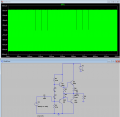
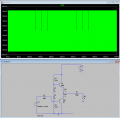
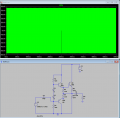
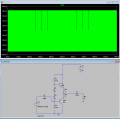
I have a wrong connection on the Darlington bottom pnp transistor, but after I fixed it nothing has changed.

Also, I have increased the voltage from 5V to 10V and there is no current gain:
1749006074770.png
1749006119229.png

why is that?
 
Top