Basic audio amp - bad book examples?

Thread Starter

mondo90

Joined May 16, 2025
122
Hi,

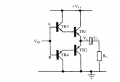
I stumbled upon this while reading "Transistor circuit techniques" by G.J.Richie:
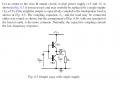
1748372148762.png

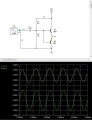
Does it have any chance to work? I have slightly modified this circuit to provide a proper bias in LTSpicie:
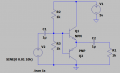
1748372529711.png
and here is what I get out of it (green signal is voltage on R3, blue on the C2)
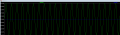
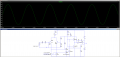
1748372731055.png

So we can see that the voltage BE of Q1 is the same meaning this transistor is OFF. This is not surprising as C2 blocks DC and the 10mv base signal is not enough to turn it back on. More so, Q2 will never turn ON because collector voltage is always more positive than the base (during negative input swing). So I don't know what to think about this book but it is certainly confusing. (Also, they reference figure 8.5b which doesn't even exists in the book)
 

Ian0

Joined Aug 7, 2020
13,097
Yes, it's a complementary emitter follower, on which most bipolar amplifier designs are based. It will work when the input signal is more than 1.4V peak-to-peak.
When employed in an amplifier, either there is global feedback around it and the rest of the drive circuit, and/or it is biassed with a couple of diodes.
 

Ian0

Joined Aug 7, 2020
13,097
If you have enough gain and enough feedback, you don't need bias:

Screenshot from 2025-05-27 21-05-06.png
Harmonic Frequency Fourier Normalized Phase Normalized
Number [Hz] Component Component [degree] Phase [deg]
1 1.000e+3 1.500e+1 1.000e+0 90.03° 0.00°
2 2.000e+3 4.065e-5 2.710e-6 -166.50° -256.53°
3 3.000e+3 9.173e-6 6.116e-7 76.94° -13.09°
4 4.000e+3 2.315e-6 1.544e-7 -74.29° -164.32°
5 5.000e+3 1.180e-5 7.867e-7 -108.42° -198.45°
6 6.000e+3 1.856e-6 1.237e-7 -108.50° -198.54°
7 7.000e+3 7.704e-6 5.137e-7 -114.90° -204.93°
8 8.000e+3 1.371e-6 9.141e-8 -112.34° -202.37°
9 9.000e+3 6.439e-6 4.294e-7 -121.40° -211.43°
Partial Harmonic Distortion: 0.000297%
Total Harmonic Distortion: 0.001827%
 

Thread Starter

mondo90

Joined May 16, 2025
122
Thank you all for answers and suggestions.

@MrChips, yes when the input signal amplitude is higher than the BE voltage drop than it "works" (beside distortions). However I wonder, without a dual supply, how does the PNP transistor work on negative swings? Once a negative input shows up on the base of NPN it stops conducting (it stops much earlier but I am simplifying a bit here), then the emitter of PNP is more positive than its base (this is OK) however the collector is at the same potential as the emitter (with 1k resistor in series on my diagram) so the transistor should remain OFF?
 

MrChips

Joined Oct 2, 2009
34,627
The operation of the transistors is not dependent on whether the circuit is powered by a single or dual supply.
This is because the signal is AC coupled via capacitor C1 and the fact that the bias resistors R1 and R2 set the transistor bias to halfway between the supply rails.

In this example, there is no negative voltage at the base of the transistors. The signal swings in the negative direction but it does not go to absolute negative voltage.
 

spenkmo

Joined Apr 24, 2025
25
The NPN and PNP transistors in the schematic work as voltage followers; there is no gain at all. Normally it's PNP on the top and NPN on the bottom to be able to amplify.
 

crutschow

Joined Mar 14, 2008
38,316
If you drove the transistors with an op amp with negative feedback from the output, you could have gain, along with a reduction in the crossover distortion.
 

MrChips

Joined Oct 2, 2009
34,627
This is just the output stage. It provides current gain, not voltage gain.
You still need to add a preamp stage and a driver stage.

To eliminate crossover distortion, go to Class AB amplifier by adding one or two diodes between the bases of the two transistors.
 

Thread Starter

mondo90

Joined May 16, 2025
122
Yes I know it is emitter follower which has a voltage gain of unity. I don't expect to have a voltage gain at this stage, but I should have a current gain.
Beside that, I wonder, without a dual supply and the use of decoupling capacitor in series with the load the output voltage will have a significant DC offset, is that OK to connect a speaker across it? This constant voltage must deform speakers internal moving parts, not to mention constant current flow, this is certainly not good. So how to cure this situation?
 

Thread Starter

mondo90

Joined May 16, 2025
122
Yes I know it is emitter follower which has a voltage gain of unity. I don't expect to have a voltage gain at this stage, but I should have a current gain.
Beside that, I wonder, without a dual supply and the use of decoupling capacitor in series with the load the output voltage will have a significant DC offset, is that OK to connect a speaker across it? This constant voltage must deform speakers internal moving parts, not to mention constant current flow, this is certainly not good. So how to cure this situation?
Okay my bad, the load is behind a capacitor so it wan't have any DC as all the DC offset is already removed by the cap.
 

Thread Starter

mondo90

Joined May 16, 2025
122
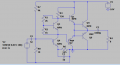
This is my current design:
1748658592319.png

It gives a nice voltage and current gain - 250mV peak voltage and 30mA current. I have added transistors Q5 and Q6 following book suggestion to get more current however they don't seem to have any effect. A quick look the diagram gives me an answer - if base is at the same potential as emitter they are bot off! So how is it supposed to work?
 

WBahn

Joined Mar 31, 2012
32,702
This is my current design:
View attachment 350229

It gives a nice voltage and current gain - 250mV peak voltage and 30mA current. I have added transistors Q5 and Q6 following book suggestion to get more current however they don't seem to have any effect. A quick look the diagram gives me an answer - if base is at the same potential as emitter they are bot off! So how is it supposed to work?
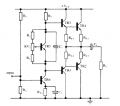
Can you provide a picture of the actual suggested circuit in the book?

Are you sure the emitters of Q5 and Q6 are shorted to the base in it? If so, it's likely a typo on the part of whomever did the publication artwork.
 

Thread Starter

mondo90

Joined May 16, 2025
122
1748659814973.png
They are with resistors but also with a comment "the RE1/2/3/4 resistors should be much smaller than RL, otherwise they will dissipate a lot of power" so that's why I removed them because a resistor < 8 Ohms won't make much difference.
 
Top