Acts like there is some kind of resistance on pin4 to ground. On the bottom side of the board clean the space between pin3 and 4 real good with a razor blade or knife with the power off please
Acts like there is some kind of resistance on pin4 to ground. On the bottom side of the board clean the space between pin3 and 4 real good with a razor blade or knife with the power off please
Can I push further?
Any thoughts on the relay problem?
The sound it made sounded like a quiet welding.
I still didn't have the balls to actually connect water to the solenoid so it
actually very hot when I noticed this. is it possible that the current increased because it got hot?
I'll try the capacitor you suggested earlier.
Oh, one more question, what tool you use to clean PCB?
I used rubbing alcohol, that worked great, but the Qtip idea didn't, fiber all over it now.
Happy to report everything is stable after 12hrs of power on, relay also clicking on/off nicely without any buzzing.
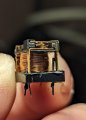
I did replace the relay that had the problem and couldn't resist to take it apart.
To my surprise no sign of any contact burning on the metal contact itself but it does smell like electrical burn.
Couldn't done it without @sghioto
THANK YOU SO MUCH for all your patience!
Yes, PS module installed and both boards working perfect.... until I connect the solenoid
Without the capacitor on the relay instant buzzing, with the cap it will work couple times but then it starts buzzing
switching on and off and buzzing again
Swapped the solenoid for 120V 6W LED bulb and it works no problem no buzzing, but in OFF state the bulb is dimly lit! How is this possible with solid state switch/relay?
That's a good question. Relay contacts should be open. Possible internal capacitance in the bulb is to blame but should eventually discharge.
As far as the solenoid you could try a 100nf/200volt cap in series with a 100 ohm resistor connected across the solenoid.
The board with the integrated PS ( black brick) working perfect no buzzing when solenoid connected, even the LED bulb is truly OFF in OFF state. Even when I remove the relay capacitor it's still working.
The one with the separated PS is exhibiting these problems only.
Will inspect the board with magnifying glass, perhaps I screwed up somewhere again.
Wonder if the problem is the PS.
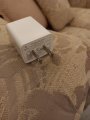
For 5 volt supplies I generally use a USB phone charger. Extract the circuit board from the case or sometimes just use as is.
That's good idea, I just got these because they were in boards I did buy before and worked great.
On the other hand there was huge amount of parts around it
I would be still using these, since the cost isn't bad at all, but it's using 12V sensors that are bulky
and the board is large as well and not easy to find place for it. Usually I had to desolder all the wire terminals sometimes
even the relay and use smaller one to gain some height in the case.
I'm still puzzled why the design is so complicated and it does exactly the same thing like the circuit you designed.
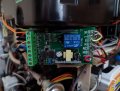
Here is picture of the board installed, sensors are 25mm x 18mm pucks.
I am using in such circuit the DIY module with old russian FET AND or OR tablets (176, 561 series). Actually, even TTL series are able as well (155 series) however they fails if water is extra clean. They cost 1 cent per cubic meter and are still effective to sense the least possible water impedance. And allows to create the Scmitt Trigger to get more accurate response. Actually, I designed the circuit of cellar water evaccuation controller observing the water level in cuphole bottom and top, switching the 2 kW pump. Then I soldered some 100 pcb stock and put on shelf components for more 10 000 pieces, but at term of 3 years I managed to sell at ebay .... 1 piece. Thus I thrashed all.
The sensors I'm using are $2.50 a piece, size is 14mm x 18mm x 4mm, and they have sensitivity adjustment.
10 PCBs cost me $10 and parts are next to nothing.
The original large board I posted above with 2 sensors cost $30 (cheaper in bulk).
Wouldn't mind paying that if the sensor form factor was same as those 5V I found, and the PCB way smaller.
Reliability was 100% and that's in dealing with water in the kitchen very important.
Looks like the PS is not the problem.
Completely removed it plugged in the relay circuit with the bulb attached still dimly turns on ( NO contact so should be OFF)
Cleaned the board, still ON
Desoldered the relay Light OFF
Soldered leads to the relay Light is OFF
Board without the relay ( just for giggles) Light OFF
Clipped The NC and secondary COM leads from the relay since they are not used, soldered the relay back in
Now working properly
Is it possible that my poor PCB design, (very crowded, not sure why I tried to make it this super compact)
is causing all these problems?
Certainly seems that way. To be clear with the relay wired up off the pc board the circuit works properly?
Have you tried cleaning the top side of the board?

 Facebook
 Google
 GitHub
 Linkedin