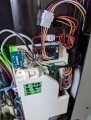
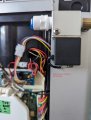
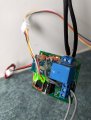
I got couple warnings while designing the PCB but "resolved" them all.
Perhaps that warning is only about safety clearance not interference.
My imprecise soldering is probably borderline ant it causes issues.
Assembled no PS interference, but had enough space to keep them a part.
Installed, calibrated both sensors, and it's was working flawlessly when I drained/filled the tank manually.
Solenoid was clicking ON/OFF as it should (no noise)
Turned the machine ON, and while it was working suddenly when the water level dropped below upper level
the solenoid turned ON. (it should have waited till the lower sensor is no longer sensing water)
Is it generally good idea to keep the sensor wires as short as possible? I have them coiled in the cavity.
So now I have to figure out if this is caused by electromagnetic interference or if the sensor is not sensing level properly.
The upper sensor is fairly close to the solenoid, (working as it should) the lower only close to power switch,
and capacitor of the machine.
I also don't understand how the sensors keep the calibration if power is disconnected. They did on my test jar but still don't know how that is possible on cheap device like that.
Reed switch that disconnects the relay when the tank container is removed is also not working properly (sticks closed)
but that could be that it's just poor quality and too sensitive to the current flow. (ordered different one)
Tried with the other board, exactly the same issue.
This happens only when the machine was turned ON.
Once I reset the calibration (machine OFF) it will hold the calibration.
The other board was installed outside of the case using its own power as well.
There is several el. motors and el. magnets in the machine itself.
I tried to move it, shake it, none of these did reset the sensor.
Wires uncoiled and leading directly out now.
I tried to see if there is specific part causing this but looks like it's random.
Only the lower sensor is having this problem.
No difference if the solenoid or regular bulb is connected.
Is there anything that would shield the sensor?
Would you have any idea where to look for the cause?
Other options:
Will setup the test jar near it to see if it happens as well.
Replacing the bottom sensor , but that would be major pain since it's glued with strong double sided tape in place.
Could the adhesive in the tape be conductive enough to interfere with the sensor. (I am assuming the sensor is part of a tuned circuit. I.E a capacitive sensor.)
Thanks for reply Les!
I don't think that's the case. I'm using 3M clear tape that is used to stick on LED light strips.
It is bonded to plastic case. The upper sensor ismounted the same way.
I just noticed interesting thing,
after it triggers in the area above the lower sensor, I don't even have to press the calibration button to recalibrate the lower sensor.
If I just fill water above the upper sensor it will work fine again for while and then it will randomly trigger again
( only when the machine operates) in the area below the upper sensor.
For testing I assembled one of those PCBs in my first post with 2 relays using the same power supply to see if it behaves the same way.
UPDATE
This board doesn't have the same problem with lower sensor being wonky. Is it possible that the low level branch of the circuit is being triggered by something else, and it overrides the sensor output for a split second and that changes the logic triggering the relay?
Perhaps different resistor value would help? ...yes I have no idea how it works
So after whole day of testing using the board with 2 relays controlled by those 2 sensors not a single false trigger.
Another test using the controller where sensors controlling the 555 circuit direct and my test jar that was located in close proximity to the machine, same problem. Good thing is that I did discover by accident what is causing the trigger.
Fairly dry here and the static electricity in the air will often shock you touching stuff. While I touched the solenoid valve to feel if it's triggered or not it on several occasions triggered the circuit to turn on. Looks like it is only affecting the lower sensor.
Is there any way to prevent this?
Perhaps grounding some part of circuit to the machine itself? Again, just my amaturisch guess
Got it! Will do
Right now the body of the solenoid valve, the common ground in the machine and the negative of the 5V power supply are not connected together.
Everything is grounded in there, from heating elements to metal brackets (yellow/green wires) to the 120V grounding pin.
If I measure from that grounding pin on the 120V cable to the the solenoid valve body I get infinite ohm, same to the negative of the 5V power supply powering the 555 circuit and sensors infinite ohm, so they are not connected to ground.

 Facebook
 Google
 GitHub
 Linkedin