Automatic Locking mechanism for spherical bearings using Push-Pull Solenoid

Thread Starter

Subhash_K

Joined Aug 1, 2024
8
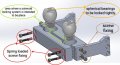
I am looking to improvise on a current mechanical design that locks spherical bearings in particular position by tightening of screws. The spherical bearings are usually in locked position and are disengaged only while carrying out calibration. I intend to incorporate automatic locking mechanism maybe by using some sort of push-pull solenoid that disengages locking during calibration.

PS: All the parts are machined in aluminum.

Need your suggestions on mechanical design of such system and selection of an appropriate solenoid that optimal locks spherical bearings for stability. Your expert advice on these aspects is highly valued.
 

Attachments

Thread Starter

Subhash_K

Joined Aug 1, 2024
8
I am looking to improvise on a current mechanical design that locks spherical bearings in particular position by tightening of screws. The spherical bearings are usually in locked position and are disengaged only while carrying out calibration ie., ( when bearings are under calibration an actuator need to unlock by pushing the front part ) I intend to incorporate automatic locking mechanism maybe by using some sort of push-pull solenoid that disengages locking during calibration.

PS: All the parts are machined in aluminum.

Need your suggestions on mechanical design of such system and selection of an appropriate solenoid that optimal locks spherical bearings for stability. Your expert advice on these aspects is highly valued.
 

Attachments

LowQCab

Joined Nov 6, 2012
5,101
The amount of force that will probably be required to lock-up the Bearings is probably
far greater than the force of any "practically-sized" Solenoid.

Even a Gear-Motor driving a Fine-Threaded-Screw would be an "iffy" proposition,
and might be quite a bit larger and heavier than what You might be envisioning for your Project.
Not to mention, expensive,
and the requirement of hard-Threaded-Brass-Inserts that won't gall and bind after the first 3 uses.

You gave no Size, or Weight, or Electrical-Power, or Force, requirements.
.
.
.
 

camerart

Joined Feb 25, 2013
3,829
The amount of force that will probably be required to lock-up the Bearings is probably
far greater than the force of any "practically-sized" Solenoid.

Even a Gear-Motor driving a Fine-Threaded-Screw would be an "iffy" proposition,
and might be quite a bit larger and heavier than what You might be envisioning for your Project.
Not to mention, expensive,
and the requirement of hard-Threaded-Brass-Inserts that won't gall and bind after the first 3 uses.

You gave no Size, or Weight, or Electrical-Power, or Force, requirements.
.
.
.
Hi L,
Don't you think there would be enough force in a solenoid moving a cam?
C
 

MisterBill2

Joined Jan 23, 2018
27,164
I question the wisdom of using aluminum in any friction clamping scheme, because it has a tendency to bind. To be more specific, I have not seen a satisfactory arrangement with aluminum on aluminum, other than disposables.
 

MisterBill2

Joined Jan 23, 2018
27,164
The amount of force that will probably be required to lock-up the Bearings is probably
far greater than the force of any "practically-sized" Solenoid.

Even a Gear-Motor driving a Fine-Threaded-Screw would be an "iffy" proposition,
and might be quite a bit larger and heavier than what You might be envisioning for your Project.
Not to mention, expensive,
and the requirement of hard-Threaded-Brass-Inserts that won't gall and bind after the first 3 uses.

You gave no Size, or Weight, or Electrical-Power, or Force, requirements.
.
.
.
The statement was quite clear that the desire is to UNLOCK the bearings for adjustment during calibration. So probably only a very small amount of motion is needed, but a great deal of force will be required. The mechanical arrangement needed to produce the high force short motion effect is not a suitable application for aluminum.
 

Thread Starter

Subhash_K

Joined Aug 1, 2024
8
I question the wisdom of using aluminum in any friction clamping scheme, because it has a tendency to bind. To be more specific, I have not seen a satisfactory arrangement with aluminum on aluminum, other than disposables.
It can be changed to other materials like delrin.
 

Thread Starter

Subhash_K

Joined Aug 1, 2024
8
The statement was quite clear that the desire is to UNLOCK the bearings for adjustment during calibration. So probably only a very small amount of motion is needed, but a great deal of force will be required. The mechanical arrangement needed to produce the high force short motion effect is not a suitable application for aluminum.
Hi S,
Can you use a cam?
C
due to space constrains CAM may not be implementable.
 

Ya’akov

Joined Jan 27, 2019
10,226
If not simply motorizing the existing screws I think I would be inclined to use pneumatic cylinders in the fashion of air brakes. The clamping is constant by springs, the pneumatic cylinders act against the springs when the bearings need to be freed.
 

Thread Starter

Subhash_K

Joined Aug 1, 2024
8
The amount of force that will probably be required to lock-up the Bearings is probably
far greater than the force of any "practically-sized" Solenoid.

Even a Gear-Motor driving a Fine-Threaded-Screw would be an "iffy" proposition,
and might be quite a bit larger and heavier than what You might be envisioning for your Project.
Not to mention, expensive,
and the requirement of hard-Threaded-Brass-Inserts that won't gall and bind after the first 3 uses.

You gave no Size, or Weight, or Electrical-Power, or Force, requirements.
.
.
.
Thank you for your detailed feedback and insights! I appreciate the points you’ve raised about the force requirements and potential issues with using a solenoid or gear-motor for my project.

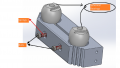
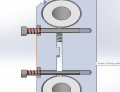
Size dimensions are provided in the attached snapshot.
Matrial: aluminum
force required is to push the front plate by at least 2mm.


Screenshot 2024-08-06 112851.png
 

Thread Starter

Subhash_K

Joined Aug 1, 2024
8
I question the wisdom of using aluminum in any friction clamping scheme, because it has a tendency to bind. To be more specific, I have not seen a satisfactory arrangement with aluminum on aluminum, other than disposables.
It can be changed to other materials like delrin.
 

Sensacell

Joined Jun 19, 2012
3,768
There is much missing information here, like how much force/torque these spherical bearings are supposed to resist when locked?
When unlocked, how much "drag" friction is acceptable?
How much power is available?
The solution lies in the definition of the problem.

But I suspect a solenoid would not be a good choice.
 
Top