Auto Relay 5 pin Relay

Thread Starter

JTSOVA

Joined Mar 9, 2026
6
Not experienced with automotive relays. Need advice on a simple setup.
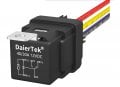
using a traditional 5-pin relay and trying to accomplish the following.

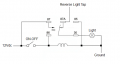
By using an on/off switch would like to manually power an additional light. When the vehicle is in reverse, would like the light to also come on. Can someone confirm if the following will work?

on/off switch pin 86
ground pin 85
battery positive with fuse pin 87
reverse light tap wire pin 87A
additional light pin 30
 

Thread Starter

JTSOVA

Joined Mar 9, 2026
6
Thank you
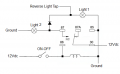
Just to ask about another scenario. If there were 2 additional aftermarket aux lights instead of just 1 light, but light 1 turned on with reverse light, but both light 1 and 2 turned on with on/off switch. What would change?

battery + to pin 30
ground pin 85
powered 12 through switch pin 86
light 1 (on reverse only) pin 87A
light 1 and 2 on with switch pin 87 with a diode between light and reverse light

is more than 1 diode needed or is there a better way?
 

sghioto

Joined Dec 31, 2017
8,633
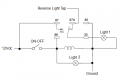
Only problem is when in manual mode besides both auxiliary lights ON so will whatever else is connected to the reverse tap.
Using this configuration eliminates the problem and the diode.
The ON-OFF switch must be rated high enough to handle the additional current of light 2.
1773154301023.png
 
Last edited:

eetech00

Joined Jun 8, 2013
4,704
Just to ask about another scenario. If there were 2 additional aftermarket aux lights instead of just 1 light, but light 1 turned on with reverse light, but both light 1 and 2 turned on with on/off switch. What would change?

battery + to pin 30
ground pin 85
powered 12 through switch pin 86
light 1 (on reverse only) pin 87A
light 1 and 2 on with switch pin 87 with a diode between light and reverse light

is more than 1 diode needed or is there a better way?
What kind of lights? Incandescent? LED?
 

MisterBill2

Joined Jan 23, 2018
27,164
Adding a diode across a relay seems to be a serious issue for some. I never do it, and have never suffered problems from the voltage generated. Slowing the switching off of a controling transistor just a bit reduces the dV/dT and greatly redues any spike voltage. AND the power dissipated during that 50 millisecond switch off does not deliver much heating.
The benefit is never burning up the control circuit because the connections were reversed .
 

MaxHeadRoom

Joined Jul 18, 2013
30,557
I remember one incident where the BEMF diode was needed on an industrial CNC machine that had a PC based control system, every time a certain contactor would pick up, the PC would go into re-boot.
A rectifier across the coil cured it.
 

MisterBill2

Joined Jan 23, 2018
27,164
OK, there may be special cases where there is a reason. Probably the computer resetting also had the very fastest swith-off of anything. E= L dI/dT, and as dI/dT getsvery fast, E grows larger.
 

MisterBill2

Joined Jan 23, 2018
27,164
In the circuit shown, then coil connection pin does not apear to be shown in the correct position. AND A WARNING: I see that some relays have that diode internal. So it the polarity to the coil is reversed, the relay will not function until the internal diode fails open.
 

MisterBill2

Joined Jan 23, 2018
27,164
I hope that they do not! BUT I recently saw a schematic that showed what appeared to be a diode, internal to the relay. THAT was thhe motivation for my comment. Hopefully it was a simple transient absorber device. BUT it did look like a diode in that instance.
 

Jon Chandler

Joined Jun 12, 2008
1,560
I see that some relays have that diode internal. So it the polarity to the coil is reversed, the relay will not function until the internal diode fails open
Indeed, some automotive relays DO INCLUDE internal diodes. Best to design for the possibility to prevent future problems if the relay is replaced.

Screenshot_20260323_055635_Edge.jpg
 

MisterBill2

Joined Jan 23, 2018
27,164
THAT scheme is certainly going to cause problems for everybody who does not pay attention to the polarity of the coil connection wires. SO it is A VERY GOOD REASON to avoid that particular brand of relays!
The manufacturer assumes that it is much smarter than all of the users.
 
Top