hi ganny,
I would like to help, please give me an idea of your specification and I will discuss it with you.
Regarding the results in LTSpice, I have been using LTS for over 10 years, running many circuits using the 2N2222.
All have worked in practical circuits giving results close to the simulation, so I have a high degree of confidence the the 2N2222 model.
Proteus works very well The circuit I have drawn and the one you have drawn seem to work as expected.
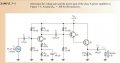
The 2n2222 model within Proteus is flawed.. The 2n2222a works as it should.. I expect the circuit being simulated by Granny isn't quite correct.. I can't see the connections in this pictures properly..
Hi guys, Could you find me an audio amplifier made using transistor about 4W? I spent a lot for this project yet I have done nothing. Its hard to look for components. Make sure it is easy to look at stores around. Thank You
As you posted in homework help, are you not supposed to design an audio amplifier?
What you are asking is like making a copy of a given design and not your own design.
The book I posted in post #23 will give you good guidelines for designing an amplifier.
I saw this in my book Electronics devices by Floyd. What transistor should I use in this circuit so ot will work in 4 watts 8 ohms speaker. Pleaseee help me.
One of the big drawbacks to the original circuit was that it has only a 5v power supply.
That's not going to produce much power out. At most, and this is beyond what is really possible, if we divide that by 2 we get 2.5v and 2.5v and 8 ohms doesnt lead to much power. It's actually much less than that though because of transistor drops and resistor drops, etc., as well as a DC voltage to sine voltage conversion factor like around 70 percent or so. So the theoretical limit of output power is very low, typical maybe for headphones. For example, with a 12v supply and plus and minus 5.5v output zeroed at +6v, the factor is 0.71 or close to that.

 Facebook
 Google
 GitHub
 Linkedin