Audio Amplification Problem

Audioguru again

Joined Oct 21, 2019
6,826
The RC parts at the output of the power amp ICs prevent oscillation at a high frequency. The ICs are different so the RC parts are also different.

The output capacitor value determines the low frequency cutoff frequency. The formula is C= 1 divided by (2 x pi x R x C).
Then 250uF into 8 ohms cuts 80Hz by -3dB and cuts lower frequencies at -6dB per octave. 470uF cuts 42.5Hz by -3dB etc.
 

Thread Starter

SamR

Joined Mar 19, 2019
5,491
OK, so it's just a standard filter on the output then. In that case I'll socket them so they can be changed. Thx.
 

Thread Starter

SamR

Joined Mar 19, 2019
5,491
I had problems with the power amp stage so I uncoupled it and now the pre amp stage is acting wonky. I'll give it a rest and start back in the morning...
 

Thread Starter

SamR

Joined Mar 19, 2019
5,491
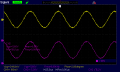
OK, I worked it out using a sig gen input. There were a couple of issues. The output of the TL071 was too high to use the LM386 so I replaced it with the LM380 and reworked the protoboard for it. Still had some problems and really suspected a ground problem but couldn't resolve it. Went back to the PDF and caught what I had missed, ground referenced input on both the LM386 and LM380. I have used the LM386 several times with floating voltage and never had a problem that I can remember. After connecting an earth ground to the system this is what I ended up with. Any higher input voltage to the TL071 will cause the LM380 to start clipping so the input has to be below 20mV. This is showing the output of the TL071 with only a gain of 10 calculated and the output of the LM380. Input from the sig gen is 20mV @ 10kHz. As much trouble as I had with this I sure hope the students who had the course with this lab fared better than I.

1605790864587.png
 

Audioguru again

Joined Oct 21, 2019
6,826
Your 'scope shows that the gain of the LM380 is 11.6V/0.244V= 47.54 times.
The output of the TL071 has a lot of noise. Poor shielding or is the TL071 a fake one from ebay?

An 8-pins LM380 can produce 11.6V p-p into 8 ohms (2.1W) when its power supply is 15V or 16V. Its datasheet shows that it will be at its maximum allowed temperature.
An LM386 can produce no more than 0.6W into 8 ohms when its heating is more than 0.6W.
 

Thread Starter

SamR

Joined Mar 19, 2019
5,491
output of the TL071 has a lot of noise. Poor shielding or is the TL071 a fake one from ebay?
There is a lot that is unshielded even with the input coax and I do have a noise problem here that I am trying to get to the bottom of to see what there is that I can do about it. Yes, it's a cheapo aliX chip.

Your 'scope shows that the gain of the LM380 is 11.6V/0.244V= 47.54 times.
Close enough to 50Av for me. I did add the compensation cap and ran Vs up to 21V and could only get to 28mV on the preamp input before the output started to clip on the top. I didn't calculate the gain for that. I did try plugging the speaker into it and it was pretty terrible. I think I'll leave audio alone now for a while after this baptism. Thx again for the input AG.
 

bloguetronica

Joined Apr 27, 2007
1,544
I don't think that the LM386 is a good candidate. Sure, I did projects with it back in the day, but it is a bit too noisy. It drives an 8Ω speaker, and serves the purpose. It is much better than the LM741 with the big resistor on the output (that, by the way, would make a big attenuator with the speaker and would effectively "kill" any signal at the output, with our without the capacitor as a filter.

If you need high-fidelity and serious power, then the LM3886 is what you need. It is one of the few survivals of the Overture family, now that the LM3875 and LM3876 are gone (still have a few in the parts bin). The LM3886 is more difficult to work with, but very doable on a double sided PCB.

Sadly, other power amp chips, like the TDA2003, TDA2009, TDA2030 are now pretty much defunct. The new wave is the class D amplifiers, I guess. You could try designing with one of those. They are getting better, at least for me, because I can't hear anything above 15KHz, anyway.
 

Thread Starter

SamR

Joined Mar 19, 2019
5,491
My hearing craps outs ~8-10kHz and that's my good ear. Looks like a nice amp but a bit more than what I need to experiment around with. The LM380 seems to have more power than I need but can take a bit higher input than the 386. Anyway, I'm just playing around trying to learn a bit. Thx for the input.
 

Wolframore

Joined Jan 21, 2019
2,619
I have a few of these to play with... very cheap and works well. Class D is very efficient... you can get these modules for next to nothing. audio test at about 6:40
 

Thread Starter

SamR

Joined Mar 19, 2019
5,491
Hard to beat those chinesium modules and I have several of various kinds including the LM386. You sure can't build one for what they cost but the point here was learning to build one.
 

Wolframore

Joined Jan 21, 2019
2,619
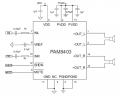
Its not about beating them. I plan to use the PAM8403 for projects in the future... they are made by Diodes Inc and class D means better battery life. They're also very quiet. Not too hard to use. Module just makes it easy to test. I suppose you can mount one on an adapter to use for breadboarding if you like. I'm pretty sure their board is an exact copy of the one in the datasheet... except for addition of volume control: Nothing different about using this vs LM386 since they're both modules, this one is just a little more up to date.
1605813668911.png
 
Last edited:

Thread Starter

SamR

Joined Mar 19, 2019
5,491
I actually have some of those chips but haven't used them yet. It has a pretty low input voltage rating.
 

Wolframore

Joined Jan 21, 2019
2,619
OK max input voltage is +/-0.3V for the PAM
Max input voltage for LM386 is +/-0.4V

you can only have so much input before you start clipping in any preamp stage. You need a front end if you're dealing with line level pro audio stuff... in which case you may want to go for higher quality.

These are today's equivalent to an LM386 or 380. Just useful little power amps. Pretty powerful for what they are. I have some 25 watt Class D chips too... also tiny.

Share the link... they're nice to have around. The chips cost $0.80 out of our domestics. About $0.25/ea @ volume of 100 direct (actual DI product). I'm sure less reputable sources on ebay might even be less.
 

Thread Starter

SamR

Joined Mar 19, 2019
5,491
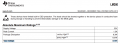
Yep, the 380 input is a whole lot higher than the 386 @ 5Vmax though which is why I ended up using it instead. Looking at the specs for the TL071 which is pin for pin same as the 741. But... It states in one place on the PDF the input range is -12 to 15V! That sure doesn't sound right. And with +/-15V Vcc it only swings +/-12V? The TI PDF for it is a bit confusing to me. One place says Vcc +/-15V another says -0.3V to 36V which I assume is the single supply voltage. Still trying to suss it out a bit. I did see a link to a TI doc on their PDF parameters that I should check out. Anyway, I set one up on the breadboard with an offset adjustment pot to see just what it actually does after I rest up a bit.
 

Wolframore

Joined Jan 21, 2019
2,619
I'm not seeing that on the datasheet for the 380, are we talking about power supply or input signal voltage?

1605820257497.png
I was looking through my stuff and found some PAM8302 which is single channel version. It's about $0.13 per chip. 24 dB gain direct.
 
Top