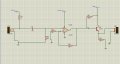
You need an output stage to match the loudspeaker’s low impedance.
R6 has no effect on the circuit.
You were given three options in the other thread.
1) Use LM386 to drive the loudspeaker.
2) Use a transistor Class-A amplifier and an audio frequency transformer on the collector.
3) Use push-pull NPN and PNP transistors as Class-B amplifier.
-Without a DC block output capacitor you will burn the speaker.
-The feedback must come from the output.
-The output transistor bias is wrong.
-R2 is shunting away all of the microphone signal.
-The 2n2369 is a small signal transistor optimized for switching, not linear operation.
-The LM358 has a low GBW product which makes a terrible choice for a high gain audio amp.
I could continue, but those are the main points. But based on your replies on your previous post, I know you will ignore.
-Without a DC block output capacitor you will burn the speaker.
-The feedback must come from the output.
-The output transistor bias is wrong.
-R2 is shunting away all of the microphone signal.
-The 2n2369 is a small signal transistor optimized for switching, not linear operation.
-The LM358 has a low GBW product which makes a terrible choice for a high gain audio amp.
I could continue, but those are the main points. But based on your replies on your previous post, I know you will ignore.
Thanks for your reply.
I sometimes don't fully understand comments due to my low knowledge about electricity.
Terribly sorry If it seemed like I ignore on purpose..
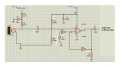
For the original circuit, R2 and R3 were much to low values, R6 should be about 47 ohms, AND there does need to be that series capacitor blocking DC into the speaker.
The circuit in post #7 looks OK.

 Facebook
 Google
 GitHub
 Linkedin