Adding DC Offset Voltage at Output of Audio Amplifier to Create “Single Ended” Effect

Thread Starter

Sir Kit

Joined Feb 29, 2012
213
I would like an ability to simulate a single ended audio amplifier using one channel of a home stereo amplifier that ordinarily outputs a push-pull bipolar signal.

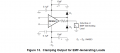
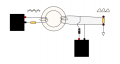
My idea is to individually use the split 120V primary windings of a toroidal power transformer for 1:1 isolation, with appropriate load compensating resistor. A similar method is described here in page 3 figure 5: https://assets.testequity.com/te1/Documents/pdf/dc_offsets.pdf

On the output side, a variable power supply would be connected to offset the signal into the positive region by one half of its Vpp, thereby feeding a single-ended signal into a test resistive load.

Please view my diagram below and comment if this, or a similar approach would achieve my objective.
signal-add-dc-offset.png
 

MisterBill2

Joined Jan 23, 2018
27,159
The description sounds a whole lot like the modulation scheme used in AM transmitters for many years. So it is certainly possible to do it easily. BUT the circuit shown in post #1 is not going to work!!! The DC offset source needs to be in series with the transformer, NOT in parallel. In addition, the resistor in series wit the amplifier output serves no useful purpose at all. And I am not sure what the diode in series with the positive voltage will do either.
The one caution is that the DC voltage with no amplifier output will be close to the DC supply voltage. If that is not part of the plan, then the DC supply voltage will need to be adjustable.
 

Thread Starter

Sir Kit

Joined Feb 29, 2012
213
Papabravo, may I have a further explanation please?

If you are referring to saturation, I had thought this applies only to DC at the primary winding. What effect is it likely to have on the secondary side? Is there any way to compensate for it in my design?

Also, how is my design functionally that different from the diagram in the linked Agilent article?
 

Thread Starter

Sir Kit

Joined Feb 29, 2012
213
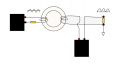
Thank you Misterbill2. Is this diagram correct?

The resistor is series with the input and output were for load compensation during test.

signal-add-offset-ver2.png
 

Ian0

Joined Aug 7, 2020
13,097
I would like an ability to simulate a single ended audio amplifier using one channel of a home stereo amplifier that ordinarily outputs a push-pull bipolar signal.
But a single-ended audio amplifier has a capacitor that removes the DC offset.
 

Thread Starter

Sir Kit

Joined Feb 29, 2012
213
But a single-ended audio amplifier has a capacitor that removes the DC offset.
Do you have a circuit diagram showing this? I cannot find any. Most are single ended amps are transformer-coupled tube circuits. In any case, I want to keep the DC offset as described in my OP.
 

Ian0

Joined Aug 7, 2020
13,097
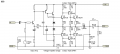
1724499412349.png
This is a single supply amplifier (from Eliot sound products website). C1L is the output coupling capacitor. There is no offset on the output.
If it were a single-ended amplifier then Q4-Q5-Q6 would be driven as a constant current source with fixed bias. It wouldn't make any difference to the output.
It is possible to make a direct-coupled singled ended amplifier, using positive and negative supplies, which also would have no output offset.
Amplifiers cannot have DC on their output as it would destroy the loudspeakers.
 

Papabravo

Joined Feb 24, 2006
22,058
Papabravo, may I have a further explanation please?

If you are referring to saturation, I had thought this applies only to DC at the primary winding. What effect is it likely to have on the secondary side? Is there any way to compensate for it in my design?

Also, how is my design functionally that different from the diagram in the linked Agilent article?
Transformers are bidirectional
 

MisterBill2

Joined Jan 23, 2018
27,159
Evidently we need a more detailed description of the desired output of the assembly.
The circuit shown in post #5 is correct IF the desired DC offset is to be negative. And an extreme caution about randomly connecting an isolated circuit to "ground", whatever that may mean in the circuit context.
In the normal configuration for the original applications the DC supply negative was connected to the load device negative side. So the circuit that I was intending to describe would have that DC supply connected in series with the lower line in the drawing, so that the load common connection would be tied to the supply negative and the ground connection.
 

LowQCab

Joined Nov 6, 2012
5,101
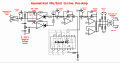
I am assuming that You are looking for Guitar-Distortion,
if so,
You may find the following Circuit will create some interesting Effects.

The Balanced-Line Input and Output-Chips are, of course, optional.

The EQ-Chip is no-longer manufactured, and
may be ignored, or replaced with your choice of many EQ Circuits

The Circuit has substantial Gain built-in, all the way up to "Line-Level".

There are also several EQ-"Switches" which can be used or left-out at your discretion,
but I recommend leaving them in, as they can be very useful.
.
.
.Asymetrical Amplifier 2 .png
 

Thread Starter

Sir Kit

Joined Feb 29, 2012
213
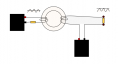
Misterbill2. I have redrawn my diagram based upon what I now think you are describing. I have removed the superfluous "ground" symbol.

Is this correct? Is there no way to use a similar technique to create a positive DC offset? For example, by repositioning the load?

signal-add-offset-ver3.png
 

Thread Starter

Sir Kit

Joined Feb 29, 2012
213
This is a single supply amplifier (from Eliot sound products website).
What I want is a DC offset, not its removal. The output will not be connected to a speaker so no problem there. I just need to create a unipolar current from a bipolar source (the amp) for magnetics experiments. Thanks.
 

Ian0

Joined Aug 7, 2020
13,097
What I want is a DC offset, not its removal. The output will not be connected to a speaker so no problem there. I just need to create a unipolar current from a bipolar source (the amp) for magnetics experiments. Thanks.
Just take a standard bipolar amplifier and remove the coupling capacitor from the input and feedback loops. Then you can control the output offset from the input.
 

MisterBill2

Joined Jan 23, 2018
27,159
Misterbill2. I have redrawn my diagram based upon what I now think you are describing. I have removed the superfluous "ground" symbol.

Is this correct? Is there no way to use a similar technique to create a positive DC offset? For example, by repositioning the load?

View attachment 329981
This circuit is FUNCTIONALLY IDENTICAL to the description in the Agilent link description, although the frequency and voltage capabilities will be different. Reversing the voltage offset will simply require reversing the polarity of the connections to the DC power supply.
 

Thread Starter

Sir Kit

Joined Feb 29, 2012
213
Thanks to the replies here, I felt confident I could try this on the bench without damage.

The configurations shown in posts 5 and 12 both produce an identical positive DC shift that can be adjusted via the series connected power supply. There is no need to build any circuitry from scratch or modify existing equipment.

The resistance of each split 120V winding of my toroid is 6.5 ohms which loads the amplifier very nicely. I am happy with the result and can now proceed with my experiments.
 

MisterBill2

Joined Jan 23, 2018
27,159
I am wondering what sort of experiments. Audio plus DC was used to drive the very early laser tubes for voice communication. It has also been used for driving glow-tubes for audio modulation.
 

Thread Starter

Sir Kit

Joined Feb 29, 2012
213
I am wondering what sort of experiments. Audio plus DC was used to drive the very early laser tubes for voice communication. It has also been used for driving glow-tubes for audio modulation.
I am intending to power electromagnets. A bipolar signal would cause periodic field reversal.
 
Top