Audi Amp works without capacitors.

Thread Starter

BjorkElec

Joined Nov 28, 2024
37
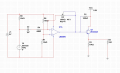
Hi, I'm creating an audio amplifier circuit. When connecting a condenser microphone, it works well and the speaker outputs my words. However, connecting an aux cable from my phone to the circuit gives very bad output.

I tried connecting the + of the aux cable directly to the end of the 680 ohm resistor, and the sound coming from my phone comes out of the speaker correctly. However, after a few tries and songs, my phone audio socket burnt.. and only the left channel works.

So I'm guessing because I bypassed the coupling capacitor.. so what might be the issue here? My I tried different capacitor values(10nf, 1uf, 10uf, 4.7uf), and the same issue stays, audio is extremely chopped/inaudable.

Note: I connect aux terminals one to ground and the other to the intersection of C2 and R8.
1734961807072.png
 

meth

Joined May 21, 2016
298
From the top of my head I dont think the signal level is the same from the mic and from your aux, aux should be line level, something like 0.3V, not 0.02V. However that doesnt explain why your phone output died. EXCEPT... if you used a stereo input jack into mono socket and somehow shorted out the output. So the circuit above, without the transistor part should work for MIC LEVEL SIGNAL only (it is standard schematic), as you said it worked. If you want to run a line level signal you should do some adjustment to weaken the signal - if you want to run it on this same circuit. I might be wrong though, I would wait on second opinion from another member :D.
 

MrChips

Joined Oct 2, 2009
34,629
As pointed out in a previous thread, what you show at Q1, emitter follower configuration, can you see that R3 , 10 kΩ is going to be over-ridden by R5, 16 Ω ?
 

Thread Starter

BjorkElec

Joined Nov 28, 2024
37
As pointed out in a previous thread, what you show at Q1, emitter follower configuration, can you see that R3 , 10 kΩ is going to be over-ridden by R5, 16 Ω ?
The 16 ohm is the speaker. And I also removed the 10 ohm, and it doesn't make any difference.
 

meth

Joined May 21, 2016
298
That makes sense.. I dont know the complete purpose of your project but you can add small block of components on the input, that would boost the mic level to line level, and also add a switch, where you can choose what type of input you are using. If you want your device to be universally used ofc.
 

Thread Starter

BjorkElec

Joined Nov 28, 2024
37
That makes sense.. I dont know the complete purpose of your project but you can add small block of components on the input, that would boost the mic level to line level, and also add a switch, where you can choose what type of input you are using. If you want your device to be universally used ofc.
The output in the simulation as about 26 millivolts.. Do you know why this happens?
In real life, it's working great.
 

meth

Joined May 21, 2016
298
Sorry I dont use simulation software but if you post your file here I am sure other members will check that for you.
 

AnalogKid

Joined Aug 1, 2013
12,050
Depending on the adjustment of R2, the circuit has a forward gain of somewhere between 0 dB and 43 dB. Note that an LM358 cannot deliver full audio bandwidth at the higher gains. At gains above around 30 dB, the 358 will act as a low-pass filter. This is a consequence of the part's relatively low gain-bandwidth product. At 40 dB of gain, the lowpass corner frequency is around 5 kHz. (2005 datasheet pages 6 and 7)

ak
 

Attachments

Ian0

Joined Aug 7, 2020
13,097
Also if the snip in the first post is from your simulation circuit, the battery is placed in reverse.
and the output connects to ground, but neither side of the battery does.
If the negative end of the battery is meant to connect to ground, then yes, it will work as an amplifier, but the net DC current through the speaker will ruin it.
 
Top