ATM type dispenser

Thread Starter

TommyTongue356

Joined Feb 19, 2025
6
Hi,
Not sure if this is an appropriate place to post. I'm pretty new at all this.
My current project is as follows.
Hosting a horse racing party. Guests will check in by scanning their QR code on there ticket. This will start a presentation on the screen. It will then state to push the button next to the screen which will then dispense a roll of money and a certificate for a horse.

The website and check in I have sorted. The general make up of the dispensing machine I have sorted.
However the project uses a 150 rpm 12v dc motor (this can be changed) I do not know how to control the rotation of the motor. It will be connected to a wire spiral. In each loop of the spiral will the be cash and certificate. As the motor rotates it pushed said package to the drop zone. Much like a vending machine.

However if people hold the button the motor will continue and they will receive more than 1 package. How do I control this.

I do not have a great budget for this project. I got the idea of the dispensing mechanism from this you tube video....

In an idea world the motor would be controlled by the presentation on the computer but I think that is not possible within my budget and skill level.

Hope this makes sense and there are ways to do this reasonable cheaply. (less than $100Can).
 

Ya’akov

Joined Jan 27, 2019
10,226
Welcome to AAC.

What you want is a gear motor. This is a type of motor that uses a gear box to reduce the speed. This makes the speed more reasonable for an application like yours, and increases the torque the motor can provide with will also be helpful.

You will want to use a limit switch to sense when the motor has moved to the next slot in the dispenser. Typically, this is a microswitch, or snap action switch with a lever that can be used to operate it. You would make your “dispense” button close the power to the motor, and have a cam with gaps at intervals for the limit switch.

When the limit switch encounters a gap, it turns off but when the dispense button is pressed, and starts the motor, the limit switch is activated by the movement of the cam. Letting go of the button will not stop it because the limit switch will make it run until if falls into the next gap—at which point it turns off and the motor stops until the button is pressed again.

You can find both the gear motor and switch as surplus for a few dollars. The switch is available with a roller on the actuator which would be the best kind for you.
 

Thread Starter

TommyTongue356

Joined Feb 19, 2025
6
Welcome to AAC.

What you want is a gear motor. This is a type of motor that uses a gear box to reduce the speed. This makes the speed more reasonable for an application like yours, and increases the torque the motor can provide with will also be helpful.

You will want to use a limit switch to sense when the motor has moved to the next slot in the dispenser. Typically, this is a microswitch, or snap action switch with a lever that can be used to operate it. You would make your “dispense” button close the power to the motor, and have a cam with gaps at intervals for the limit switch.

When the limit switch encounters a gap, it turns off but when the dispense button is pressed, and starts the motor, the limit switch is activated by the movement of the cam. Letting go of the button will not stop it because the limit switch will make it run until if falls into the next gap—at which point it turns off and the motor stops until the button is pressed again.

You can find both the gear motor and switch as surplus for a few dollars. The switch is available with a roller on the actuator which would be the best kind for you.
Thanks for quick response. I’m not that versed in electronics. I understand the motor. I think I understand what the limit switch is and also the manual switch. What I am failing to picture is how it works with the spiral turning then stopping. I guess how the actual mechanism would work?
 

Ya’akov

Joined Jan 27, 2019
10,226
If you are talking about a screw feed mechanism, it becomes more complicated since you can’t just index the a cam.

In that case you need what a bistable multivibrator also called a flip-flop. This sounds scary but it‘s simple enogh—it’s a circuit that switches from one state to another when it gets a signal. In your case it would switch the motor on, then off.

Your dispense button would start the motor, and a limit switch positioned to detect that the bundle had been dispensed would stop it. You can get pre-built flip-flop modules from Amazon for a few bucks. I would suggest that you find a motor that uses a low DC supply (<50V) and avoid having the mains voltage (120V/240V AC) anywhere except for a power supply.

You can get motors, flip-flips, and power supplies for 12V easily so it is a good target.

One more strategy—which would be called open loop as opposed to the closed loop idea above is to use a time delay relay. This is a module that, when operated, stays on for a selectable, fixed time. You can time how long it takes to dispense and then set the relay.

This is open loop because there is no feedback to indicate success, unlike the closed loop of the first method where the motor runs until it delivers the bundle. Ideally, you can combine both so if after a generous time allotment the motor shuts off whether or not there was a delivery detected. This is a failsafe mechanism.
 

MisterBill2

Joined Jan 23, 2018
27,258
Another option to gai an education would be to study the setup and service manual for a vending machine that is similar. You may even find a vending machine service company willing to sell you parts. AND, there are single-rotation mechanisms that will only allow a single rotation when triggered.
 

tonyStewart

Joined May 8, 2012
231
Welcome to AAC.

What you want is a gear motor. This is a type of motor that uses a gear box to reduce the speed.
150 RPM already looks like a gear motor or 2.5 Revs/s
The dispenser might look more like a printer paper feed with a stack of paper. It may be hard to deal with wrinkled papers and the details may be too complex.
 

Thread Starter

TommyTongue356

Joined Feb 19, 2025
6
Another option to gai an education would be to study the setup and service manual for a vending machine that is similar. You may even find a vending machine service company willing to sell you parts. AND, there are single-rotation mechanisms that will only allow a single rotation when triggered.
Great idea however probably too expensive and way too much time. This is for a bit of a gimmick at a virtual horse racing party.
 

MisterBill2

Joined Jan 23, 2018
27,258
"Y" has a good suggestion, and to expand on it a bit, have the button press latch a relay that gets unlatched when the dispenser has made one revolution. And copy the industrial machine safety interlock that demands a release of the button before another cycle can be started. I am up way to early to recall it right now, but that scheme is a classic, used around the world. "Two Hand, Anti-tiedown/Anti Repeat" is the name.
 

Thread Starter

TommyTongue356

Joined Feb 19, 2025
6
Hey guys so I have a very simple understanding of electronics. Kinda understand all above but not the jargon.

This is what I’m thinking.
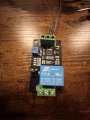
Simple push switch to switch on a time delay which will switch off after say 2 seconds(1 revolution of spiral/motor). I have got the following timer module. But it is not as simple as I thought to wire. I do not know what the x1 terminal does. I was expecting positive negative in on the input and common and either no /nc output. However this configuration does not seem to work. A simple diagram would survive to help me out. All I want is to connect a battery. Press a switch the motor run for a period of time then switch off. I bought this off temu!!! (Yes I know but this is for a stupid gadget/gimick for a party)The module has no instructions or diagrams with it.
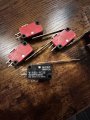
Really appreciate the help. I also have some switches as per photo

the switches…

IMG_3643.jpegthe packaging states : x002yUGMYX delay timer relay. DC 5c/12v. I supposedly ordered the 5 v! IMG_3642.jpegIMG_3640.jpeg
 

MisterBill2

Joined Jan 23, 2018
27,258
How about a scheme copied from production equipment and regular vending systems: Pressing the start button latches a relay sealed thru a limit switch that shifts at the feed system's home position. The start button is disconnected as soon as the rotation starts, and the motor turns until the revolution is completed and that switch releases the relay. At the same time the revolution starts, a timer is also triggered, which also holds the start button disconnected for some time greater than the time for a single revolution.
What this does is assures that holding the button pressed is not able to start a second revolution, because the timer is not reset until both the button is released AND the time interval has passed.
 

Thread Starter

TommyTongue356

Joined Feb 19, 2025
6
Really appreciate all your suggestions. I think I may be in the wrong forum as I do not understand most of what has been written. Can somebody perhaps suggest a hobby forum or beginners forum so I don’t take up all your precious time needing rudimentary language and wiring explain.
This is a gimmick for party guests so budget is a concern. Also my time I have already spent many hours trying to do this for a toy that will be used for 2 mins once a year.
thanks guys.
 

MisterBill2

Joined Jan 23, 2018
27,258
T.T. This forum certainly is also for beginners, entry level hobbyists, and others.
That means all folks able to produce a posting that others can read.

You stated the requirements quite adequately and clearly, and it was a new and interesting question posed.
The fact that some ideas are complex and other a challenge to understand is rather typical.
And if I forgot to welcome you the first time, welcome this time!!
 

Ya’akov

Joined Jan 27, 2019
10,226
So, using a timer is a non-starter. That approach falls under open loop. it might sound daunting but the idea is simple.

Your device can either be open or closed loop. In an open loop arrangement your device has no idea what is actually happening. Take the timer—you suggest that you would run the timer for "one revolution" which you calculate to be 2 seconds.

How accurate and consistent is that interval. Let's imagine you measure the distance the item moves in one revolution to be (for sake of discussion only) 2cm. You then place your items on the feed screw very carefully, and manage to do a very good job, your variation from item to is only an average of 3mm, or 0.3cm.

You use the timer, at set it as close to 2s as it can be, let's say the error for that model is ±0.1s, just a tenth of a second. So now you have everything ready to go with 10 items to dispense. You press the button to drop the first one and the timer runs for 2.1s (for this example, I will use an error of excess rotation, but 1.9s would also be a problem)

The first item drops perfectly. The second also works though it drops just a little sooner than the first—at 1.9s rather than 2s. Each time you run your cycle, the next item creeps forward in time until by the ninth, with the cumulative error in timing and placement drops one item just after the button is pressed and one just before it stops.

It's called "open loop" because you are depending on what it should do, theoretically, and not testing to see if it is doing that.

On the other hand, closed loop employs one or more sensors to ensure that what you wanted to happen actually did. To convert the open loop version above to a closed loop, it could be as simple as adding a limit switch (sensor) that can detect an item actually dropped. Where you put the switch is flexible, just as long as when it is closed, an item has been dispensed.

Leaving everything else the same, connecting the switch so that It resets the timer when it is operated by the successful delivery closes the loop by adding measurement of the real world and solves the problem. In practice, the timer isn't a bad addition since if something goes wrong the motor will only run for a maximum of the interval you set.

Open loop systems necessarily required great precision in their construction to ensure that whatever you choose as the basis for control—time, pulses that are expected to do something, &c.—will actually result in what you expect. An example is most 3D printers. They can work with sub-millimeter precision because they use stepper motors that are extremely predictable.

By "homing" the tool head using limit switches, the printer starts with a physical confirmation of its position and then counts steps to move around. If anything causes the tool head to move, or to remain in place outside the pulses sent to drive it, an error results just as if the calibration step (homing) was incorrect.

You actually *could* use a stepper motor and toothed belt in an open loop arrangement, but it would be more complex than the screw feed idea, both electronically, and mechanically. It would still be a nice method, just beyond what you are likely to want to learn to do for this project.

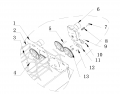
Below is a diagram of a vending machine that uses a screw/auger feed scheme. They use a gear motor (6) to drive what they call the "spring" (3, 4). The picture is of a "double slot" which has two counterrotating springs driven by a gear motor which is further reduced in speed by large plastic gears (13).

1741179691416.png

They use a photo interruptor (not pictured) for what they call "drop detection", to stop the motor once the product drops. The photo interruptor is a switch activated when a light source is blocked from a sensor. I has the same function as a mechanical limit switch but there is no physical contact.
 
Top