AT Tiny 85 not responding

Thread Starter

abuhafss

Joined Aug 17, 2010
318
Ok, now I have soldered a 10nF cap across pin 8 and 4 (close to the chip) but nothing improved.

Voltages
Pin 1 - 1.33V
Pin 2 - 265mV
Pin 3 - 560mV
Pin 5 - 255mV
Pin 6 - 185mV
Pin 7 - 5.04V
Pin 8 - 5.04V

The buck converter is supplying enough current, I have tested 1A LEDs.

In the setup() of the code, I have switched on the LED for 5 sec. After another 5 sec., in the loop(), I have flashed the LED indefinitely.

NO RESPONSE FROM THE MICROCONTROLLER.
 
Last edited:

Thread Starter

abuhafss

Joined Aug 17, 2010
318
It is clear that the chip is not even entering the setup(). The low voltage at the reset pin is continuously reseting the chip. I temporarily connected a 10k across 5V and the pin1, the chip responded immediately.
 

Thread Starter

abuhafss

Joined Aug 17, 2010
318
If RESET is pulled low, the chip will do nothing, so that makes sense. But why is it low?
Well, I can't say about. Maybe the 10k baising resistor is pulling it low.
I have seen when using bare AT Mega 328P chip the RESET pin is pulled up with a 10k. May be Tiny 85 also needs the same but I haven't came across such idea.

Anyway, I have removed the LED connection at pin 3 and connected the 10k baising resistor instead.
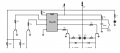
Tiny circuit B2.png
 
Last edited:

Thread Starter

abuhafss

Joined Aug 17, 2010
318
At the right side of the schematic, I am using 2N2222 transistors to activate 24V pneumatic valves. As per my experience 10K baising is fine for BC546, 2N3904, 2N2222 (general purpose NPN) but in this circuit 10K would not activate the coils. So I had to replace it with 1k (even 4.7k did not worked). Am I wrong with 10k baising idea?
 

MrChips

Joined Oct 2, 2009
34,809
Think current.
How much current does the load on the collector require?
Now, use a current gain of 10 in order to guarantee that the transistor is switched on in saturation mode.

For example, suppose the valve requires 35mA to turn on.
The base current needs to be at minimum 35mA / 10 = 3.5mA
The MCU output pin has to supply 3.5mA when at logic HIGH.
4V / 3.5mA = 1.14kΩ
Hence 1kΩ would be a good choice for the base series resistor.
 

djsfantasi

Joined Apr 11, 2010
9,237
Back to the basics… What is the current draw of your servo? With a 10K biasing resistor, you can drive a load of around 5mA. Sounds barely enough to drive anything but an LED. Which is probably why the motor was sluggish.

The max current the ‘
This was the change I made, but LED remains off.
Code:
void loop()
{
  digitalWrite(LED, HIGH);
  delay(3000);
  digitalWrite(LED, LOW);
}
Just saying… without a second delay after writing the LOW to the LED, the effect will f this sketch to the human eye is as if the delay and the digital write of LOW never was there.

After writing LOW, the sketch will immediately write a HIGH with an imperceptible delay.

Add a second delay and see what happens.

I looked at the 20 mA pin (practical) maximum and the chip 200 mA maximum and didn’t see a problem with the schematics posted. This is often the source of burnt chips.
 
Top