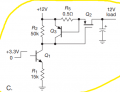
If you understand how it works, then you should be able to what condition has to be met for it to limit the current.
Take you best shot to figure it out and present your work. We then have something to work with to try to help you spot anything that you are missing or doing wrong.
If you understand how it works, then you should be able to what condition has to be met for it to limit the current.
Take you best shot to figure it out and present your work. We then have something to work with to try to help you spot anything that you are missing or doing wrong.
Sounds good. The actual limit will be slightly different, but that's the mechanism. As Q3 starts turning on, it shunts current around R2. It is the voltage across R2 that provides the gate-source voltage to turn Q2 on, so as Q3 turns on, Q2 is turned off. This is not a distinct on/off event, but a smooth transition over a fairly small range of currents. That range is in the ballpark of when the Vbe of Q3 is in the 0.6 V to 0.7 V range.
Note that you have a typo in your first equation -- it's 0.5 Ω, not 0.5 V. But kudos for tracking your units through your work.
Sounds good. The actual limit will be slightly different, but that's the mechanism. As Q3 starts turning on, it shunts current around R2. It is the voltage across R2 that provides the gate-source voltage to turn Q2 on, so as Q3 turns on, Q2 is turned off. This is not a distinct on/off event, but a smooth transition over a fairly small range of currents. That range is in the ballpark of when the Vbe of Q3 is in the 0.6 V to 0.7 V range.
Note that you have a typo in your first equation -- it's 0.5 Ω, not 0.5 V. But kudos for tracking your units through your work.

 Facebook
 Google
 GitHub
 Linkedin