Are there photons for emissions outside the visible spectrum?

Thread Starter

ischonfeld

Joined Jun 22, 2019
63
It's been decades since my physics classes and this question occurred to me while watching an educational program on TV. I may not have the technical terms exactly right.

Visible light is composed of electromagnetic waves. It is also emitted as photons. And it is a small part of the EM spectrum. Do other areas of the EM spectrum also emit photons?

Just a question to ponder
 

Wendy

Joined Mar 24, 2008
23,797
If radio emissions were common on this planet our eyes would have evolved to see in the radio spectrum.
 

Ian0

Joined Aug 7, 2020
13,097
If radio emissions were common on this planet our eyes would have evolved to see in the radio spectrum.
Unfortunately, you can't resolve anything smaller than half a wavelength, so you'd need to be seeing with frequencies >600GHz to be any use.
 

crutschow

Joined Mar 14, 2008
38,325
If radio emissions were common on this planet our eyes would have evolved to see in the radio spectrum.
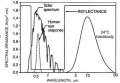
Thus the eye evolved for peak sensitivity near the peak of the solar spectrum (below):

Coincidentally, I think it would be difficult to devise a biological sensor for good sensitivity much outside those wavelengths.
Shorter wavelengths (e.g. UV) can cause biological damage, and longer wavelengths (IR) have reduced sensitivity due to the black body radiation at biological temperatures.
Of course many creatures, besides most mammals, have evolved some sensitivity to near UV,

1740861617985.png
 

nsaspook

Joined Aug 27, 2009
16,252
The IR sensor on our bodies is our skin. A somewhat directional sensor if we manipulate our bodies.

https://onlinelibrary.wiley.com/doi/10.1111/phpp.12899

IR exposure often produces a sensation of heat when humans come in contact with it, it is not identical to heat. IR is a form of energy that when absorbed by water molecules (in the skin) is converted to kinetic energy—this kinetic energy is then perceived as heat.7 This method of heat transfer is not to be confused with conduction in which atoms come in direct contact with each other and kinetic energy is transferred from higher energy atoms to lower energy atoms; an example of this is the heat sensation felt when touching hot metal. Convection represents yet another distinct method of heat transfer in which heat is transferred by a liquid or gas in motion—such as when hot air rises, for example.
 
Top