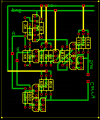
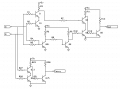
Any recommendations on how to improve my first PCB design?

Thread Starter

drcne

Joined Aug 3, 2017
15
Probabally could have shrunk the real estate somewhat?
Max.
Yeah definitely. It was challenging for me to connect certain gates together and I had to resort to using actual wires in my design though. I wasn't too sure where to start, so I made each gate the half-adder composes of separately, and then started connecting them all together.
 
Probably should have layed out the board with "snap to grid"

Traces near R6, Near R11
Q13, Q14 and Q15 might be too close
You have pieces of PCB traces near the pads.
Traces at the top lack pads
Copper Lettering in top of a copper trace in two places?
R3 - Make one end a square pad to remind you that you have to solder on the top of the board if your
etching it yourself, otherwise make the VIA a separate entity.

Mounting holes: Even if you don't use them. the can help when stuffing or debugging. i.e. Place the board on standoffs.

Consider using "copper pour" and/or ground or power plane regions to reduce etch times. Even a Nylon spacer and nylon screw would keep the board suspended in an etch solution.

"connectorize" it.

Add pads for capacitors. At least an electrolytic on +5 and possibly a reverse biased diode for reverse polarity protection, Leaded fuse. You don't have to populate them and you can replace the "fuse" with a jumper.

There are "0-ohm" resistors that can be purchased to use as jumpers.

If your going to etch yourself, watch for printing options that allow the pattern to contain "divits" or places to help center your drill bits.
 

#12

Joined Nov 30, 2010
18,224
Yes on the extra fat traces or big islands of copper, and yes, you need options for decoupling capacitors on the +5V. All fast switching circuits use fast pulses of current and 100nf per gate can facilitate fast switching. Think for a minute like you are designing the spaces between the traces instead of designing the traces and see that leaving all the copper you can is good for easy current flow and EMI suppression.

And yes, you could use less real estate by packing the components tighter together and using the already required resistors to jump over traces that are "in the way". Sometimes a two sided board is used to make the jumpers on the back side, but zero ohm resistors or wire jumpers are good on a small board.

That second green line at the top screams out to me, "shorten line 2 and flood copper from line 1 to R11 and R13".

and "divit" is spelled, "divot".:rolleyes::p
 

Thread Starter

drcne

Joined Aug 3, 2017
15
Thank you all for the help. I tried to make most of the changes you guys suggested; however, I am not very familiar with decoupling capacitors so I haven't added those yet. Here is my new design, let me know if these changes are what you all meant.

Edit: Hm.. for some reason I cannot embed the picture, well here is the url until I can embed
http://imgur.com/a/JY4zR


#12

Joined Nov 30, 2010
18,224
You're getting there. Problem is, you can mess with these for a week!:mad:
When you get to where you can't see how to save a tenth of a square inch, you're done.;)
 
Top