Any idea regarding MPPT system?

I scanned through the posts and didn't see any discussion of the edge case where the power available from the array is high but the load is lighter, and unable to consume all the power from the array. Remember, you can limit current going to a load that is too great for the power available from the array, but you can't force current into a load that isn't drawing it when the array has more power than the load needs.

I haven't seen what started this thread or what the code is controlling. Usually solar MPPT management is done within an inverter, limiting the inverter's conversion when the load draws more power than the array can handle and shifts the cells from their optimum operating point. My point in this reply is that your code has to handle the condition where there the power plot doesn't have a maximum, but just tops out below the array's maximum theoretical capacity. In that case, the voltage regulation on the inverter should be the limiting factor.

Hope this wasn't off base.
 

Lestraveled

Joined May 19, 2014
1,946
Off Grid Battery based MPPT systems (recreational vehicles)
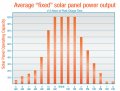
How your solar panels are sized verses the demand and storage, determines how long the MPPT function will be used in the morning and late afternoon. During the high solar intensity period of the day, more power is being generated from the panels then can be used. This is acceptable design because you normally have to size your panels to provide adequate power for more than 4-5 hours a day. So this means that the MPPT is only functional in the early mornings and late afternoon.


Power Grid MPPT (Thanks KISS for bringing it up)
In this application the voltage is fixed and the current is varied to transfer all of the power generated to the grid. Here the MPPT runs continually from first light to last light.

Please note that the "Off grid battery system", and the "Power Grid/sell power back to the electric company system", are two very different MPPT applications. The concepts are the same but the application is completely different. Also note that an MPPT controller never directly supplies power to appliances. An MPPT will keep your batteries charged as best as it can, and make your electric bill as small as it can. Hook a light bulb up to the output of an MPPT controller and you will have a blown out bulb. It was not designed to directly power appliances.
 

Attachments

Thread Starter

shiva007nand

Joined Sep 25, 2015
38
Hello again,

The most difficult part is trying to determine from a function like:
P=p(x,t)

what variable (x or t) is causing the change.

A Statement of the Main Problem:
If 'x' (your control variable) is causing the change, then any change in 'P' can be perfectly attributed to your change in 'x' and thus you have made a good measurement and can then exactly determine what to do next.
On the other hand, if 't' is causing the change (due to natural occurrences) you wont be able to tell because 'x' might be (by sheer coincidence) simultaneous with 't'.

What might help is to repeat the control test several times in a row, probably spaced by random short time intervals, using the same test and then backing up to the original point before the next test. IF several tests show the same result then you might assume that your control variable is responsible for any change. If any test shows a different result, then you would have to repeat the test until you get a result that is the same every time. This of course still assumes that the next change will happen under the same environmental conditions, which it may not. If the test changes are small and frequent, it might work most of the time.

The natural phenomena include variable cloud cover and moving dust particles for example. Cloud cover can be very erratic where it blocks the sun light for a second or two, then allows it through, then blocks again, then unblocks again, etc., due to variable cloud shape and travel speed and direction. Dust can blow over the array and cover part of it, then blow away, etc.
Just a couple examples of what you will have to deal with :)

If you find anything good on the web on this subject please post a link.

BTW, this thread got moved because you must have started this conversation within someone elses thread.
I am new here, I don not know rules of all about circuits. next time I will start with my own thread.
 

Thread Starter

shiva007nand

Joined Sep 25, 2015
38
I scanned through the posts and didn't see any discussion of the edge case where the power available from the array is high but the load is lighter, and unable to consume all the power from the array. Remember, you can limit current going to a load that is too great for the power available from the array, but you can't force current into a load that isn't drawing it when the array has more power than the load needs.

I haven't seen what started this thread or what the code is controlling. Usually solar MPPT management is done within an inverter, limiting the inverter's conversion when the load draws more power than the array can handle and shifts the cells from their optimum operating point. My point in this reply is that your code has to handle the condition where there the power plot doesn't have a maximum, but just tops out below the array's maximum theoretical capacity. In that case, the voltage regulation on the inverter should be the limiting factor.

Hope this wasn't off base.
Here is a file which contains code on which discussion was started
 

Attachments

MrAl

Joined Jun 17, 2014
13,702
Hi,

I cant imagine why anyone would want to run say a light bulb only for 4 hours a day when the sunlight is brightest.
I would think they would at least want to charge a battery so that they can draw power whenever the lamp was needed.
That means MPPT comes into play during most of the daylight hours.
This is the idea with line tied applications, and are becoming increasingly popular.

For my own purposes, i intend to charge smaller batteries and then use the power as needed. This means MPPT would be good for me too.
There will be times probably when the batteries are fully charged, so they dont need the full normal current from the panel. This doesnt bother me at all, except maybe i could have other batteries switch in so that they start to charge also, and thus not wasting any of that valuable sunlight energy (something like 1000 watts per square meter incident). But even without doing that, the MPPT would have to recognize that the load is lighter than it was before or else when it tries to increase current it would see that it can not increase power and therefore it would end up being viewed as the maximum power transferred.
This would represent another stage in the control however, because the battery charger would start to limit current to the battery. This means we would have a third variable thrown into the mess:
P=p(x,t,Imax)

Probably the best bet here is to build this known information into the controller, so that the controller has knowledge of the Imax as a separate input with known characteristics, unlike 't' which is still random. This would probably help when the current would be higher than normal too, if that ever happens.

I would think we could set this all up in a simulation just to see what happens. I might end up doing this anyway because i intend to start using my panel soon too.
 

Lestraveled

Joined May 19, 2014
1,946
You are getting it. When the panels are producing more power that what is needed, the battery charger will charge the battery per the normal profile, as if it were plugged into a wall outlet. When power is in short supply, the MPPT will change the chargers current to maximize the charge per the available power.
 
Last edited:

Lestraveled

Joined May 19, 2014
1,946
MrAl
Power usage/strategies in an RV are more complex than the "on grid, making my power meter run backwards" systems. The goal is to keep your batteries at the highest state of charge as you can. When is the toughest time for an RV battery? At night and early in the morning. People retire to their trailers at night, watch TV, a movie, surf the internet, sleep with a humidifier or a BPAP on. Then comes the big test......is there enough energy in the batteries to start the generator in the morning to make coffee. Then the cycle repeats.
 

Bernard

Joined Aug 7, 2008
5,784
Another interesting read still available: EDN December 5 2008, page 51. This is the one " Solar-array controller needs no multiplier to maximize power."
 
Top