Antique words and phrases

wayneh

Joined Sep 9, 2010
18,127
It also increases the specific heat of the liquid and that increases the efficiency of the radiator.
I'm pretty sure that's incorrect. Pure water is a better heat remover - better transfer coefficient and higher heat capacity - but you need the other properties as noted; anti-corrosion, boiling point elevation and freezing point depression.
 

cmartinez

Joined Jan 17, 2007
8,798
I'm pretty sure that's incorrect. Pure water is a better heat remover - better transfer coefficient and higher heat capacity - but you need the other properties as noted; anti-corrosion, boiling point elevation and freezing point depression.
I think you're wrong on that one... the anti-freeze mixture also increases the mix's heat capacity of just plain water
 

Thread Starter

#12

Joined Nov 30, 2010
18,224
I'm pretty sure that's incorrect. Pure water is a better heat remover - better transfer coefficient and higher heat capacity - but you need the other properties as noted; anti-corrosion, boiling point elevation and freezing point depression.
cmartinez to the rescue!
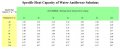
Huge increase in specific heat of a 50% antifreeze solution ABOVE 100 C.
116C is 240.8 F and a 15 PSI pressure cap will raise the boiling point of water to 250F

So, if your engine ever gets to the point where it is in danger of boiling water, the antifreeze changes the specific heat of the solution to 8.37 j/g/C instead of 4.179 j/g/C

That's a solid 2.00 to 1 ratio.
 

cmartinez

Joined Jan 17, 2007
8,798
cmartinez to the rescue!
Huge increase in specific heat of a 50% antifreeze solution ABOVE 100 C.
116C is 240.8 F and a 15 PSI pressure cap will raise the boiling point of water to 250F

So, if your engine ever gets to the point where it is in danger of boiling water, the antifreeze changes the specific heat of the solution to 8.37 j/g/C instead of 4.179 j/g/C

That's a solid 2.00 to 1 ratio.
Yeah... and it's interesting to notice that it's non-linear... I leave it to the chemists (read @GopherT and @jpanhalt) to explain to us why, if they're in the mood, of course.
 

GopherT

Joined Nov 23, 2012
8,009
Yeah... and it's interesting to notice that it's non-linear... I leave it to the chemists (read @GopherT and @jpanhalt) to explain to us why, if they're in the mood, of course.
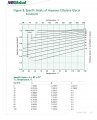
Where did you get your data? Pure water on the left. Sorry, I could not find a good one in SI units. (At least, not a good one that makes you look wrong). That was a joke - where did you get your data.

image.jpg

And from Dow's distributor...

image.jpg
 
Last edited:

jpanhalt

Joined Jan 18, 2008
11,087
Well, I am an organic chemist, and this is a bit out of my field. But, as I understand it, you need enough ethylene gylcol to depress the freezing point by the well-know molal depression of freezing, but not so much as to reduce the specific heat too much ( neat water = 55.56 molar and molal; neat ethylene glycol = 18.0 molar) The happy point seems to be ≤50 %. I guess we use 50% since people add "water" to their radiator when at a service station.

Here is Wikipedia's take:

Pure ethylene glycol has a specific heat capacity about one half that of water. So, while providing freeze protection and an increased boiling point, ethylene glycol lowers the specific heat capacity of water mixtures relative to pure water. A 50/50 mix by mass has a specific heat capacity of about 3140 J/kg C (0.75 BTU/lb F) three quarters that of pure water, thus requiring increased flow rates in same system comparisons with water. Additionally, the increase in boiling point over pure water inhibits nucleate boiling on heat transfer surfaces thus reducing heat transfer efficiency in some cases, such as gasoline engine cylinder walls. Therefore, pure ethylene glycol should not be used as an engine coolant in most cases.
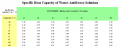
And here is a nice chart showing the specific heat of various mixtures with water (Source: http://homepage.usask.ca/~llr130/physics/HeatCapcityOfAntiFreeze.html):
upload_2015-1-22_17-52-4.png

John
 
Last edited:

cmartinez

Joined Jan 17, 2007
8,798
(At least, not a good one that makes you look wrong).
As if I haven't suffered enough today already... ha ha ha...
Anyway... the link is in the image, and John already posted the same reference... it's from the University of Saskatchewan.. did they get it wrong?
 
Last edited:

atferrari

Joined Jan 6, 2004
5,018
I know... it's spanish for "chinese ink"... I'm amused because that's the same name used down here for that kind of product
I believe the expresion is used in most if not all Spanish-speaking countries. Good to stain everything at school even before you started to practice gothic calligraphy. Been there...believe it or not.
 

wayneh

Joined Sep 9, 2010
18,127
And here is a nice chart showing the specific heat of various mixtures with water (Source: http://homepage.usask.ca/~llr130/physics/HeatCapcityOfAntiFreeze.html):
There's something terribly wrong with that table. It supposedly comes from the Engineering Toolbox site, but as quoted there (emphasis is their own):

"Note! The specific heat capacity of ethylene glycol based water solutions are less than the specific heat capacity of clean water. For a heat transfer system with ethylene glycol the circulated volume must be increased compared to a system with clean water.

In a 50% solution with operational temperatures above 36 oF the specific heat capacity is decreased with approximately 20%. The reduced heat capacity must be compensated by circulating more fluid.

Note! The density of ethylene glycol is higher than water - check the specific gravity (SG) table above, so the net impact on the heat transport capacity is reduced. Example - the specific heat of an ethylene glycol water solution 50% / 50% is 0.815 at 80 oF (26.7 oC). Specific gravity at the same conditions is 1.077. The net impact can be estimated to 0.815 * 1.077 = 0.877."

They also note the negative effect of increased viscosity of the glycol solution versus pure water. Not only do you need more flow, but it requires a lot more pump energy because of the viscosity.
 
Top