another patch...

Thread Starter

panic mode

Joined Oct 10, 2011
5,002
one of my favourite topics is patches (like this)

did not have to fix boards in a while... just long enough to get relaxed.... and then - it happens. :mad:

turns out on part of the board I2C lines are crossed.
easy to happen with copy and paste when other priorities create distraction or when copying from working project and not paying attention. 4 ICs affected. patch time...

fortunately i had pair of 0-ohm resistors (0603) on that bus... this made it possible to add crossed jumpers instead. i would prefer to hide it on the back side but no choice, this one runs on inner layer and nothing on the back loos=
it is just what i had on hand. the insulation is stripped of 30ga wire-wrap wire, trimmed to 1.5mm/0.060" length then one of jumpers was run through it. it is small enough to not draw attention. tiny drop of liquid solder mask would be nice but won't be here for another 2-3 days. till then, flag of shame (piece of masking tape) will have to do.

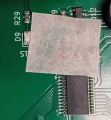
1780956721895.png


1780957244456.png

here is one where things got a bit rougher. problem was the wire was too thick (#30) and that was more than enough to rip the part of the track. #30 is too coarse for job like this, it is not pliable enough.

1780967511481.png

this is what #30 look like on same board, i know in othrer thread some liked it but it is way too thick for repair of smaller tracks. may as well use rebar... ;)

1780968380814.png
 
Last edited:
Certainly PCB connection problems can cause failure to function in NEW ASSEMBLIES!
Those problems are much less common in systems that have been functioning correctly for some time.
Fixing PCB errors is never fun, and seldom simple.
The patches shown are OK for entertainment systems, but not in any "life critical" systems! Nor would they be OK for use in most vehicles.
 

Thread Starter

panic mode

Joined Oct 10, 2011
5,002
pictured above are prototypes and patching is allowing to proceed with tests/development. done properly this will match correct design (without patchwork) but...

obviously most vehicles are manufactured in huge volumes. if there was a comparable design mistake there, it would be impractical and too costly to hand-patch millions of boards. not to mention consistency and quality of patch application on such huge scale...

similarly, not sure i agree about entertainment systems... you probably think of indoors entertainment only (TV/stereo/computer/gaming console etc). many people go way out to have fun...

1781197691202.png1781198137027.png
1781197614145.png
1781197004050.png1781198244072.png
1781197160218.png

and while combat systems are built to some of most stringent specs, how many times had unapproved or even defective system been used in action?
 

MisterBill2

Joined Jan 23, 2018
27,584
OK, to clarify what I MEANT by "entertainment systems", in post #3, I was referring to the mass-produced consumer electronics "consumable" devices, mostly television, but presently a larger realm of video, text, and assorted audio devices. Never intended to be repairable, and obsolete before the 90-day warrantey runs out.
 

Thread Starter

panic mode

Joined Oct 10, 2011
5,002
according to strategy of many companies, nothing should be repairable because that is the only way they see themselves staying in business. but this topic was not about staying in business, or economics of mass production...

so yeah, your posts miss the point. and i am also sorry for engaging in jousting match instead of simply saying what should be said.

the repair here is not because of a bad connections. it is because of design mistake (incorrect connection).
it was not on a mass-produced vehicle or home entertainment system. it was on small batch of prototypes.

more importantly, this topic was meant to remind or inspire to:

a) double check designs before releasing order and avoid possible repairs hurdles later,
b) share some of repair techniques (if or when it comes to that)
c) draw criticism and improvement suggestions to repair work or alternative techniques.

so please try to contribute without dragging the topic into wrong direction. i would love to see your designs, specifically ones that did not work on the first go, and how you handled it.
 

MisterBill2

Joined Jan 23, 2018
27,584
As an alternate change in routing/connectivity, on existing PC boards, I have used "lifted" traces from scrapped PCBs with a hot iron, and both glued and soldered them onto the PCB needing modification. Tinning the removed side of the lifted trace does take a bit of effort, but the finished product works well and looks good. The added benefit is that on RF assemblies it tends toward maintaining the impedance matches better than wire jumpers.
 
Even the most seasoned and capable engineers will recognize that a modification must be made on a product for which a large batch of boards has already been manufactured.
We are only humans, we make mistakes.
But no worries! With AI we’ll be producing flawless boards every single time. Boards will remain at revision “A” forever and ever.
SARC OFF
 

MisterBill2

Joined Jan 23, 2018
27,584
Even the most seasoned and capable engineers will recognize that a modification must be made on a product for which a large batch of boards has already been manufactured.
We are only humans, we make mistakes.
But no worries! With AI we’ll be producing flawless boards every single time. Boards will remain at revision “A” forever and ever.
SARC OFF
A GREAT JOKE!!!
"To ERR is HUMAN! BUT To Really foul things up, You NEED a computer! (I take no credit for this statement! It has been posted in the computer room of several past employers.)
 

MisterBill2

Joined Jan 23, 2018
27,584
And another case of having to fix a design error: EXCEPT the creator was not a designer. AND excess current on a PCB, and inwires, produces excess heat. The problem was that the small LEMO six pin and 4 pin connectors CAN carry six amps for a few minutes without overheating. The failure was that not much else in that package could do even that well. While some power transistors can carry 24 amps safely, their specification demends a rather serious heat sink. THAT was a project that I inherited when I hired in at a small company. The creator of the disaster had been an outside contractor, without the experience of making designs work, when finally built.
 
Top