Another Capacitor (Bootstrap) circuit Clarification

sarahMCML

Joined May 11, 2019
697
Can you please suggest if it can increase the speed? I observed a MOSFET failure after populating the diodes, i am not sure of the exact reason, i have removed the 3 diodes in 3 Mosfet gate drivers at present, may be i have repopulate and test it again.
As I suggested previously, the external diode allows a lower resistance path to charge the bootstrap capacitor than does the internal diode, which has a 25 Ohm resistor in series. I've built such circuits using the external diodes with no such MOSFET failures, and many datasheets often recommend using external diodes if needed! Anode to VCC, Cathode to VB.
 

du00000001

Joined Nov 10, 2020
189
Do you have any recommendation or suggestion to increase the speed by another 200 RPM. The back emf constant of the motor is 12.6 /*!< Volts RMS ph-ph /kRPM */
12.6 - 1000 RPM so for 200 RPM i need to increase the phase voltage by 2.52V? I have increased the boot capacitance by 10uF from 4.7uF but the motor does not spin.
It doesn't look like you have a plan at all:
  1. The "external" diodes between the supply (10..20 V) are mandatory - the HS driver doesn't have one "on board". [edit] OK, this one has an internal diode. An external one won't hurt anyway.
  2. These diodes have to withstand the operating voltage of the "power side" - plus some headroom for transients during switching. So schottky diodes are not applicable in most cases (though they have the lower voltage drop).
  3. "motor doesn't spin" like in "motor doesn't spin at all" ? Could it be you damaged one or more components during the "wild" actions (diodes out, diodes in and alike)? Are you sure the microcontroller is still operational and has the appropriate software to control the power stages? Are the gate drivers still healthy? . . . Lots of questions to be answered . . .
  4. How are we supposed to increase the speed if "the motor does not spin".
    BTW: 2.52 V might be the minimum requirement. But you can easily double your supply voltage which would also solve the issue with requiring too high duty cycles. This is not a brushed motor where the voltage controls the rpms - the software is supposed to control rpms, torque etc. And the only requirement to the power supply is to provide at least the voltage/current required to fulfill the specifications.
 
Last edited:

Thread Starter

Vihaan@123

Joined Oct 7, 2025
238
Summary of the current situation
1. Motor spins up to 2560 RPM at 48V. As per the OEM specifications it will reach 3300 RPM at 48V.
2. Boot strap capacitor value 4.7uF.
3. Using Internal diode of Mosfet driver and not external diode (need to connect and verify again).

Issues:
a. If boot strap capacitor value changed to 10uF the motor does not spin, so i am sticking with 4.7uF.

I am unable to figure out any other hardware limitations for such huge RPM difference.
 

MrAl

Joined Jun 17, 2014
13,704
Summary of the current situation
1. Motor spins up to 2560 RPM at 48V. As per the OEM specifications it will reach 3300 RPM at 48V.
2. Boot strap capacitor value 4.7uF.
3. Using Internal diode of Mosfet driver and not external diode (need to connect and verify again).

Issues:
a. If boot strap capacitor value changed to 10uF the motor does not spin, so i am sticking with 4.7uF.

I am unable to figure out any other hardware limitations for such huge RPM difference.
Isn't there some recommendation as to what the boot strap cap value should be?
If not, you have to see if you can find an optimum value. That would be based on series resistance and frequency for example. If it is hard to estimate the resistance then you have to do some bench testing, or set up an ideal case in simulation and test different value caps and different value (expected) resistances.
 

Thread Starter

Vihaan@123

Joined Oct 7, 2025
238
Isn't there some recommendation as to what the boot strap cap value should be?
If not, you have to see if you can find an optimum value. That would be based on series resistance and frequency for example. If it is hard to estimate the resistance then you have to do some bench testing, or set up an ideal case in simulation and test different value caps and different value (expected) resistances.
Thank you for replying, Yes i followed the article Bootstrap Capacitor Calculation from infineon and the Mosfet gate charge was
1769621724240.png
for Mosfet IRFB4110PBF which i am using in the project.
1769621836600.png

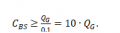
The maximum Gate Charge was 210nC, and as per the formula the capacitance shall be 10*210nC = 2100nF = 2.1uF. I am using 4.7uF and hence i feel it shall be enough. I will stick to 4.7uF. I have never done Mosfet simulation using LTspice, I will try.
 

Thread Starter

Vihaan@123

Joined Oct 7, 2025
238
I compared the competitor product for the performance difference at 48V can anyone please suggest how do i improve to match the performance
1769841318452.png
Competitor phase currents

1769841356369.png

My hardware Phase current
1769841569957.png

How do i up the input DC input current or the output phase currents.
 

du00000001

Joined Nov 10, 2020
189
Hall frequency 250 Hz should equal 3000 rpm? I doubt that. (Hall pulses per round are a multiple of 3 for all 3-phase BLDCs. So I'd expect either 150 Hz or 300 Hz for 3000 rpm - unless your clock is running different from mine.)
And comparing measurements that have been made with settings not meant to compare them is next to impossible.
Provide measurements with the documentation of the settings (equal settings for both measurements), measure the significant things (e.g.node voltage (of one leg) vs. phase current ofthis leg - I assume your motor is in star configuration).
 

Thread Starter

Vihaan@123

Joined Oct 7, 2025
238
I provide the details of measurements, for RPM the formula i used is 120*f Hz / P = 120 * 250 Hz / 10 poles = 30000/10 = 3000 RPM
 

Thread Starter

Vihaan@123

Joined Oct 7, 2025
238
I assume your motor is in star configuration).
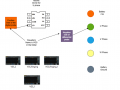
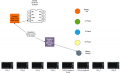
Yes the motor is in star configuration, i have taken the waveforms using differential probe brief explanation of the tests i have done.
Test setup
1770116298405.png
1770116342303.png

When i take the waveforms between Lowside gate output and source is it is going to 48V battery voltage which is not correct, that may be happening as the high side mosfet is turning ON and the oscilloscope may not be measuring accurately. Hence started capturing the waveforms between Low side gate output and battery ground.
Coming to the waveforms i observe ringing, pulses going to the negative side and also not ideal, request to please review and let me know if that is the root cause. Please let me know if i have missed sharing information. The supply to the gate driver is 12V.
 

Attachments

Top