As soon as the chinese find out; they will tenfold their prices too... just imagine if the demand of these was higher as in the eighties. Then they would ask $100 each.
Speaking of cleaning… how do you prefer to clean the tip, with a wet sponge or with a brass braid?
Me? I prefer the wet sponge. The braid I only use if the tip has a cooked flux buildup.
I ignore whether this is optimal or not.
Speaking of cleaning… how do you prefer to clean the tip, with a wet sponge or with a brass braid?
Me? I prefer the wet sponge. The braid I only use if the tip has a cooked flux buildup.
I ignore whether this is optimal or not.
I use thick high quality paper napkins used in the bar of waves-piercing ferries built in Tasmania still crossing from Bs .As - Montevideo. Current bunch expected to last a long time.
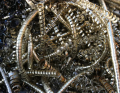
I… sit... corrected. The alloy of brass being used seems a lot harder than other brass I encounter. I still reserve “wool” as the corrected nomenclature, so “brass wool” it is.
They call it “shavings” which I suppose it is, but it is made into metallic wool and it is certainly not “braid” in any case.
I used to clean my iron's tips using a wet sponge. But then I discovered that I could clean it much more efficiently (and effectively) by simply grabbing a thick, dry napkin and squeezing and wiping the iron's tip with my hand. It's a quick operation, so the napkin never burns and barely browns on its surface ... It's good that I don't have a safety inspector looking over my shoulder when I'm working on one of my circuits ...
I… sit... corrected. The alloy of brass being used seems a lot harder than other brass I encounter. I still reserve “wool” as the corrected nomenclature, so “brass wool” it is.
They call it “shavings” which I suppose it is, but it is made into metallic wool and it is certainly not “braid” in any case.
I… sit... corrected. The alloy of brass being used seems a lot harder than other brass I encounter. I still reserve “wool” as the corrected nomenclature, so “brass wool” it is.
They call it “shavings” which I suppose it is, but it is made into metallic wool and it is certainly not “braid” in any case.
The only why I would know such details is that the work safety dept. requested MSDS data and heavy metal sampling for the repair and rework stations. They wanted to make us use lead-free solder for repairs but the EE dept. said, hell no, we have internal use and high reliability exceptions from RoHS (Restriction of Use of Hazardous Substances) regulations.

 Facebook
 Google
 GitHub
 Linkedin