analysis second Order CIrcuit RC

Thread Starter

Jorge Comp

Joined Jun 24, 2018
2
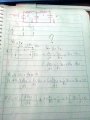
I need obtain the differential equation from V, first, before 0, the capacitors are charged with 1V, they are my initial conditions, in the time after 0, the source is in short circuit and only i have two capacitors an two resistors, but i am not sure from my analysis

MOD
: Lightened your image.
 

Attachments

Last edited by a moderator:

MrAl

Joined Jun 17, 2014
13,667
I need obtain the differential equation from V, first, before 0, the capacitors are charged with 1V, they are my initial conditions, in the time after 0, the source is in short circuit and only i have two capacitors an two resistors, but i am not sure from my analysis

MOD
: Lightened your image.
Hi,

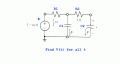
Your drawing is slightly unclear. Is that an input voltage source and is it really 1-u(t) ?
Or is it maybe a current source?

Also, a small point is that if you are going to keep the symbol "R2" in the equations then you should probably keep "R1" in them too, rather than default to the numerical value. In this way your symbolic result will remain most general. Otherwise if you want to see what happens with a different value of R1 later, you'd have to do the equations all over again.

Also, maybe you did not get this far yet but i dont see any dVc2/dt anywhere.
 
Last edited:

WBahn

Joined Mar 31, 2012
32,707
I need obtain the differential equation from V, first, before 0, the capacitors are charged with 1V, they are my initial conditions, in the time after 0, the source is in short circuit and only i have two capacitors an two resistors, but i am not sure from my analysis

MOD
: Lightened your image.
Thanks for posting the actual problem. Note that in your original post, there is no way to tell the polarity of the voltage source. That matters!

Let's look at your differential equation and check if it has ANY change of being correct.
Edit_2018-06-25_1.jpg

You have six terms. What are the dimension on each term?

Term #1: time
Term #2: current
Term #3: unitless
Term #4: unitless
Term #5: conductance
Term #6: voltage

This would be like coming up with an equation for something and ending up trying to add minutes to pounds to miles to gallons.

So you KNOW that this equation is wrong.

You very first equation starts off trying to set current equal to voltage, so you know that it can only go downhill from here.

Now, let's say that the equation had been dimensionally sound -- would it make sense?

Is it reasonable to believe that the value of C2 has absolutely no effect on v(t)?

If not, then is it reasonable for your differential equation to be independent of C2?
 

WBahn

Joined Mar 31, 2012
32,707
Hello again,

Here is a drawing of your circuit with elements labeled and a ground added.

Do you still have initial conditions?
I have a feeling English is a second language for you.
Note that he chose his R1 and R2 the opposite of what you've done.

He correctly identified the initial conditions as 1 V for the capacitors, although technically the direction of the voltage is ambiguous for C1.
 

MrAl

Joined Jun 17, 2014
13,667
Note that he chose his R1 and R2 the opposite of what you've done.

He correctly identified the initial conditions as 1 V for the capacitors, although technically the direction of the voltage is ambiguous for C1.
Hi,

Yes but all that information was for the original circuit, and this is obviously a different circuit because the R's are not labeled for one.
Also, i was not sure that he wanted to still work the problem with initial conditions or not, because starting without doing that is a little easier for a beginner.
It's entirely possible that he wants to stick to the original circuit with original specifications, but i wanted him to verify and beyond that, i wanted to fish a little just to see if he can read English ok or not as he did not answer any previous questions yet.
 

WBahn

Joined Mar 31, 2012
32,707
Hi,

Yes but all that information was for the original circuit, and this is obviously a different circuit because the R's are not labeled for one.
99% sure that it is the same problem. The first was his incomplete diagram as part of his work and the second was posted in response to it being pointed out that his original diagram was unclear.
 

MrAl

Joined Jun 17, 2014
13,667
99% sure that it is the same problem. The first was his incomplete diagram as part of his work and the second was posted in response to it being pointed out that his original diagram was unclear.
Hi,

I am almost sure too, but as i said i had other motives for posting also and it does not hurt to ask.
What i was hoping for was just about ANY reply from the OP just to make sure he can read English so we can have a productive discussion.
 
Last edited:
Top