analog to 4-20 ground issue

Thread Starter

bassplayer142

Joined Jan 2, 2007
89
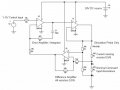
In the following link is a circuit from this site that I have used to take a 0-5 volt signal and convert it to a 4-20ma loop. I have tested the output with 470 ohm resistors and used an o-scope to get a voltage across it to verify that the conversion works which it does.

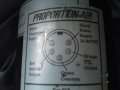
The problem lies in the pin out of the proportion air controller that I am using. The pin out on the datasheet is incorrect in that pin 5 and pin 2 are not the current loop pins as seen in the datasheet below. I have proved this with a simple ohm meter and found that the pin out is pins 1 and 3 as proven by a picture on the unit itself.

http://www.allaboutcircuits.com/vol_3/chpt_8/7.html
http://www.proportionair.com/media/brbb1.pdf

The pin out which I have taken a picture of and attached is as follows...

1. White command signal
2. Red analog output (ignore)
3. Green common
4. Orange TTL output (ignore)
5. Black power supply 15-24VDC


The problem lies in the fact that there is not two pins for the power supply ground and the 4-20ma loop itself. In the voltage to current circuit, there is a 250 ohm resistor that is between the current source and ground.

So what I'm left with is an incorrect ground for the power supply.

I hope I haven't been too confusing over the explanation. Any help would be greatly appreciated! Thanks!
 

Attachments

GetDeviceInfo

Joined Jun 7, 2009
2,271
In the following link is a circuit from this site that I have used to take a 0-5 volt signal and convert it to a 4-20ma loop. I have tested the output with 470 ohm resistors and used an o-scope to get a voltage across it to verify that the conversion works which it does.

The problem lies in the pin out of the proportion air controller that I am using. The pin out on the datasheet is incorrect in that pin 5 and pin 2 are not the current loop pins as seen in the datasheet below. I have proved this with a simple ohm meter and found that the pin out is pins 1 and 3 as proven by a picture on the unit itself.

http://www.allaboutcircuits.com/vol_3/chpt_8/7.html
http://www.proportionair.com/media/brbb1.pdf

The pin out which I have taken a picture of and attached is as follows...

1. White command signal
2. Red analog output (ignore)
3. Green common
4. Orange TTL output (ignore)
5. Black power supply 15-24VDC


The problem lies in the fact that there is not two pins for the power supply ground and the 4-20ma loop itself. In the voltage to current circuit, there is a 250 ohm resistor that is between the current source and ground.

So what I'm left with is an incorrect ground for the power supply.

I hope I haven't been too confusing over the explanation. Any help would be greatly appreciated! Thanks!
Not completely sure if your referring just to the device or partly to the AC schematic. I'll assume device only.

What you likely have is a current device which provides an output current loop by sinking +V through analog out, and reacts to the input current loop 'command to common'.
 

ifixit

Joined Nov 20, 2008
652
Hi bassplayer142,

What is the part number of the valve you have? Just to check it has the features you want.

The bottom of page 5 in the data sheet shows how to connect for current loop, or voltage mode. Which do you want to use?

If you connect a current meter between pins 5 and 2 you should read either 4mA or 20mA. If the signal is switching fast then the meter will average the value to somewhere in between 4 and 20 mA.

The 24V power pin (5) is the common for current mode, and pin 3 is the signal common for voltage mode.

The current mode of signalling is used because it tends to be immune to power rail and ground noise, there-by allowing signals and power to share a common wire.

Regards,
Ifixit
 

Thread Starter

bassplayer142

Joined Jan 2, 2007
89
I think you guys got a little confused about my original post and for that I apologize. What I have is a micro-controller (PSOC) that is outputting a 0-5V analog signal. This signal is fed into that op-amp from the previous link and able to output 0-20mA (4-20mA for 1-5V). This was tested on a 470 ohm resistor to prove that the op amp is correctly outputting a 4-20mA signal and then reconverting this current to voltage over the 470 ohm resistor. (Currently I don't have a fuse for my multi-meter current reading).

I ohmed out pins 1&3 and they are the correct pins for the current loop due to a reading of 477 ohms. The pin out and diagram on page 5 of the datasheet is incorrect for this particular unit. Pins 2 & 4 are 4-20mA outputs which give the actual reading of the solenoid position. Right now I'm not interested in that, just in commanding the module.

My problem is when I attach pins 1 & 3 to the opamp output to rload. This is correct so far until I attach the 24VDC power. There is no separate ground reference for the power source. I would like to share the ground reference but it cannot be done because the true ground is on the other side of the 250 ohm resistor.

I hope this is a little clearer. Thanks for the quick responses.


The serial number is #BB1MFIC300
 

ifixit

Joined Nov 20, 2008
652
Hi,

The AAC circuit is for current loop receivers that are isolated from ground. You need a current transmitter that references the same ground as the valve common pin 3.

You need a circuit that sources 4 to 20mA from a +ve voltage of at least 15V and is referenced to the same common as the valve and the micro.

I can do a sketch tomorrow. What is the frequency of the control signal? Some opamps are not very fast.

Regards,
Ifixit
 

t_n_k

Joined Mar 6, 2009
5,455
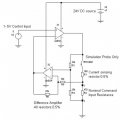
Or even something simpler - lose the integrator stage and works just as well ....... plus you can still do the job with the one IC - four amps on the one LM324 chip. Or use an LM358 with two amps on the chip. You could also change R1 to 250 ohms and R4 , R6 to 10k each for the same outcome.

Accuracy (with simulation) over the operating range is pretty good with these older style amplifiers. The low end suffers slightly. Improved accuracy over the full 4-20mA [1-5V DC input] would be achieved using a better (low offset/more expensive?) op amp such as the LT1006 [LT1013/1014 - multiple amplifier packages]. The LT1006/1013/1014 can all source the 20mA.
 

Attachments

Last edited:

Thread Starter

bassplayer142

Joined Jan 2, 2007
89
Awesome! Thanks a lot fellas. Luckily the opamp I used has two onboard and one is not in use. I will give it a shot soon when I get some time...
 
Top