analog switch IC DG419

MrChips

Joined Oct 2, 2009
34,810
V+ and V- are the analog supply voltages.
VL and GND are the logic supply voltages.

If you are simply switching current to LEDs you really do not need to use an analog switch such as a DG419.
An analog switch is used when you need to route analog signals through different paths, for example, switching sound signals from different sources.
 

Thread Starter

dlatch

Joined May 15, 2016
91
Switching leds is just to confirm what it does. The VL pin does not figure in any of the test circuits on the data sheet. Neither does the data sheet explain the VL pin.

I am switching the chip by applying ground to the IN pin.

"The logic supply" please clarify how is it used?
 

Alec_t

Joined Sep 17, 2013
15,119
Neither does the data sheet explain the VL pin.
True, but it is clear from Fig 1 that VL is the positive supply rail for the logic circuit (two push-pull FETs on the left) which controls whether the analog switch (four FETs on the right) is on or off.
I am switching the chip by applying ground to the IN pin.
So what voltage is on that pin when it isn't grounded? It should be ~ the same as the VL pin voltage, not just left floating.
 

Thread Starter

dlatch

Joined May 15, 2016
91
I'm using a 12V single supply. I want to switch the feedback loop in a DC linear circuit. Is this an appropriate chip for that? Or is it A/V signals only?

Grounding the IN pin seems to toggle it but, it is not stable, any stray movements around the bread board cause it to oscillate o

I need to know the best practice to simply toggle the chip switch from a transistor.
 

Thread Starter

dlatch

Joined May 15, 2016
91
I need to know the best practice to simply toggle the chip from a transistor. the IN pin works: I can pull it high and switch it low or, pull it low and switch it high. BUT I don't think that is right. The data sheet always shows a voltage applied to the VL pin. But on my breadboard anything done to the VL pin causes it act up.

I am using a single 12V supply. I come from a muzak background...think...relays....how do I simply switch this chip correctly?
 

jjw

Joined Dec 24, 2013
823
I'm using a 12V single supply. I want to switch the feedback loop in a DC linear circuit. Is this an appropriate chip for that? Or is it A/V signals only?

Grounding the IN pin seems to toggle it but, it is not stable, any stray movements around the bread board cause it to oscillate o

I need to know the best practice to simply toggle the chip switch from a transistor.
What kind of signal is switching the transistor?
You can probably connect it directly to IN pin unless it needs to be inverted.
If the transistor is connected between 0 - 12V you can connect VL to 12V.
 

eetech00

Joined Jun 8, 2013
4,705
I need to know the best practice to simply toggle the chip from a transistor. the IN pin works: I can pull it high and switch it low or, pull it low and switch it high. BUT I don't think that is right. The data sheet always shows a voltage applied to the VL pin. But on my breadboard anything done to the VL pin causes it act up.

I am using a single 12V supply. I come from a muzak background...think...relays....how do I simply switch this chip correctly?
Hi
Think of the VL and GND pins as enable pins, but they also set the expected voltage level at the IN pin. The IN pin is the same as the connection to the coil of the relay. Pins 1,8,2 are the same as a form c relay contact. When IN = GND, pins 1 and 2 are closed, 1 and 8 open. When pin IN=VL, pins 1 and 8 close, 1 and 2 open. The V+ and V- pins can be connected to a bi-polar supply if needed, in case a user wants to route a sine wave, or other bipolar signal, through the switch contacts.
 
Last edited:

Thread Starter

dlatch

Joined May 15, 2016
91
Hi
Think of the VL and GND pins as enable pins, but they also set the expected voltage level at the IN pin. The IN pin is the same as the connection to the coil of the relay. Pins 1,8,2 are the same as a form c relay contact. When IN = GND, pins 1 and 2 are closed, 1 and 8 open. When pin IN=VL, pins 1 and 8 close, 1 and 2 open. The V+ and V- pins can be connected to a bi-polar supply if needed, in case a user wants to route a sine wave, or other bipolar signal, through the switch contacts.

Thank you jj, etech I just saw your posts. I will take them to the bread board and see if I can understand this switch chip. I simply want to route a DC circuit, the output of an op amp and perhaps the feedback loop too. I will post a diagram soon.
 

Thread Starter

dlatch

Joined May 15, 2016
91
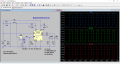
Here is my test circuit since reading etechs explanation. With 5 volts at VL I see nearly full VCC at IN. But grounding IN does not switch it. I even made sure it was a brand new chip.

I want to toggle it with a small bjt. High or low I can deal with that I just need to understand how to make it switch properly, reliably. all responses are appreciated.
 

Attachments

eetech00

Joined Jun 8, 2013
4,705
Here is my test circuit since reading etechs explanation. With 5 volts at VL I see nearly full VCC at IN. But grounding IN does not switch it. I even made sure it was a brand new chip.

I want to toggle it with a small bjt. High or low I can deal with that I just need to understand how to make it switch properly, reliably. all responses are appreciated.
Connect V+ to +12v
Connect V- to GND
Connect VL to +5v
Connect GND to GND
Connect a 10k resistor from IN to GND
(Leave this connected)

To toggle the switch:
Connect IN to +5v

eT
 

Attachments

Thread Starter

dlatch

Joined May 15, 2016
91
It works! AFTER I tried another new chip. Apparently...fat finger them ONCE and they're done. Because I'm pretty sure I had tried that combo before. Thank you eT.

So...I really do have to worry about power sequence? Power and then signals? That's gonna tax my skills.
 

eetech00

Joined Jun 8, 2013
4,705
It works! AFTER I tried another new chip. Apparently...fat finger them ONCE and they're done. Because I'm pretty sure I had tried that combo before. Thank you eT.
.
Glad you got it working...

So...I really do have to worry about power sequence? Power and then signals? That's gonna tax my skills.
The switch is silicon, so it won't pass a signal unless it has power applied to the voltage supply V+ and V- pins.
But it really depends on the circuit. If you have a schematic, post it and someone will help.

eT
 
Last edited:
Top