Analog Humidistat

Thread Starter

deleoe20

Joined Apr 11, 2022
11
Hello,

I'm working on designing an analog humidistat where I aim to use 24vac to power the rest of the circuit.

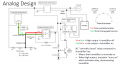
Currently uses an AC/DC power module to go from 120vac to 5vdc, 600mA. This powers a humidity sensor, voltage comparator (LM311), and relay (G2RL-14E-DC5). I want to instead use a transformer to drop down the 120vac to 24vac, then convert the 24vac into 5vdc. So far I have connected the output of the 24vac transformer into a full bridge rectifier. I was then going to attach the output of the rectifier into a DC/DC step-down converter, such as TSR 1-2450 (6.5-36vdc input to 5vdc output).

Is this an appropriate approach?

Thank you!
 
24VAC HVAC transformers have poor regulation and will output more voltage at small loads i.e when the humidifier (solenoid/motor) is off.
I'd expect to see over 35VDC after the bridge rectifier. This is a problem for the 5V regulator's rated max 36V so I would not use it.
There are many other 5V 1A regulator modules with higher Vin spec like 42-72V I can find. It depends on what is available and low cost for you. Recom R-78C5.0-1.0 is 42V max. and SRH05S05 is 72V. Don't forget a fuse.

If this is for a house somewhere cold, it is common to use a temperature sensor to correct humidity based on outdoor temperature, to avoid frost and ice build up on inside windows etc. You want the house having lower humidity inside as it gets colder outside.
 

Thread Starter

deleoe20

Joined Apr 11, 2022
11
This is an older version of the circuit that used the power module. Since then I've attached a protect diode in the relay between Vcc (pin 1) and GND (pin 8).

Attached is the circuit for the bridge rectifier that I am using which the output will connect to the DC/DC stepdown
 

Attachments

MisterBill2

Joined Jan 23, 2018
27,530
What is the problem with using a separate power supply for the measuring and control portion? Isolating the control and power sections is often done to eliminate noise problems in equipment. Using one transformer and then a linear regulator will be less efficient, but it can work.
 

Thread Starter

deleoe20

Joined Apr 11, 2022
11
The reason why I'm designing the circuit to run under 24vac is because for humidistats, roughly 90% are powered under this rating. The solenoid valve that humidistats are attached to are rated for 24vac. Under common HVAC configurations that I have seen, they either use a 24vac transformer or directly connect to a furnace HUM terminal to go from 120vac to 24vac. At the current configuration (with the power module) it's as if the humidistat were directly connected to a wall outlet, which is not how they're installed in the field. That's why I was looking at going from 120vac>24vac, then a full bridge rectifier followed by a DC/DC step-down.
 

Thread Starter

deleoe20

Joined Apr 11, 2022
11
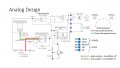
I should've mentioned, the 24vac transformer won't be integrated into the circuit, but rather will come from the HUM terminals or 24vac transformer a customer uses. I'll have two 24 VAC terminals for the humidistat, which connects to the full bridge rectifier as well as going into the COMM terminal of the relay. With the humidifier (or more specifically the solenoid valve) attached to the NC portion, this should give me the 24vac needed to power the solenoid valve. With the power module configuration (120vac to 5vdc, 600mA), the solenoid would be getting 120vac which would fry it.
 

GetDeviceInfo

Joined Jun 7, 2009
2,271
24VAC HVAC transformers have poor regulation and will output more voltage at small loads i.e when the humidifier (solenoid/motor) is off.
I'd expect to see over 35VDC after the bridge rectifier. This is a problem for the 5V regulator's rated max 36V so I would not use it.
There are many other 5V 1A regulator modules with higher Vin spec like 42-72V I can find. It depends on what is available and low cost for you. Recom R-78C5.0-1.0 is 42V max. and SRH05S05 is 72V. Don't forget a fuse.

If this is for a house somewhere cold, it is common to use a temperature sensor to correct humidity based on outdoor temperature, to avoid frost and ice build up on inside windows etc. You want the house having lower humidity inside as it gets colder outside.
it takes a prairiemystic to recognize the realities of winter. I went without a humidity sensor and turned strictly to temp to mitigate window icing. Actually, the icing wasn't as bad as the melting whenever the sun came up. Beyond some temperature, moisture is pumped from the humidifier, onto the cold surfaces, and a humidity senor is useless.
 

MisterBill2

Joined Jan 23, 2018
27,530
OK, and, by the way, I was not suggesting to get rid of the 24 volts for powering other parts of the system. Now the details make the goal much more reasonable.
One solution to the problem of the excess voltage for the linear regulator is to use a switching regulator. There are a number of companies that sell switcher regulator IC s and some offer very good applications information. That is not as cheap and a simple 78L05, but it would work very well. A second scheme that might be cheaper is to use a 24 volt pilot light bulb as a dropping resistance for the DC supply from the bridge. It would add the benefit of indicating when the system was powered up. It would also provide protection in case some part of the sensor circuit became short circuited. That would save the expense of a fuse, and offer even better protection. BUT if you do that you WILL need both the 0.1 Mfd cap, AND another larger value capacitor, to provide the low source impedance that those regulators MUST HAVE.
 

MisterBill2

Joined Jan 23, 2018
27,530
The challenge spot is the lines exiting terminals 3 and 2 of the "black box." The "recom AC/DC module." 120 volts in and preferably about 15 volts of smooth DC out. In addition, it must be isolated from the 120 VAC mains, because there is no assurance that the connections to line and neutral will be correct. So there could also be a transformer just prior to that box providing 24 volts AC instead of 120. While the description presently describes a bridge rectifier, a simple half wave rectifier with a larger filter capacitor can also serve and be simpler. I do seriously recommend NOT GROUNDING any portion of the low voltage circuit, to avoid problems if some other portion of the circuit accidentally becomes grounded. Grounding the negative part of the low voltage system provides no functional benefit at all.
Since the analog comparison circuit is entirely ratiometric, the less than good regulation of the 24 volts supply does not matter. So the common supply for both sense and reference was a very good choice.
 

Thread Starter

deleoe20

Joined Apr 11, 2022
11
Analog Humidistat Modified.JPG

Here is the modified circuit that is using the 24vac coming from a transformer. I have to remove the GND from the low voltage circuit. I currently have 5 terminals, 2 for power (24vac for full bridge rectifier so polarity doesn't matter), 2 for NO/NC for the relay, and a third for the the other connection to the solenoid valve. I tested it out with a 24Vac hydraulic actuator and it produced the desired result.

Thanks for all the replies!
 

MisterBill2

Joined Jan 23, 2018
27,530
The circuit looks GOOD! One suggestion that I neglected previously is that when you actually wire the circuit, is that the wire from the emitter of the PN2222 switch transistor be a separate wire from the reference/sensor wires.
 

Reloadron

Joined Jan 15, 2015
7,890
This is the data sheet for the LM311 (family) of comparators. The comparator is an open collector open emitter output. See the data sheet Page 9 for examples of use. Pin 7 is open collector out and pin 1 is open emitter out. Your emitter is not connected? Tie pin 1 to GND for your application. Pin 2 the non inverting input would normally be designated Vref since you use it to set a reference. Pin 3 the inverting input would be designated Vin since it is a variable from your sensor. Not sure what R1 and R2 are all about, all you need is a 10K pot with wiper being Vref. I would drive the base of your 2N2222 with a 2.2K resistor and lose the 10K resistor. Not sure what that 1K & 10K is about? You can use the 2N2222 since your relay coil at 5 volts is an 80 mA coil. Actually any low power NPN switching transistor will work.

Ron
 

MisterBill2

Joined Jan 23, 2018
27,530
OOPS!! Ron is correct. I was recalling the application of an opamp used as a comparator.
Also you must have a collector pull-up resistor because the LM311 has an open collector output. One alternative, which results in fewer connections and resistors, is to connect the output emitter (pin #1) to the base of the switching transistor and have a single 2.7K resistor from the output collector (Pin#7) to the V+ supply. Consult the actual data sheet on the LM311 to understand what is going on. The on/off logic might also need to be reversed.
 

MisterBill2

Joined Jan 23, 2018
27,530
Really, the graphic representing the functionality of the LM311 is confusing and non-informative. The line from the output of the comparator portion should go upwards to the base of an NPN transistor, with the collector connected to pin #7 and the emitter connected to pin#1. That would then accurately describe the functionality of this very useful component.
 

Reloadron

Joined Jan 15, 2015
7,890
Really, the graphic representing the functionality of the LM311 is confusing and non-informative. The line from the output of the comparator portion should go upwards to the base of an NPN transistor, with the collector connected to pin #7 and the emitter connected to pin#1. That would then accurately describe the functionality of this very useful component.
Really? After you managed to post this:
The circuit looks GOOD! One suggestion that I neglected previously is that when you actually wire the circuit, is that the wire from the emitter of the PN2222 switch transistor be a separate wire from the reference/sensor wires.
Looks good? You completely missed several things including confusing a comparator for an operational amplifier. You completely called it wrong because you failed to look at the data sheet for the part used in the schematic posted. Now you want to critique? Cool with me I'm done in this thread. Obviously my skills can't compare with yours.

Ron
 

MisterBill2

Joined Jan 23, 2018
27,530
Really? After you managed to post this:

Looks good? You completely missed several things including confusing a comparator for an operational amplifier. You completely called it wrong because you failed to look at the data sheet for the part used in the schematic posted. Now you want to critique? Cool with me I'm done in this thread. Obviously my skills can't compare with yours.

Ron
It seems that I did goof on this one. Never claimed to be infallible, though. And it had been a long day today.
And I am not being critical of any of the folks here, the graphic as shown is what has been in the databook for years, since at least the 1982 issue. But that does not make it any more correct. Showing the non-committed transistor in that graphic would certainly make the connections required clearer. THAT ALONE was my point. Not to be critical of any participants in the thread!
 

Thread Starter

deleoe20

Joined Apr 11, 2022
11
Thanks for all the feedback! I am just starting to dab into circuits (my background is in mechanical engineering), but I do enjoy learning a lot about circuits. Just a few months ago I didn't even know what a voltage comparator was, how relays/switches work, what a potentiometer was, or even how transistors work and evidently I still don't!

The reason I originally had the two resistors R1/R2 with the potentiometer is because that's when I was initially learning how voltage dividers can be used to vary the output voltage. But you're right Ron, a 10k pot with wiper would work. The only problem with that is the following: if this circuit were placed inside an enclosure (as in an actual product), then you wouldn't be able to adjust the high pot right? With a potentiometer/dial, this would be easy to accomplish even with an enclosure for the circuit.

I gave myself this task of designing something to force me to learn various aspects of circuits. Now I understand how a low voltage circuit can regulate higher voltage ones (through relays/switches), differences between AC/DC, how to convert from one to another, amongst many other things.

To be honest I didn't even realize there were different types of voltage comparators (open emitter out vs. open collector). I'll look into this in closer detail. Personally I find the graphic for the LM311 comparator a bit confusing, but I haven't really checked it out too much yet.

If there's any fundamentals of circuits that you'd recommend, I certainly would appreciate any resources/links.
 
Top